3.5.7 Fehler II
en Errors II
fr Erreurs II
| ⇧ Probleme / Problems / Problèmes | |||||
| ⇨ | Klimaschwindel | Klima-Panik | UNEP/UNFCCC | IPCC/GIEC | Fehler I |
|---|---|---|---|---|---|
| Fehler II | Kritik | Klima-Modelle | Prognosen | Manipulation | |
| ⇨ | Klima: Wandel│ Fragen│ Wissenschaft│ Probleme│ Beurteilung│ Diskurse│ Auswirkungen | |||
| ⇩ | Klima-Skandal: Manipulation│ Realität│ Angst | |||
| ⇩ | Neue Kälteperiode: Kaltzeit│ Auswirkung | |||
Mit folgenden Links wird von anderen Webseiten auf diese Seite verwiesen:
▶Fehler der Klimamacher ( I ⁄ II )
| de | en | fr |
|---|---|---|
|
Klima: Probleme Fehler Teil 1, Fehler Teil II Fehler und Falschaussagen der Panikmacher |
Climate: Problems Errors Part I, Errors Part II Errors and wrong statements of the panic-makers |
Climat: Problèmes Erreurs partie I, Erreurs partie II Erreurs et faux témoignages des faiseurs de la panique |
- 1 Keine wissenschaftliche Objektivität des IPCC
- 2 Falsche Klima-Modelle / Wrong Climate Models / Fausses Modèles climatique
- 3 Tropen: Falsche Resultate der Panik-Modelle
- 4 Hotspot: Der in den Panik-Modellen vorausgesagte Hotspot ist nicht vorhanden
- 5 Antarktis: Panik-Modelle können die Zunahme des antarktischen Meereises nicht erklären
- 6 Polare Klimaschaukel: Panik-Modelle können dies nicht erklären
- 7 Falsche Prognosen / Wrong Prognostics / Fausses prévisions
- 8 Alarmisten-Prognose 2008: "Erderwärmung macht zehn Jahre Pause"
- 9 Klimaerwärmung auch wenn es kälter wird
- 10 Das CO2 steigt
und die Temperaturen fallen
IPCC zeigt die Abkühlung nicht und kann sie nicht erklären - 11 IPCC anerkennt keine Temperaturmessungen der Satelliten
- 12 Anschuldigungen an das IPCC: Sind die IPCC Rapporte korrumpiert?
- 13 Fehler von Aktivisten der "Klima-Rettung"
- 14 Kurzschluss der Wissenschaft/Short circuiting the scientific method
- 15 Vorsorge nicht zu jedem Preis
⇐ de Teil I en Part I fr Partie I
|
|

⇧
1 Keine wissenschaftliche Objektivität des IPCC
en No scientific objectivity of the IPCC
fr Pas d'objectivité scientifique du GIEC
|
|
|


-
Watts up with that? (Antony Watts)
2009-10-20 en Spencer: IPCC Crushes Scientific Objectivity
-
Roy Spencer
2009-10-18 en IPCC Crushes Scientific Objectivity -
Unquestionably, the U.N. Intergovernmental Panel on Climate Change (IPCC) was formed to build the scientific case for humanity being the primary cause of global warming.
Such a goal is fundamentally unscientific, as it is hostile to alternative hypotheses for the causes of climate change.
-
The most glaring example of this bias has been the lack of interest on the IPCC's part in figuring out to what extent climate change is simply the result of natural, internal cycles in the climate system.
In Chapter 9 of the latest (4th) IPCC report, entitled "Understanding and Attributing Climate Change",
you would think the issue of external versus internal forcing would be thoroughly addressed. - But you would be wrong.
-
The IPCC is totally obsessed with external forcing, that is, energy imbalances imposed upon the climate system that are NOT the result of the natural, internal workings of the system.
For instance, a search through Chapter 9 for the phrase "external forcing" yields a total of 91 uses of that term.
A search for the phrase "internal forcing" yields ...(wait for it)... zero uses.
Can we really believe that the IPCC has ruled out natural sources of global warming when such a glaring blind spot exists?
-
While chaos in weather is exhibited on time scales of days to weeks, chaotic changes in the ocean circulation could have time scales as long as hundreds of years, and we know that cloud formation - providing the Earth's natural sun shade - is strongly influenced by the ocean.
-
IPCC Fourth Assessment Report: Climate Change 2007 -
The Physical Science Basis
2009-10-18 en Understanding and Attributing Climate Change
⇧
2 Falsche Klima-Modelle
en Wrong Climate Models
fr Modèles climatiques èronnés

Weiterleitung / Link to following page
| de | en | fr |
|---|---|---|
|
Klimawandel: Probleme Klima-Modelle |
Climate change: Problems Climate Models |
Climat: Problèmes Modèles climatiques |
⇧
3 Tropen: Falsche Resultate der Panik-Modelle
en The Tropics: Wrong results of the climate models
fr Les tropiques: Fausses résultats des des modèles climatiques
|
|
de Die Atmosphäre im rot markierten Bereich ist Gegenstand der Suche nach dem menschlichen Fingerprint des Klimawandels. Resultat: Keine Belege für den sogenannten lang gesuchten menschlichen Fingerabdruck als Wirkmechanismus auf das Klima. en We examine tropospheric temperature trends of model simulations and try to reconcile them with the best available updated observations. Result: Model results and observed temperature trends are in disagreement in most of the tropical troposphere. |

de Die Atmosphäre im rot markierten Bereich ist Gegenstand der Suche nach dem menschlichen Fingerprint des Klimawandels.
Bis zu einer Höhe von ca. 14 km soll sich die Atmosphäre stärker erwärmt haben als die Oberfläche. So lautet das Ergebnis von allen Modellstudien des IPCC wie sie im Report von 2007 dokumentiert sind.
Die Studie von Douglass, et al kommt zu dem Schluss, dass die Messungen das Gegenteil zeigen. Die Atmosphäre hat sich langsamer erwärmt als die Oberfläche.
-
de
Climatepatrol hat freundlicherweise das Abstract schon übersetzt:
Wir untersuchen Temperaturtrends der Troposphäre von 67 Durchgängen aus 22 'Klima des 20ten Jahrhunderts' Modell Simulationen und versuchen, diese mit den besten verfügbaren aktualisierten Beobachtungen (in den Tropen während der Satelitenaera) in Übereinstimmung zu bringen.
Die Resultate der Modellvorhersagen und die der beobachteten Temperaturverläufe stehen in den meisten Schichten der Troposphäre im Widerspruch zueinander, ja sie weichen sogar um mehr als das Doppelte des ausgewiesenen Konfidenzintervalles vom Mittelwert des Modelles ab.
Bis auf eine Höhe von 5 km ist der modellierte Trend um 100 bis 300% höher als der beobachtete Wert, und in Luftschichten über 8 km stehen vorhergesagte und beobachtete Werte sogar unter umgekehrten Vorzeichen.
Diese Schlussfolgerungen stehen in scharfem Kontrast zu jenen von kürzlichen Publikationen, die auf im Wesentlichen derselben Daten basieren.
Zusammenfassend ist die Schlussfolgerung der Autoren, dass die Klimarechenmodelle und der reale Temperaturverlauf signifikant divergieren.
Zudem ist es so, dass gerade die Temperaturtrends der tropischen Troposphäre die Auswirkungen der Globalen Erwärmung am deutlichsten zeigen sollten, die Klimamodelle jedoch weit über die Realität hinaus rechnen.
Ökologismus
2007-12-28 de Klimamodelle rechnen weitab der Realität
en ABSTRACT:
We examine tropospheric temperature trends of 67 runs from 22 'Climate of the 20th Century' model simulations and try to reconcile them with the best available updated observations (in the tropics during the satellite era).
Model results and observed temperature trends are in disagreement in most of the tropical troposphere, being separated by more than twice the uncertainty of the model mean.
In layers near 5 km, the modelled trend is 100 to 300% higher than observed, and, above 8 km, modelled and observed trends have opposite signs.
These conclusions contrast strongly with those of recent publications based on essentially the same data.
-
de
Eine im angesehenen INTERNATIONAL JOURNAL OF CLIMATOLOGY
veröffentlichte Studie findet keine Belege für den sogenannten
lang gesuchten menschlichen Fingerabdruck als Wirkmechanismus auf
das Klima. ...
EIKE Europäisches Institut für Klima und Energie
2008-07-30 de Kühle Tropenluft entschärft Treibhausargument
-
INTERNATIONAL JOURNAL OF CLIMATOLOGY
David H. Douglass, John R. Christy, Benjamin D. Pearsona and S. Fred Singer
Scribed.com en A comparison of tropical temperature trends with model predictions
en A comparison of tropical temperature trends with model predictions
⇧
4 Der in den Panik-Modellen vorausgesagte Hotspot ist nicht vorhanden
en The missing Hotspot
fr Le 'hotspot' (point chaud) manque
| de | en | fr |
|---|---|---|
| Physikalische Aspekte | Physical aspects | Aspects physiques |
| Der fehlende Hotspot (warme Zone) | The missing Hotspot | Le 'Hotspot'(point chaud) manque |
⇧
5 IPCC Modelle können die Zunahme des antarktischen Meereises nicht
erklären
en IPCC models cannot explain progress in
Antarctic Sea Ice
fr Les modèles du GIEC ne peuvent pas expliquer
l'augmentation de la glace maritime en antarctique
-
Die kalte Sonne (Fritz Vahrenholt & Sebastian Lüning)
2012-10-22 de Klimamodelle können die Zunahme des antarktischen Meereises nicht nachvollziehenEine neue Studie des British Antarctic Survey hat sich jetzt angeschaut, zu welchen Ergebnissen die gängigen IPCC-Klimamodelle bei der antarktischen Meereisbedeckung kommen.
Leitautor John Turner und seine Kollegen veröffentlichte ihre Studie im September 2012 im Journal of Climate.
Das Ergebnis ist erschreckend:
Die meisten Klimasimulationen modellierten für die vergangenen 30 Jahre fälschlicherweise einen Rückgang des antarktischen Meereises.Reale Satellitendaten hingegen dokumentierten eine deutliche Zunahme des antarktischen Meereises.
-
The Hockey Schtick
2012-09-17 en Antarctic sea ice reaches record high while IPCC models predicted the opposite
Quelle / Source;
-
Journal of Climate
John Turner, Tom Bracegirdle, Tony Phillips, Gareth J. Marshall, J. Scott Hosking
British Antarctic Survey, National Environment Research Council, Cambridge, UK
2012 en An Initial Assessment of Antarctic Sea Ice Extent in the CMIP5 ModelsAbstract
We examine the annual cycle and trends in Antarctic sea ice extent (SIE) for 18 Coupled Model Intercomparison Project 5 models that were run with historical forcing for the 1850s to 2005.
Many of the models have an annual SIE cycle that differs markedly from that observed over the last 30 years.
The majority of models have too small a SIE at the minimum in February, while several of the models have less than two thirds of the observed SIE at the September maximum.
In contrast to the satellite data, which exhibits a slight increase in SIE, the mean SIE of the models over 1979-2005 shows a decrease in each month, with the greatest multi-model mean percentage monthly decline of 13.6% dec-1 in February and the greatest absolute loss of ice of -0.40 × 10⁶ km2 dec-1 in September.
The models have very large differences in SIE over 1860-2005.
Most of the control runs have statistically significant trends in SIE over their full time span and all the models have a negative trend in SIE since the mid-Nineteenth Century.
The negative SIE trends in most of the model runs over 1979-2005 are a continuation of an earlier decline, suggesting that the processes responsible for the observed increase over the last 30 years are not being simulated correctly.
⇧
6 Polare Klimaschaukel: Panik-Modelle können dies nicht erklären
en Polar see-saw cannot be explained by climate models
fr Balançoire polaire ne peut pas être représneté par les modèles
| de | en | fr |
|---|---|---|
| Pole, Arktis, Antarktis | Pols, Arctic, Antarctic | Pôles, Arctique, Antarctique |
| Polare Klimaschaukel | Polar see-saw | Balançoire polaire |
⇧
7 Falsche Prognosen
en Wrong prognostics
fr Fausses pronostiques
Weiterleitung / Link to following page
| de | en | fr |
|---|---|---|
|
Klimawandel: Probleme Prognosen |
Climate change: Problems Prognostics |
Climat: Problèmes Pronostiques |
⇧
8 Alarmisten-Prognose 2008: "Erderwärmung macht zehn Jahre Pause"
en Computer models 2008: "Global Warming makes a
pause of 10 years"
fr Modèles d'ordinateur 2008:
"Le rechauffement climatique fait une pause de 10 ans"
de Aus der Panik-Küche en From the panic laboratory fr De la marmite des alarmistes
Das ist keine Wissenschaft mehr !
en That is not science anymore !
fr Ce n'est plus de la science !
-
de
Der Klimawandel könnte erst mal eine kleine Pause einlegen,
schreiben der Kieler Forscher Mojib Latif und seine Kollegen im
Wissenschaftsmagazin "Nature" (Bd. 453, Seite 84-88).
Klimamodelle, die auch Ozeanströmungen berücksichtigten, ergaben einen um etwa 0,2 Grad geringeren Temperaturanstieg als bei früheren, gröberen Simulationen
Einen äußeren Grund für das langfristig schwankende Klima, etwa die Sonne, gibt es laut Latif nicht: "Das Klima der Erde schwankt von sich aus, ohne dass man einen speziellen Antrieb dafür braucht."
Spiegel Online
2008-05-02 de Neue Klimaprognose: Erderwärmung macht zehn Jahre Pause
-
fr
Les décennies 2000-2010 et 2005-2015 seront-elles globalement
moins chaudes que la décennie 1994-2004 ? », s'interroge le
journaliste Stéphane Foucart dans Le Monde du 28 août 2008.
Affirmatif, répondent des climatologues du Leibniz Institut
(Kiel) et du Max-Planck Institut (Hamburg),
Le journaliste continue d'expliquer que le réchauffement climatique est une réalité incontestable, principalement imputable à l'activité humaine.
En l'état des connaissances, le Soleil n'est pas le principal responsable des changements actuels »
En clair, pendant les périodes récentes où l'on a observé un réchauffement global de la planète (1975-1995), le soleil n'a joué qu'un rôle marginal. Mais lorsqu'aucun réchauffement de la planète n'est observé, la faute en incombe au Soleil, soudainement capable d'annuler les effets provoqués par l'homme ! Curieux.
Skyfall / Changement climatique
2008-09-06 fr La nature freine le réchauffement climatique, selon Le Monde
| Mojib Latif |
Dr. rer. nat.,
Professor für Meteorologie am Leibniz-Institut für
Meereswissenschaften (IFM-GEOMAR) an der Universität Kiel.
▶Mojib Latif: Who is who (Aktivisten der anthropogenen Erwärmung) |
⇧
9 Klimaerwärmung auch wenn es kälter wird
en
Global Warming also when it gets colder
fr
Réchauffement climatique même s'il devient plus froid
- a
de
Klimawissenschaftlerin der Rutgers University:
Europa steht möglicherweise erneut ein harter Winter ins Haus
en Guardian Have All Bases Covered
Globale Erwärmung führt zur Abkühlung !
en Colder winters possible due to Global Warming !
fr Refroidissement par le réchauffement climatique !
Siehe auch / See also / Voir aussi:

↑
a Klimawissenschaftlerin der Rutgers University: Europa steht
möglicherweise erneut ein harter Winter ins Haus
en Guardian Have All Bases Covered
-
Die kalte Sonne (Fritz Vahrenholt & Sebastian Lüning)
2012-10-17 de Klimawissenschaftlerin der Rutgers University: Europa steht möglicherweise erneut ein harter Winter ins HausUnd was wäre, wenn es nun doch ganz anders kommt, und wir einen milden Winter bekommen?
Dann ist natürlich ebenfalls die Klimaerwärmung schuld.
Eine bequeme Situation.
Egal was kommt, immer ist es der Klimawandel gewesen.
Vielleicht sollte man alle Klimawissenschaftler einmal bitten, konkrete Prognosen in einem versiegelten Umschlag bei ihrem jeweiligen Wissenschaftsministerium abzugeben.
Die Auswertung müsste dann durch einen neutralen Schiedsrichter erfolgen.
Im Gegensatz zu früher wären nachträgliche Korrekturen in dieem Verfahren dann aber nicht mehr erlaubt.
-
NOT A LOT OF PEOPLE KNOW THAT
2012-09-28 en Guardian Have All Bases CoveredJust in case we get a cold winter this year, the Guardian thought it advisable to warn us that this would no doubt be because of global warming.
de Panik-Küche en Panic laboratory fr Marmite alarmiste
-
The Guardian
2012-10-14 en Arctic sea ice melt 'may bring harsh winter to Europe'
The unprecedented loss of polar sea ice may lead to 'wild extremes' in the UK and northern Europe, say researchers.
⇧
10 Das CO2 steigt und die Temperaturen fallen
IPCC zeigt die Abkühlung nicht und kann sie nicht erklären
en
CO2 is rising and the temperatures are falling
IPCC doesn't show the cooling and cannot explain it
fr
Le CO2 monte et les températures baissent
Le GIEC ne montre pas le refroidissement et ne peut pas l'expliquer
- a de
Das CO2 steigt und die Temperaturen
fallen
en CO2 is rising and the temperatures are falling
fr Le CO2 monte et les températures baissent - b de
Die Abkühlung zeigt den IPCC-Irrtum: Es ist nicht das
CO2!
en The cooling shows the IPCC eror: It is not the CO2!
fr Le refroisissemen montre l'erreur du GIEC: Ce n'est pas le CO2! - c de
IPCC-Report 2007: Zeigt keine Abkühlung
en IPCC-Report 2007: Does not show the cooling
fr Rapport GIEC 2007: Ne montre pas le refroidissement - d de CO2-Ausstoß erreicht Rekordwerte während die Globaltemperatur fällt
- e de
Brief an Dr. Pachauri, IPCC (2008-04-14)
en Letter to Dr. Pachauri, IPCC
| de | en | fr |
|---|---|---|
| Neuste Informationen über den Klimawandel | News on Climate Change | Nouvelles informations sur le changement climatique |
| Die Erwärmungspause | The Hiatus | La pause du réchauffement climatique |
↑
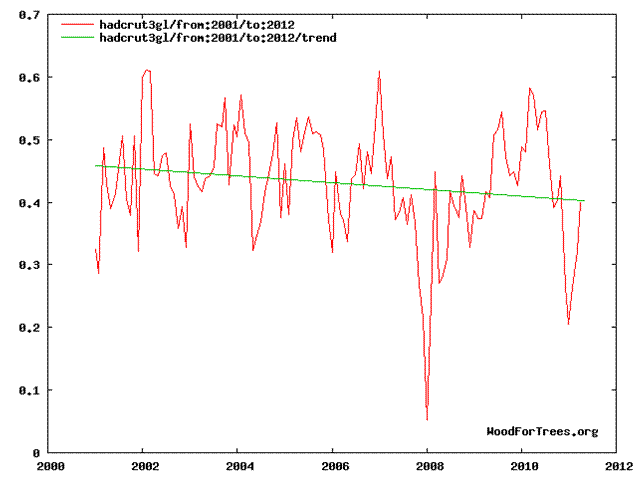
a Das CO2 steigt und die Temperaturen fallen
en
CO2 is rising and the temperatures are falling
fr
Le CO2 monte et les températures baissent
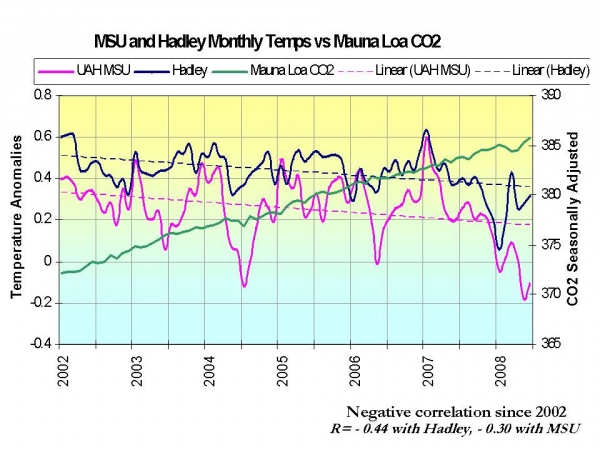
 Hadley (CRUT3v) and MSU (Satellite Lower Trop) Temps vs CO₂
|
|
|
|
de Das CO₂ steigt und die Temperaturen fallen.
Wenn das CO₂ die Erwärmung erklärt,
muss es auch die Abkühlung erklären ...
oder es muss eine andere Erklärung
gefunden werden, en CO₂ is rising and the temperatures are falling.
If the CO₂ explains the warming,
it must also explain the cooling ...
or another explanation must be found fr Le CO₂ monte et les températures baissent.
Si le CO₂ explique le réchauffement,
il doit aussi expliquer le refroidissement ...
ou bien une autre explication doit être trouvée, |
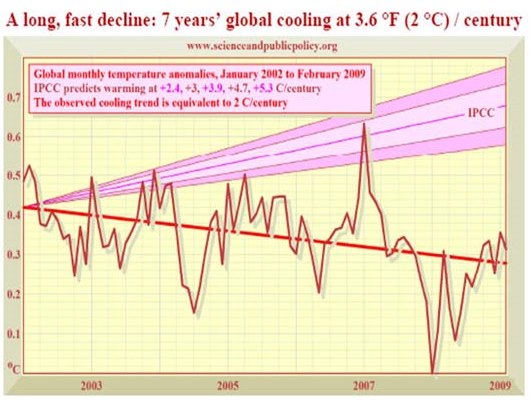 Climate Models vs Reality
7 years' global cooling at 2°C/century
|
Who would like to bet the following outcomes on the models being correct.
|
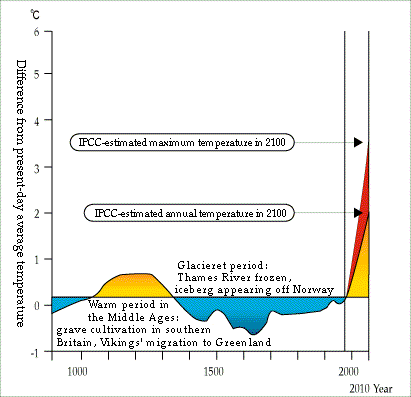
|
de Zwei Fragen:
en Two questions:
fr Deux questions:
|
↑
b Die Abkühlung zeigt den IPCC-Irrtum: Es ist nicht das
CO2!
en
The cooling shows the IPCC eror: It is not the
CO2!
fr
Le refroisissemen montre l'erreur du GIEC:
Ce n'est pas le CO2!
World Temperatures Falling Whist CO2 Keeps Rising
-
EIKE Europäisches Komitee Für Klima und Energie Jena
2009-03-17 de Was man uns nicht erzählt! Die Warnungen von Experten vor einer unmittelbar bevorstehenden Klimakatastrophe sind ausschließlich das Produkt von Computermodellen
-
Research Review / Hans Labohm
2009-03 en
What we are not being told
-
CO2 Science COM
2008-10-28 en World Temperatures Falling Whist CO2 Keeps Rising
| de | Wenn das CO2 die Erwärmung erklärt, muss es auch die Abkühlung erklären ... oder es muss eine andere Erklärung gefunden werden, dass nebeneinander liegende kalte und warme Zonen - gleichzeitig - verschiedene Ursachen haben. |
| en | If the CO2 explains the warming, it must also explain the cooling ... or another explanation must be found how neighbor cold and warm sectors may - simultaneously - obey to different causes. |
| fr | Si le CO2 explique le réchauffement, il doit aussi expliquer le refroidissement ... ou bien une autre explication doit être trouvée, signifiant alors que des secteurs voisins, chauds et froids, peuvent - simultanément - obéir à des causes différentes. |
|
Marcel Leroux *1938-08-27 †2008-08-12 |
Professeur de climatologie PhD, Professor Emeritus of Climatology, University Jean Moulin of Lyon, France; former director of Laboratory of Climatology, Risks and Environment, CNRS ▶Marcel Leroux: Who is who (Skeptiker) ▶Marcel Leroux: Video (Präsentationen) ▶Marcel Leroux: Sites web (français) ▶Marcel Leroux: Wikipedia (Opfer von Wikipedia) |
 Temperature: HadCRUT3 (negative→positiv→negative),
CO2: Mauna Loa (positive)
Temperature: HadCRUT3 (negative→positiv→negative),
CO2: Mauna Loa (positive)
1939-2008

-
Global warming quiz by Dr. Richard Keen, University of Colorado, Boulder
Skyfall fr QCM sur le réchauffement climatique
↑
c IPCC-Report 2007: Zeigt keine Abkühlung
en
IPCC-Report 2007: Does not show the cooling
fr
Rapport GIEC 2007: Ne montre pas le refroidissement
-
de
Temperaturkurven - CRU 2007:
Die Abkühlung nach 2000 wird auf den Kurven des IPCC nicht gezeigt!
en Temperatures - CRU 2007:
The Cooling after 2000 is not showed on the IPCC diagrams!
fr Températures - CRU 2007:
Le refroidissement après 2000 n'est pas montré sur les diagrammes du GIEC!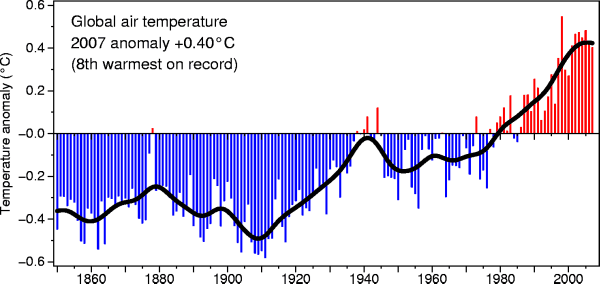
-
de
Deutliche Abkühlung nach 2000.
Diese Abkühlung kann mit dem CO2-Treibhauseffekt nicht erklärt werden.
en Visible cooling after 2000.
This cooling cannot be caused by the CO2 Greenhouse Effect.
fr Refroidissement apparente après 2000.
Ce refroidissement ne peut pas être expliqué avec l'effet de serre.
Quelle: / Source:
-
CRU - Climate Research Unit
UEA - School of Environmental Sciences University of East Anglia
en Home
en Temperature
en Global Temperature Record
-
de
Deutliche Abkühlung nach 2000.
-
de
IPCC Bericht 2007 zeigt keine Abkühlung nach 2000
en IPCC Report 2007 doesn't show the cooling after 2000
fr Rapport 2007 du GIEC ne montre pas le refroidissement après 2000

-
de
Temperaturkurven - IPCC Rapport 2007:
Abkühlung nach 2000 wird nicht gezeigt!
Das IPCC kann diese Abkühlung nicht erklären.
Das IPCC irrt sich mit seiner Politik.
en Temperatures - IPCC Report 2007:
Cooling after 2000 is not showed!
IPCC cannot explain this cooling.
IPCC has to change his policy.
fr Températures - rapport GIEC 2007:
Le refroidissement après 2000 n'est pas montré!
Le GIEC n'a pas d'explication pour ce refroidissement.
Le GIEC doit modifier sa politique.
-
de
Temperaturkurven - IPCC Rapport 2007:
-
de
IPCC Temperatur Prognosen
en IPCC Temperature Prognnostics
fr Prévisions des températures du GIEC


- Source: IPCC/WG 1 Fig. 10.4
-
de
Die Prognosen sind nicht realistisch
Falsche Prognosen - Falsche Politik
en The prognostics are not realistic
Wrong prognostics - Wrong Politics
fr Le prognostiques ne sont pas réalistes
Fausses prognostiques - fausses politiques
↑ d CO2-Ausstoß erreicht Rekordwerte während die Globaltemperatur fällt
|
|
|
↑
e Brief an Dr. Pachauri, IPCC (2008-04-14)
en Letter to Dr. Pachauri, IPCC
fr Lettre adressée à Dr. Pachauri, GIEC
Dear Dr. Pachauri and others associated with IPCC
We are writing to you and others associated with the IPCC position
- that man's CO2 is a driver of global warming and climate change
- to ask that you now in view of the evidence retract support from the current IPCC position
and admit that there is no observational evidence in measured data going back 22,000 years or even millions of years that CO2 levels
(whether from man or nature) have driven or are driving world temperatures
or climate change.
...
|
Hadley (CRUT3v) and MSU (Satellite Lower Trop) Temps vs CO₂
|
|
|
|
de Das CO₂ steigt und die Temperaturen fallen.
Wenn das CO₂ die Erwärmung erklärt,
muss es auch die Abkühlung erklären ...
oder es muss eine andere Erklärung
gefunden werden, en CO₂ is rising and the temperatures are falling.
If the CO₂ explains the warming,
it must also explain the cooling ...
or another explanation must be found fr Le CO₂ monte et les températures baissent.
Si le CO₂ explique le réchauffement,
il doit aussi expliquer le refroidissement ...
ou bien une autre explication doit être trouvée, |
de Wissenschaftler fordern IPCC zu Kurswechsel auf
-
In einem offenen Brief fordern Wissenschaftler und ein Friedensnobelpreisträger den Vorsitzenden des IPCC auf, die aktuellen Meßergebnisse zu akzeptieren, die auf eine Abkühlung während der letzten 10 Jahre hindeuten, oder aber Belege vorzulegen für die immer noch vom IPCC und anderen Vertretern der Treibhaushypothese vertretene Ansicht, es gebe eine Erwärmung und diese stehe mit dem CO2-Anteil der Atmosphäre in ursächlichem Zusammenhang.
Der Brief enthält auch Verweise auf öffentlich zugängliches Datenmaterial, das der CO2-Treibhaushypothese widerspricht.
en UN asked to admit climate change errors
- A group of four scientists has sent a letter to the UN's IPCC.
-
The Climate Scam
2008-04-14 de / en Wissenschaftler fordern IPCC zu Kurswechsel auf
-
The Climate Scam
2008-04-14 en UN asked to admit climate change errors
-
I love my carbondioxide
2008-04-14 en
Dear Dr. Pachauri and others associated with IPCC
⇧
11 IPCC anerkennt keine Temperaturmessungen der Satelliten
en IPCC does not recognise temperatures from satellites
fr Le GIEC ne reconnaît pas les températures prises par satellites
| de | en | fr |
|---|---|---|
| Temperatur | Temperature | Température |
| Temperaturmessungen durch Satelliten | Satellite Temperature Data | Température mesurages par satelllites |
| de | en | fr |
|---|---|---|
| Temperatur | Temperature | Température |
| Offizielle, weltweite, amtliche Temperaturbestimmungen | Official worldwide temperature measurement | Mesurages officielles des températures mondiales |
12 Anschuldigungen an das IPCC:
Sind die IPCC Rapporte korrumpiert?
en Accusation of the IPCC: Are the IPCC corrupted?
fr Accusations sévères du GIEC: Les rapports du GIRC corrempus?
↑ Begriffe
|
|
↑
Sind die IPCC Rapporte korrumpiert?
en Are the IPCC Reports corrupted?
fr Les rapport du GIEC sont-ils corrompus?
| IPCC/GIEC |
en
Intergovernmental Panel on Climate Change fr Groupe d'experts intergouvernemental sur l'évolution du climat ▶IPCC: Who is who (Institute & Organisationen der Globalen Erwärmung) ▶Ausschluss und Maulkorb für Kritiker (Sind die IPCC Rapporte korrumpiert?) ▶Anschuldigungen an das IPCC (Sind die IPCC Rapporte korrumpiert?) |
de IPCC Rapporte - Korruption?
-
"Dieser Report enthält nicht, was die auf der Titelseite des Rapports angegebenen Wissenschaftler angenommen haben."
-
"Mindestens 15 Schlüssel-Abschnitte wurden gestrichen", wie zum Beispiel:
-
"Keiner der obenerwähnten Studien zeigt einen klaren Beweis, dass der Klimawandel der Erhöhung der Treibhausgase zugeordnet werden kann."
-
"Die Änderungen seien auf die Antwort von Regierungen, individuellen Wissenschaftlerrn und NGO's vorgenommen worden."
en IPCC Reports - Corruption?
-
"This report is not what was approved by the contributing scientists listed on the title page."
-
"At least 15 key sections have been deleted." These include statements as:
-
"None of the studies cited above has shown clear evidence that we can attribute the observed [climate] changes to the specific cause of increases in greenhouse gases".
-
"No study to date has positively attributed all or part of the climate change observed to date to anthropogenic [manmade] causes."
-
Professor Seitz concluded:
"I have never witnessed a more disturbing corruption of peer-review process than the events that led to this IPCC report." -
"In his reply IPCC did not deny making these deletions but stated:
There has been no dishonesty, no corruption of the peer-review process and no bias and that uncertainties have not been suppressed." -
"Changes were in response to comments from governments, individual scientifists and non-governmental organizations."
fr Rapports du GIEC - Corrompu?
-
"Ce n'est pas la version qui a été approuvée par les scientifiques participants listés en première page."
-
"Au moins 15 parties de la section science ont été supprimées", comprenant des sections comme:
-
"Aucune des études citées ci-dessus n'a montré de preuve claire que nous pouvons attribuer les changement climatiques observée à la cause spécifique de l'augmentation des gaz à effet de serre."
-
"Aucune étude à ce jour n'a attribué de manière positive, tout ou une partie des changements climatiques observés aux causes humaines."
-
La conclusion de Professeur Seitz:
"Je n'ai jamais été témoins d'une corruption plus dérangeante du processus de relecture par des pairs que dans ce rapport du GIEC." -
"Dans sa réponse, le GIEC n'a pas nié avoir fait ces suppressions mais il disait qu'il n'y avait pas de malhonnêteté ou biais dans le rapport et que les incertitudes sur les causes du réchauffement global ont été incluses."
-
"Les changements ont été faits, dit le GIEC, en réponse aux commentaires venant des gouvernements, des scientifiques individuels et des ONG."
↑ Vincent Gray
| Vincent Gray |
Dr., M.A.,Ph.D., F.N.Z.I.C., Climate Consultant, Wellington, Neuseeland
▶Vincent Gray: Who is who (Skeptiker) ▶Paul Reiter: Who is who (Skeptische Wissenschaftler des IPCC) ▶Ausschluss und Maulkorb für Kritiker (Sind die IPCC Rapporte korrumpiert?) ▶Anschuldigungen an das IPCC (Sind die IPCC Rapporte korrumpiert?) |
Ist das IPCC (Intergovernmental Panel on Climate Change) korrumpiert?
-
EIKE Europäisches Institut für Klima und Energie
2008-07-25 de Ist das IPCC (Intergovernmental Panel on Climate Change) korrumpiert ?Der international hoch geachtete Klimaforscher Dr.Vincent Gray aus Neuseeland - als IPCC Gutachter Insider dieses Gremiums und schon seit 1990 dabei - ist sich dessen sicher.
Er erhebt schwerste Vorwürde ("... the IPCC is fundamentally corrupt. The only 'reform' I could envisage, would be its abolition.") gegen das IPCC und fordert dessen sofortige Auflösung.
Er belegt diese Vorwürfe umfassend in seiner gerade erschienenen Kritik "THE INTERGOVERNMENTAL PANEL ON CLIMATE CHANGE: SPINNING THE CLIMATE" zu deutsch etwa:
"DAS IPCC DREHT SICH DAS KLIMA ZURECHT!"
Darin beschreibt er detailliert seine langen Erfahrungen, wie die führenden Leute innerhalb des redaktionellen Kreises des IPCC mit der Wahrheit, der wissenschaftlichen Erkenntnis, erforderlichen Korrekturen, nicht genehmen Ergebnissen und unerwünschten Gutachtern umgehen.
Seine bittere und niederschmetternde Zusammenfassung liest sich so:
Ich war vom ersten Anfang an einer der 'Expertengutachter' des IPCC und habe eine recht große Anzahl von Kommentaren zu den Entwürfen beigesteuert.
Kürzlich wurde mitgeteilt, dass ich 1.878 Kommentare zum letzten Entwurf des gegenwärtigen 4. IPCC-Berichts eingereicht hätte.
Über den gesamten Zeitraum habe ich intensiv die Daten und Verfahren derjenigen untersucht, die an den IPCC Studien in ihrer ganzen Bandbreite mitgewirkt haben.
Ich habe eine große Bibliothek an Nachdrucken, Büchern und Kommentaren.
Viele meiner Kommentare liegen in gedruckten Aufsätzen, in einem Buch, und in gelegentlichen Rundschreiben öffentlich vor.
Ihre Zahl beläuft sich zur Zeit auf insgesamt 157.
Ich begann die Arbeit im Vertrauen auf die wissenschaftliche Ethik, nämlich dass Wissenschaftler Fragen ehrlich beantworten und ihre wissenschaftlichen Argumente ausschließlich auf Tatsachen, Logik und gültige wissenschaftlichen und mathematische Prinzipien gründen.
Gleich von Anfang an bereiteten mir die Verfahren des IPCC Schwierigkeit.
Eindringliche Fragen blieben oft ohne jede Antwort.
Kommentare zu den IPCC-Entwürfen wurden ohne Erklärung zurückgewiesen, und Versuche, den Fragen nachzugehen, wurden uneingeschränkt abgewürgt.
Im Lauf der Jahre habe ich mehr über die Daten und Verfahren des IPCC gelernt, ich bin zunehmend auf Widerstand gestoßen, wenn ich Erklärungen anbieten wollte, bis ich schließlich zu dem Schluss gezwungen war, dass die Datenerfassung und wissenschaftlichen Methoden, die der IPCC in beträchtlichen Teilen seiner Arbeit anwandte, unzuverlässig sind.
Der Widerstand gegen alle Bemühungen, diese Probleme zu untersuchen und zu diskutieren oder zu korrigieren, hat mich davon überzeugt, dass normale, wissenschaftliche Verfahren nicht nur vom IPCC abgewiesen werden, sondern auch davon, dass diese Praktiken endemisch und vom ersten Anfang an Teil dieser Organisation waren.
Ich gehe daher davon aus, dass der IPCC von Grund auf korrumpiert ist.
Die einzige 'Reform', die ich mir vorstellen könnte, wäre seine Abschaffung."
Das "International Panel for Climate Change", das in der deutschen Presse oft zum "Weltklimarat" hochstilisiert wurde, besteht nur aus einer relativ kleinen Gruppe von Klima-Experten, Verwaltungsbeamten und Politikern, und wurde 1988 von interessierten Kreisen speziell dazu gegründet, einen "menschengemachten Klimawandel" nachzuweisen.
Es war also nie die Aufgabe des IPCC, die Klimaentwicklung neutral oder sachlich zu untersuchen, sondern nur die anthropogenen Einflüsse zu propagieren.
Dieser angebliche "menschliche Einfluss" auf das Klima basiert auf der Hypothese, dass die CO₂-Emissionen einen globalen Temperaturanstieg verursachen würden.
Einen solchen Anstieg gab es jedoch nur von 1975 bis 2000.
Dies wird heute von seriösen Fachleuten als natürliche Klimaschwankung betrachtet, genauso wie die gegenwärtige globale Temperaturabnahme.
Die Theorie vom "Klimakiller" CO₂ konnte trotz großem Forschungs- und noch größerem Publicity-Aufwand bis heute nicht experimentell nachgewiesen werden.
Im Gegenteil, die Tatsache, dass trotz ständig steigender CO₂-Emissionen die globalen Temperaturen seit zehn Jahren nicht weiter steigen, sondern erst konstant klar unter dem Niveau von 1998 blieben und seit mehr als drei Jahren deutlich abnehmen, beweist, dass die Wirkung von CO₂ auf das Klima minimal ist.
Da sich viele Politiker und Journalisten im "Kampf gegen den Klimawandel" stark engagiert haben, fällt es ihnen jetzt außerordentlich schwer, einen Irrtum einzugestehen.
Stattdessen versucht man, das Märchen vom "menschengemachten Klimawandel", das in Deutschland zur Staatsreligion erhoben wurde, mit allen Mitteln aufrecht zu erhalten, um vor den Bürgern weitere Abgaben und Steuern zu rechtfertigen.
Dr. Gray hält nach vielen fruchtlosen Versuchen das IPCC für nicht reformierbar, überdies völlig von fremden Geldern total abhängig und fordert daher seine sofortige Auflösung.
Michael Limburg unter Mitwirkung von Dr. D. Kölle. Die Worddatei im Anhang enthält den vollständigen Text von Dr. V. Gray
SPINNING THE CLIMATE
THE INTERGOVERNMENTAL PANEL ON CLIMATE CHANGE
-
Vincent Gray
2009-05-13 en SPINNING THE CLIMATE: THE INTERGOVERNMENTAL PANEL ON CLIMATE CHANGE (IPCC)PREFACE
I have spent a lifetime on scientific research.
My father was a working class intellectual, eager for knowledge.
He took me to all the London museums and I remember a visit to the Royal Albert Hall to see the Exhibition which celebrated the discovery of Electromagnetic Induction by Michael Faraday.
This must have been 1931 when I was 9 years old.
My secondary school in London, Latymer Upper, had top scientists, as the only job those days was teaching.
I won a Major scholarship to Emmanuel College Cambridge and obtained a PhD degree from war work on flame thrower and incendiary bomb fuels.
I avoided academia as I wished to help industry, and over the years I had a range of jobs with industrial research organisations working on oil, protein, plastics, fibres, paint, adhesives, building, coal and forensic science in The UK, France, Canada and New Zealand.
I published well over 100 scientific papers, several patents and several Chapters on books.
After retiring from my job in New Zealand in 1987 I worked for four and a half years in China on coal slurries.
The colleges, in Hangzhou, and in Kunming, where I taught English during my last year, had excellent libraries of science journals in English.
I became interested in the Greenhouse Effect and gave several lectures on the subject in China.
In a visit back to New Zealand in 1989 I was invited to comment on the drafts of the Supplement to the First Report (published 1992) that had been circulated to my former employer from the Intergovernmental Panel on Climate Change.
These comments were submitted, amongst others, by the Director, R.S Whitney.
I submitted comments as a Reviewer for all of the subsequent IPCC Reports, including the Fifth Report, which is now pending.
The IPCC is claimed by some to have provided evidence that the earth's climate is harmed by changes in the atmospheric concentrations of greenhouse gases.
These claims are false.
This report explains how dubious observations and some genuine science has been distorted and "spun" to support a global campaign to limit human emissions of certain greenhouse gases which has no scientific basis and no proven capacity to forecast future climate
-
Vincent Gray
2006-05-31 en
Temperature trends in the lower atmosphere
Consensus ? Vous avez dit consensus ? Même au sein du GIEC, il n'existe pas !
-
fr
Vincent Gray est depuis 1991 et jusqu'à nos jours inclus, un
des relecteurs officiels et attitrés des différents rapports
pondus par le GIEC
Evidemment, le rapport final du GIEC s'est empressé de passer sous silence ces critiques fondamentales qui viennent pourtant de l'un de ses membres les plus éminents tout comme d'ailleurs de celles de son Vice Président Yuri Izrael. Le bureau du GIEC serait obligé de renier tous les discours alarmistes qu'il a tenu depuis le début...
Bizarre .. et inquiétant. N'est-ce pas ? Le rapport final du GIEC ne tient aucun compte des préventions de son Vice-Président et d'un de ses meilleurs experts. Pas plus d'ailleurs que les vives critiques de trois autres de ses experts officiels : Paul Reiter, Richard S. Courtney et Peter Dietze qui ont tous signé en 2006 une pétition auprès du gouvernement Canadien le mettant en garde contre l'application du protocole de Kyoto sur des base scientifiques infondées. On se demande qui tire les ficelles au GIEC .
Pensée unique fr Vincent Gray
↑ Yury Izrael
| Yury Izrael |
Directeur de l'Institut de l'Ecologie et
du Climat du Globe de l'Académie des Sciences Russe Vice-President of IPCC (Vice-Président du GIEC) ▶Yury Izrael: Who is who (Skeptiker) ▶Yury Izrael: Who is who (Skeptische Wissenschaftler des IPCC) ▶Ausschluss und Maulkorb für Kritiker (Sind die IPCC Rapporte korrumpiert?) ▶Anschuldigungen an das IPCC (Sind die IPCC Rapporte korrumpiert?) |
▶Skeptische Wissenschaftler des IPCC
de "Der Zusammenhang zwischen menschlicher Aktivität und globaler Erwärmung ist nicht erwiesen."
en "There is no proven link between human activity and global warming."
fr "Il n'y a aucun lien prouvé entre réchauffement global et activités humaines"
en "The European Union has established by fiat that a two-degree rise in global temperatures would be quite dangerous. However, this data is not scientifically sound."
fr
"L'Union européenne a établi par décret qu'une hausse de 2°C de la
température global serait très dangereuse.
Cependant, cette valeur n'est pas scientifiquement saine."
Der Zusammenhang zwischen menschlicher Aktivität und globaler
Erwärmung ist nicht erwiesen.
en There is no proven link between human activity and global warming
fr Le lien entre l'activité humaine et le
réchauffement global n'est pas prouvé
|
IPCC Vice
Präsident:
G8 Papiere 23.6.2005 Klimaveränderung ist keine globale Bedrohung "There is no proven link between human activity and global warming". Es gibt keinen definitiven Beweis für einen Zusammenhang zwischen menschlichem Handeln und der globalen Erwärmung" |
-
Schulphysik.de:
IPCC Vice Präsident: G8 Papiere 23.6.2005
Klimaveränderung ist keine globale Bedrohung
-
Rian.ru
2005-06-23 en Climate change: not a global threat
-
en
"One issue on the table at the G8 summit at Gleneagles in early July
is global climate change. As I see it, this problem is overshadowed
by many fallacies and misconceptions that often form the basis for
important political decisions.
G8 leaders should pay attention to them.
There is no proven link between human activity and global warming.
Global temperatures increased throughout the 1940s, declined in the 1970s and subsequently began to rise again. Present-day global warming resembles the 1940s, when ships could easily navigate Arctic passages. However, man's impact was much smaller at that time. A Russian expedition that recently returned from the central Antarctic says that temperatures are now starting to decrease. These sensational findings are one of Mother Nature's surprises."
fr En Juin 2005, Yury Izrael, Directeur de l'Institut de l'Ecologie et du Climat du Globe de l'Académie des Sciences Russe et Vice-Président de l'IPCC (GIEC), contredit la position officielle du GIEC (IPCC) qui affirme que la tendance du climat du globe peut être attribuée à des causes résultant de l'activité humaine. A la veille du sommet du G8 de 2005, Yury Izrael a déclaré ceci :
En français, voici ce qu'a déclaré le Vice Président du GIEC!
"Un des objectifs du prochain sommet du G8 à Gleneagles au début du mois de Juillet, est relatif au changement climatique. Tel que je la vois, cette question est obscurcie par des affirmations et des interprétations erronées qui souvent conduisent à des décisions politiques importantes. Les dirigeants du monde, présents au G8 doivent être circonspects. Le lien entre l'activité humaine et le réchauffement global n'est pas prouvé.
La température du globe a augmenté pendant les années 1940 puis a décliné dans les années 1970 avant de se remettre à augmenter depuis lors. Le réchauffement global actuel ressemble à celui qui s'est produit pendant les années 40 quand les navires pouvaient facilement naviguer à travers l'arctique, alors qu'à cette époque, l'impact de l'activité humaine était bien moins important qu'il ne l'est à présent. Une expédition Russe qui revient d'une étude dans la partie centrale de l'antarctique déclare que les températures ont commencé à s'abaisser. Ces découvertes sensationnelles ne sont rien d'autre qu'une des surprises que nous réserve la "Mère Nature".
Pensée unique fr Yury Izrael
↑ Paul Reiter
| Paul Reiter |
Professor of medical entomology at the Pasteur Institute in Paris,
France. He is a member of the World Health Organization Expert Advisory Committee on Vector Biology and Control. He was an employee of the Center for Disease Control (Dengue Branch) for 22 years. He is a Fellow of the Royal Entomological Society. He is a specialist in mosquito-borne diseases such as malaria and dengue fever. ▶Paul Reiter: Who is who (Skeptiker) ▶Paul Reiter: Who is who (Skeptische Wissenschaftler des IPCC) ▶Paul Reiter: Video (Präsentationen) ▶Ausschluss und Maulkorb für Kritiker (Sind die IPCC Rapporte korrumpiert?) ▶Anschuldigungen an das IPCC (Sind die IPCC Rapporte korrumpiert?) ▶Paul Reiter: Sites web (français) |
-
Wikipedia
de
Paul Reiter (Entomologe)
en Paul Reiter
fr -
-
Pensée unique fr Paul Reiter
fr Paul Reiter est un grand spécialiste mondial des maladies propagées par les moustiques telles que la malaria.
Il est directeur de l'équipe "insectes et maladies infectieuses" de l'Institut Pasteur et a participé à de nombreuses et prestigieuses institutions internationales comme l'OMS.
Voici ce qu'il déclare dans un interview réalisé pour un documentaire qui est sorti le 8 mars 07 sur C4 BBC, "The great Global Warming Swindle".
"L'affaire du réchauffement climatique est déguisée comme de la science mais ce n'est pas de la science : c'est de la propagande!
"J'ai été horrifié par ce que j'ai lu dans la partie II du rapport (NDLR : rapport du GIEC, la partie qui concerne les possibles épidémies liées au réchauffement climatique).
Il y avait tellement d'informations erronées sans aucun recours à la littérature scientifique, la vraie littérature scientifique des spécialistes de ces problèmes!".
Paul Reiter profite de cet interview pour démolir une des idées préférées et généreusement propagées par le GIEC (et Al Gore dans "an unconvenient truth") qui déclare que "les moustiques ne peuvent survivre à des températures inférieures à 16 ou 18 °C", faisant ainsi craindre une extension de la malaria dans l'hémisphère Nord si celui-ci se réchauffe.
Paul Reiter déclare que c'est absolument faux et que la densité de moustiques est très élevée en Arctique et, aussi, que la plus grande épidémie de malaria qui a fait plusieurs centaines de milliers de morts s'est produite dans le nord de la Russie, jusqu'en sibérie!
Et aussi de Paul Reiter, dans le même documentaire à propos des "meilleurs spécialistes du GIEC"
"Cette affirmation que le GIEC est composé des 1500 ou 2500 meilleurs savants du monde ?
Vous jetez un coup d'oeil à la bibliographie, et vous voyez que c'est faux.
Il y a dedans un grand nombre qui ne sont pas des scientifiques."
Et Richard Lindzen, lui aussi ancien membre du GIEC, donne des précisions:
"Et pour parvenir à faire monter le nombre jusqu'à 2500, ils sont dû recruter des journalistes, des gouvernementaux etc. n'importe qui proche d'eux à un moment quelconque, et on ne demande l'avis d'aucun d'entre eux !
Beaucoup d'entre eux ne sont pas d'accord!"
Paul Reiter en rajoute une couche !
"Ceux qui sont des spécialistes mais qui ne sont pas d'accord et qui démissionnent - j'en connais un grand nombre - On rajoute simplement leurs noms sur la liste des auteurs et ils font toujours partie de cette liste des fameux "2500 meilleurs scientifiques"!
(NDLR : C'est exactement ce qui est arrivé à Paul Reiter qui a dû menacer le GIEC d'un procès pour que son nom soit enfin retiré de la liste)
en "The global warming is dressed up as science but it is not science: it is propaganda!"
"I was horrified to read the second assessment report.
There was so much misinformation, without any kind of recourse to the scientific literature, the truly scientific literature by specialists in those fields ! ".
▶Skeptische Wissenschaftler des IPCC
de "Der Global-Warming-Alarm kommt im Gewand der Wissenschaft daher, aber es handelt sich dabei nicht um Wissenschaft. Es ist Propaganda."
▶Paul Reiter: Video (Präsentationen)
2009
-
2009-10-08 en
 The Distortion of the Malaria Issue by the UN and Al Gore - from The Great Global Warming Swindle
This video clip from the documentary video The Great Global Warming Swindle explains that claims made by organizations such as the United Nations Intergovernmental Panel on Climate Change (IPCC) about the spread of malaria due to the effects of global warming are false and have been fabricated for political purposes.
Professor Paul Reiter, an expert on insect-borne diseases explains that mosquitoes historically have been able to survive in areas as cold as the Arctic, and the most devastating outbreak of malaria occurred in the soviet Union in the 1920.
2008
-
2008-05-09 en
Climate change & mosquitos
Part 1 Part 2 Part 3
Professor Paul Reiter contibuted to the IPCC's 3rd assessment report & explains why Al Gore is wrong on many issues involving mosquitos & climate change.
Part 2: He continues his entertaining explanation on mosquitos, diseases & climate.
Part 3: Professor Paul Reiter was a part of the IPCC's 3rd assessment report & concludes his presentation on mosquitos, diseases and climate changes refuting what Al Gore says on the subject.
2007
- Skyfall / Changement Climatique
⇧
13 Fehler der Aktivisten der "Klima-Rettung"
en Errors of the "Climate-Rescue" Activists
fr Erreurs des activistes qui veulent "sauver le climat"
-
Watts Up With That? (Antony Watts)
2008-10-05 en Gore demonstrates he doesn't understand basic meteorology, much less climate
-
CFP Canada Free Press
2008-10-05 en Silly: Gore links Iowa floods and tornadoes to climate change
| de | en | fr |
|---|---|---|
|
Klima: Probleme Fehler Teil I, Teil II Fehler und Falschaussagen der Panikmacher |
Climat: Problems Errors Part I, Part II Errors and wrong statements of the panic-makers |
Climate: Problèmes Erreurs partie I, partie II Erreurs et faux témoignages des faiseurs de la panique |
| de | en | fr |
|---|---|---|
| Klimawandel: Probleme | Climate change: Problems | Changement climatique: Problèmes |
| Falsche CO2-Konzentrationen von IPCC und Kyoto | Wrong CO2-Concentrations of IPCC and Kyoto | Fausses concentrations du CO2 du GIEC et de Kyoto |
| de | en | fr |
|---|---|---|
| Fehler der "Klimamacher", Teil I | Errors of the "Climatemakers", Part I | Erreurs des "faiseurs du climat", partie I |
| Kritik an Kernaussagen des Global Warming | Basic declarations of global warming disputed | Déclarations de base du réchauffement contestées |
| de | en | fr |
|---|---|---|
| Fehler der Klimamacher, Teil I | Errors of the Climatemakers, Part I | Erreurs des faiseurs du climat, partie I |
| Schwerwiegende Fehler in den IPCC-Rapporten | Fatal errors in the IPCC Reports | Erreurs graves dans les rapports du GIEC |
| de |
▶ Internet-Terror: Manipulation von Wikipedia durch einen Administrator
Video: Die dunkle Seite der Wikipedia
▶ Das Lexikon der Lügen ▶ Vom Onlinelexikon zur Propagandamaschine: Zensur, Einschüchterung und arglistige Täuschung ▶ Wikipedia: Klima-Fälscher Connolley: Der Mann, der unser Weltbild umschrieb ▶Die dunkle Seite von WIKIPEDIA: EIKE Zensur - kurz und knapp [Who is who (Skeptische Institute): EIKE; Wikipedia: Websites, Opfer: EIKE, Manipulatoren: Andol] |
|||||
|---|---|---|---|---|---|---|
| en |
▶ At Wikipedia, one man engineers the debate on global warmingator |
|||||
| fr |
▶ A Wikipedia, un homme dirige le débat sur le réchauffement climatique et à sa manière |
⇧
14 Kurzschluss der Wissenschaft
en Short circuiting the scientific method
fr Court-circuit de la méthode scientifique
en There has been a development over the last 10-15 years or so in the scientific peer reviewed literature that is short circuiting the scientific method.
Steps of the Scientific Method
- Ask a Question
- Do Background Research
- Construct a Hypothesis
- Test Your Hypothesis by Doing an Experiment
- Analyze Your Data and Draw a Conclusion
- Communicate Your Results
-
Watts up with that? (Antony Watts)
2009-06-08 en Short Circuiting The Scientific Process - A Serious Problem In The Climate Science Community
- Science Buddies en Steps of the Scientific Method
⇧
15 Vorsorge nicht zu jedem Preis
en Precautionary principle
fr Principe de précaution
-
Die kalte Sonne (Fritz Vahrenholt & Sebastian Lüning)
2013-11-06 de Vorsorge nicht um jeden Preis: Max More's Proaktivitätsprinzip setzt auf Common SenseEinleitung:
Eine kürzliche Studie im Fachmagazin Biogeosciences förderte Ungeheuerliches zutage: Wiesenlandschaften sind unter Berücksichtigung aller Teilprozesse eine Quelle von CO2-Treibhausgasen.
In der Kurzfassung des von Imer et al. 2013 verfassten Papers lesen wir:
Mean annual soil and plant respiration losses of CO2, measured with opaque chambers, ranged from 5.2 to 6.5 µmol m-2 s-1. [positive numbers indicate a net source]Im Sinne des Klimaschutzes sollten wir daher nun diskutieren, die klimaschädlichen Grasflächen mit einem Betonsarkophag zu verplomben.
Es wird ein paar Jahrzehnte dauern, bis alle Wiesen, Graslandschaften, Golfplätze und Savannen mit Beton überzogen sind, und schön wird es auch nicht aussehen.
Aber der Klimaschutz sollte es uns wert sein.