3.1.1 Einführung
en Introduction
fr Introduction
| ⇨ | Klima: Wandel│ Fragen│ Wissenschaft│ Probleme│ Beurteilung│ Diskurse│ Auswirkungen | |||
| ⇩ | Klima-Skandal: Manipulation│ Realität│ Angst | |||
| ⇩ | Neue Kälteperiode: Kaltzeit│ Auswirkung | |||
Mit folgenden Links wird von anderen Webseiten auf diese Seite verwiesen:
| de | en | fr |
|---|---|---|
|
Klima: Wandel Einführung |
Climate: Change Introduction |
Climat: Changement Introduction |
de Verzeichnis en Contents fr Sommaire
- 1 de
Allgemein
en General
fr Générale
- 2 de Einführung
- 3 en Introduction
- 4 fr Introduction
- 5 de Präsentationen
- 6 en Presentations
- 7 fr Présentations
- 8 de
Wettbewerb: Die Herausforderung
en The Ultimate Global Warming Challenge (UGWC)
fr L'enjeu
de Text en Text fr Texte
⇧ 1 de Allgemein en General fr Générale


-
Watts UP With That? (Anthony Watts) / But Now You Know
2014-07-29 en A brief history of climate panic and crisis... both warming and coolingFor at least 120 years, climate "scientists" have been claiming that the climate was going to kill us...
but they have kept switching whether it was a coming ice age, or global warming.
-
Pensée unique fr
Préparons-nous au refroidissement!
| de | en | fr |
|---|---|---|
|
Klimawandel: Beurteilung Vortrags-Präsentationen |
Climate change: Evaluation Lecture presentations |
Climat: Évaluation Présentations de conférences |
| Video-Präsentationen | Video presentations | Vidéo présentations |
⇧ 2 de Einführung
- a Historische Daten zum Klima und zum "Treibhauseffekt"
- b Ablauf der Ereignisse
- c Kontroverse: Sonnenaktivität versus CO2
- d Kirstein
- e Hans H.J. Labohm
- f Vahrenholt
- g Wisnewski
- h Röck
- i Robert Stein
↑ a Historische Daten zum Klima und zum "Treibhauseffekt"
Mit folgendem Link wird von anderen Webseiten auf diese Seite verwiesen.
-
Der Wasserplanet / Ernst-Georg Beck
de ▷Historische Daten zum Klima und zum "Treibhauseffekt" (Wayback ohne Bilder)- Der Treibhauseffekt hat eine fast 200 jährige Geschichte
Der Wasseplanet von Ernst-Georg Beck wurde anscheinend nach dem Ableben von Beck von der Zentrale für Unterrichtsmedien (ZUM) aus offensichtlich ideologischen Gründen mit sämtlichen Spuren zu Beck vom ZUM-Server gelöscht.
- Teile abschreiben und das Original entfernen ??
- die gleichen Links führen nun auf die neuen Seiten der Aktivisten des Verlags.
- Der Wasserplanet war das Lebenswerk von Ernst-Georg Beck, das er auch seinen ehemaligen Schülern hinterlassen wollte.
▶Der Wasserplanet (Ernst-Georg Beck)▶Klimawandel-Einführung ▶Historische Daten zum Klima und zum "Treibhauseffekt
|
Ernst-Georg Beck *1948 †2010-09-21 |
Dipl. Biologe, Biesheim, Frankreich
|
↑ b Ablauf der Ereignisse
-
Konservativ / Nigel Calder
de Globale Erwärmung? Die Sonne ist schuld!
-
Konservativ/DIE ZEIT / Dirk Maxeiner
1997-07-25 de Ist der Treibhauseffekt wirklich auf menschlichen Einfluß zurückzuführen? Zweifel sind angebracht
↑ c Kontroverse: Sonnenaktivität versus CO2
-
Es wird die Hypothese vertreten, dass in der Erdatmosphäre
Treibhausgase, wie Wasserdampf,
Kohlenstoffdioxid, Methan und
Ozon, seit Bestehen der Erde einen
Treibhauseffekt bewirken, der entscheidenden Einfluss auf die
Klimageschichte der Vergangenheit und das heutige Klima hat.
Die vom Menschen verursachte Zunahme der Treibhausgase in der Atmosphäre, der so genannte anthropogene Treibhauseffekt, werde in den nächsten Jahrzehnten und Jahrhunderten eine weitere globale Erwärmung und damit einen Klimawandel bewirken.- ⇒ Klima-Panik: Horror-Voraussagen und Schuldzuweisung
- ⇒ Physikalische Aspekte: Treibhauseffekt, Gegenstrahlung und Treibhausgase
- Viele Wissenschafter sind jedoch der Ansicht, dass die Sonne für den Klimawandel verantwortlich ist.
↑ d Prof. Dr. Werner Kirstein: Videos
Klimatologe sagt Claus Kleber die Meinung
Zur ZDF-Sendung vom 2018-08-03,
Video: 2018-08-06
-
Prof. Dr. Werner Kirstein
2018-08-06 de Klimatologe sagt Claus Kleber die Meinung
Der Klimatologe und Physiker Prof. Dr. Werner Kirstein richtete am 04.08.2018 eine Mail an Claus Kleber vom 'heute-journal' im Zweiten, bzgl. des Beitrages
"Trockener Sommer: Woher kommt die Hitze?"
in der heute-journal-Sendung vom 03.08.2018.
Hier nach besagtem Beitrag aus der Sendung, verlesen.
Sehr aufschlussreich.
Quelle/Source:
-
EIKE Europäisches Institut für Klima und Energie
2018-08-07 de Dr. Claus Kleber (ZDF heute Journal 3.8.18): ".. sich die Atmophäre 'grundstürzend' ändert!"Am 3.8.18 brachte das ZDF im heute Journal angekündigt von seinem Moderator, dem bekannten Klimakatastrophenprediger und Sachbuchautor in nämlicher Sache, Dr. Claus Kleber einen Beitrag zur Hitzeperiode dieses Sommers.
Der Physiker und Klimatologe Prof. Dr. Werner Kirstein fühlte sich bemüßigt, diese permanent wiederholte Klimaktastrophenmeldung, diesmal
sogar als mögliche "grundstürzenden" Änderung der Atmosphäre angekündigt
zu widerlegen mehr Objektivität und Sachlichkeit anzumahnen. Wohl wissend, dass diese beiden Begriffe für das ZDF und Claus Kleber lästige Fremdworte sind.
Schauen und lesen Sie selbst
Klimawandel: Wird die Wissenschaft politisch beeinflusst?
Werner Kirstein: TU Dresden 2018-04-12,
Video: 2018-06-22
-
Prof. Dr. Werner Kirstein / TU Dresden 2018-04-12
2018-06-22 de
Klimawandel: Wird die Wissenschaft politisch beeinflusst?
Ist der Klimawandel menschengemacht?
Ganz klar nein, sagt Prof. Dr. Werner Kirstein.
Als Klimageograph kennt er die Daten der Klimaaufzeichnungen sehr genau.
Und so weiß er auch, dass der Gehalt von CO2 in unserer Atmosphäre nicht nur einen historischen Tiefstand aufweist, welcher nahezu kritische Auswirkungen auf die Flora haben, sondern die Temperatur keinesfalls beeinträchtigt.
Viel mehr ergeben die Daten, dass der Prozess genau umgekehrt ist.
Der CO2-Gehalt passt sich an die Temperatur an.
Im Dezember 2015 trafen sich in Paris mehr als 50.000 Menschen, um an dem Weltklima-Gipfel teilzunehmen.
Besonders stolz war man darauf, dass sich alle teilnehmenden Nationen für eine Reduzierung von Kohlenstoffdioxid (CO2) ausgesprochen und sich verpflichtet haben zu Reduzieren.
Wieviel und nach welchen Maßstäben wurde nicht definiert.
Ziel des Ganzen sei, durch den verminderten Aussoß von CO2 zu bewirken, dass sich die Erde nicht mehr als 2 Grad im Vergleich zum Beginn des Industrie-Zeitalters (ab Mitte des 19. Jhd.) erhöht.
Ein Grad davon haben wir bereits erreicht, so dass das Ergebnis des Klimagipfels letztlich die Absicht aussprach, dass der Mensch, nicht weiterhin das Klima so stark beeinflusst.
Klimawissenschaft und Klimapolitik stehen sich diametral gegenüber.
In diesem Vortrag zeigt Prof. Dr. Werner Kirstein auf, weshalb die Debatte um das Senken von CO2 ausschließlich politischen Zielen dient und keinesfalls der Umwelt, dem Weltklima oder den Menschen.
Faktentabelle
en Table of facts
fr Tableau de faits

|
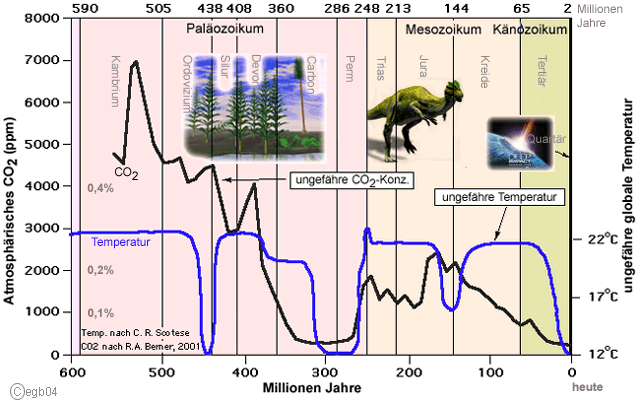
de CO2-Konzentration und Temperatur vor 600 Millionen Jahren en CO2-Concentration in the atmosphere in the last 600 Millions of Years fr Concentration du CO2 depuis 600 millions ans
|
|
|
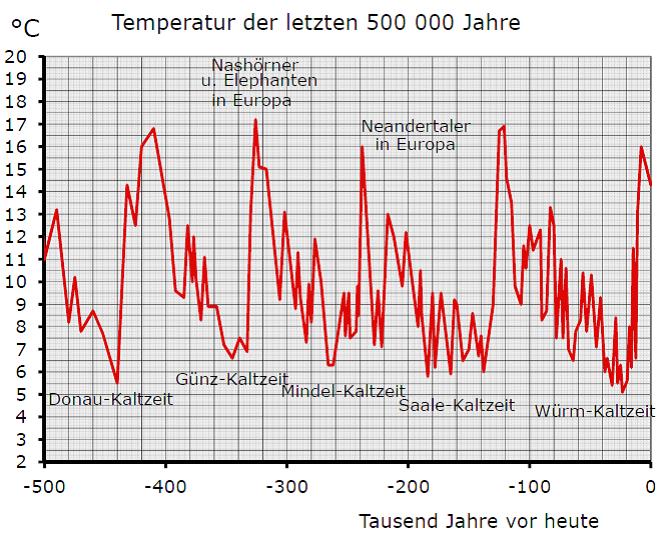
de Die aktuelle Eiszeit seit 500'000 Jahren en The actual Ice Age since 500'000 Years fr L'aire glacière actuelle depuis 500'000 ans Wenn sich der Klimazyklus der vergangenen 500'000 Jahre so fortsetzt, dann könnte das bedeuten, dass in wenigen tausend Jahren wieder der Rückfall auf das echte Eiszeit-Temperaturniveau mit Ausbreitung der Gletscher über Kanada und Skandinavien eintreten würde. |
| de | en | fr |
|---|---|---|
|
Neue Kälteperiode Eiszeiten & Warmzeiten |
New Cold Period Ice Ages & Warm Periods |
Nouvelle periode froide Glaciations & periodes chaudes |
|
|
de Das Holozän en The Holocene fr Le holocène de Das Holozän ist der jüngste Zeitabschnitt der Erdgeschichte; er dauert bis heute an. en The Holocene is a geological epoch which began at the end of the Pleistocene (at 11,700 calendar years BP) fr L'Holocène est une époque géologique s'étendant sur les 10'000 dernières années. |

|
|
de In den letzten 5'000 Jahren waren drei Warmzeiten (grün) wo es wärmer war als heute und die Erde hat dies überlebt. Geniessen Sie die Wärme noch solange sie dauert. en Over the last 5'000 years there were three warm periods (green sections) where it was warmer than today and the Earth survived. Enjoy the warmth while it lasts. fr Pendant les dernières 5'000 années il y avait trois periodes chaudes (vert) avec des températures plus élevés qu'aujourd'hui et la terre a survécue. Réjouissez-vous de la chaleur tant qu'elle dure. |

|
|
de Klima-Entwicklung in den letzten 3200 Jahren en Climat in the last 3200 Years fr Climat dans les 3200 dernières années/span> monte seulement après
|

|
|
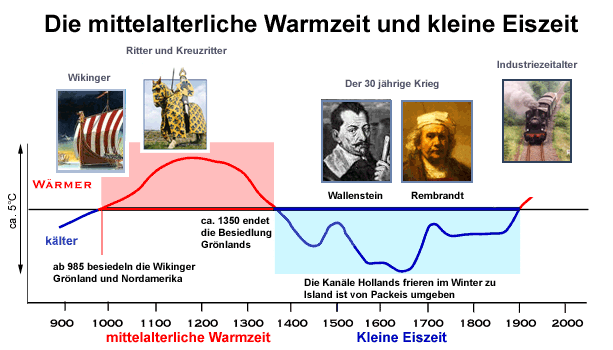
de Die Mittelalterliche Warmzeit und die Kleine Eiszeit en Medieval Warm Period and the Little Ice Age fr L'optimum climatique médiéval et le petit âge glaciaire
|
|
|
de Meeresspiegel-Anstieg vor Kohlenwasserstoff-Anstieg Kein Einfluss von CO2 und der fossilen Energien! en Sea level rise before Hydrocarbon use increase
No influence of CO2 and fossile energy! fr Augmentation du niveau des océans avant l'augmentation des hydrocarbures Pas d'influence du CO2 et des énergies fossiles! |

|
|
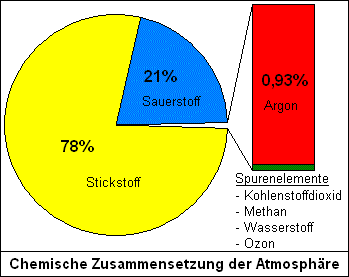
de Der Anteil von CO2 in der Luft fr Concentration du CO2 actuelle
Sauerstoff (O2): 21 %
0,04 Volumen-Prozent der Luft Von den 0,04 Prozent CO2 in der Luft produziert die Natur 96,5 Prozent, der Rest, also 3,5 Prozent, der Mensch.
Der Mensch produziert also 3,5 % 0.0014 % der Luft sind etwa 1 Teil CO₂ auf 71'000 Teile Luft oder 1/71'000 der Luft. |


Die Realität: CO2-Rückgang seit 600 Millionen Jahren.
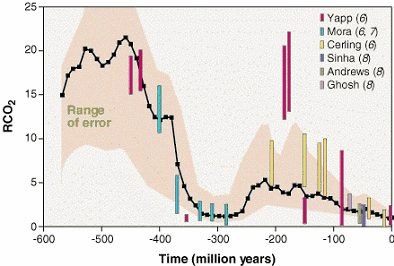
Entwicklung des CO2-Gehalts
der Atmosphäre in den letzten ca. 570 Mio. Jahren.
Der Parameter RCO2 bezeichnet das Verhältnis des Massenanteils an
CO2 in der Atmosphäre des jeweiligen Zeitpunkts
im Vergleich zum vorindustriellen Wert von ca. 300 ppm
(Grafik: W. H. Berger)
Demnach lag der CO2-Gehalt der Erdatmosphäre vor etwa 500-600 Millionen Jahren bis zu 20mal höher als in den letzten paar Jahrhunderten vor der industriellen Revolution.
Im Laufe der Zeit gab es dabei auch teils erhebliche Schwankungen.
So begann der CO2-Gehalt vor etwa 450 Millionen Jahren erheblich abzusinken, bevor er vor rund 250 Millionen Jahren erneut auf etwa den fünffachen heutigen Wert anstieg.
Seither nimmt er - wenn auch mit einer Reihe von Schwankungen - im Prinzip kontinuierlich ab.
Heute haben wir die seit 500-600 Millionen Jahren nahezu niedrigsten CO2-Konzentrationen in der Atmosphäre.
Würde man der obigen "Fieber"-Argumentation folgen, dann hätte die Erde vor Jahrmillionen fast schon kochen müssen.
So sprach der Schweizer Professor und IPCC-Berichts-Chef Thomas Stocker in einem Interview mit der Weltwoche am 11. 4. 2013 von einem Temperaturanstieg von 2 bis 4,5 °C pro Verdopplung des vorindustriellen CO2-Gehalts von 280 ppm.
Zahllose Fossilien belegen jedoch, dass sich die Tier- und Pflanzenwelt früherer Zeiten trotz eines um bis zu 2000 % höheren CO2-Gehalts im Großen und Ganzen bester Lebensbedingungen erfreute.
|
|
de Vom Menschen verursachtes CO₂ CO2 ist einer der wichtigsten Nährstoffe für Leben auf der Erde. Es hat sich in den letzten Perioden der großen Vereisung in der Eiszeit des Pleistozäns einem gefährlich niedrigen Niveau angenähert, und die menschlichen CO2-Emissionen können das Aushungern und den letztendlichen Tod des meisten Lebens auf dem Planeten aufgrund eines CO2-Mangels verhindern.
▶de
Die Auswirkungen von CO₂ auf das
Überleben des Lebens |

 IPCC AR 5 SYR Figure 1.5
|
|
de Falsche CO2-Konzentrationen von IPCC und Kyoto en Wrong CO2-Concentrations of IPCC and Kyoto fr Fausses concentrations du CO2 du GIEC et de Kyoto de Diese Annahmen für das Kyoto-Protokoll sind falsch en These data used as basis for the Kyoto-protocol are wrong fr Ces valeurs pris comme base du protocole de Kyoto sont fausses So macht man den Leuten Angst; so wird man hereingelegt. Dieses Bil wurde jahrelang als "Logo" der WG1 vom IPCC (Prof. Thomas Stocker) verwendet. |
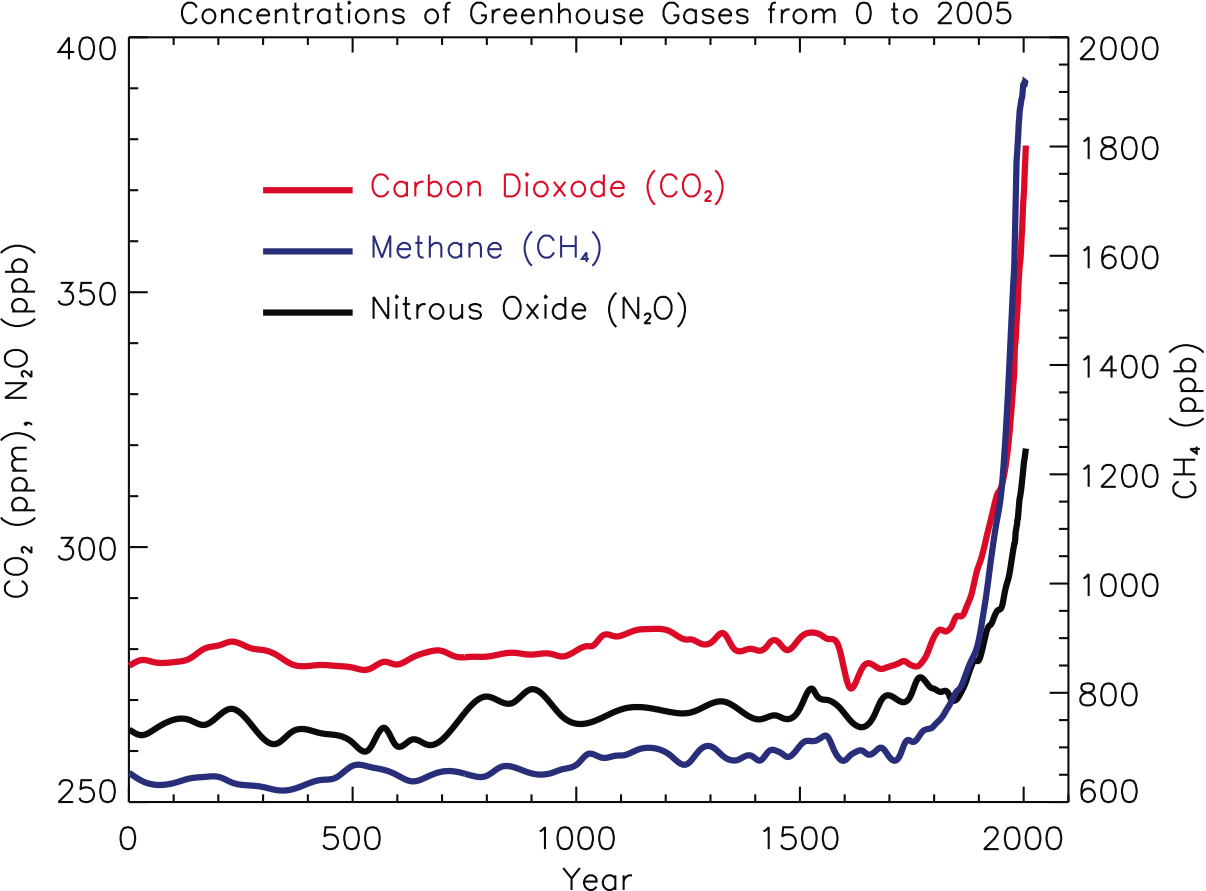
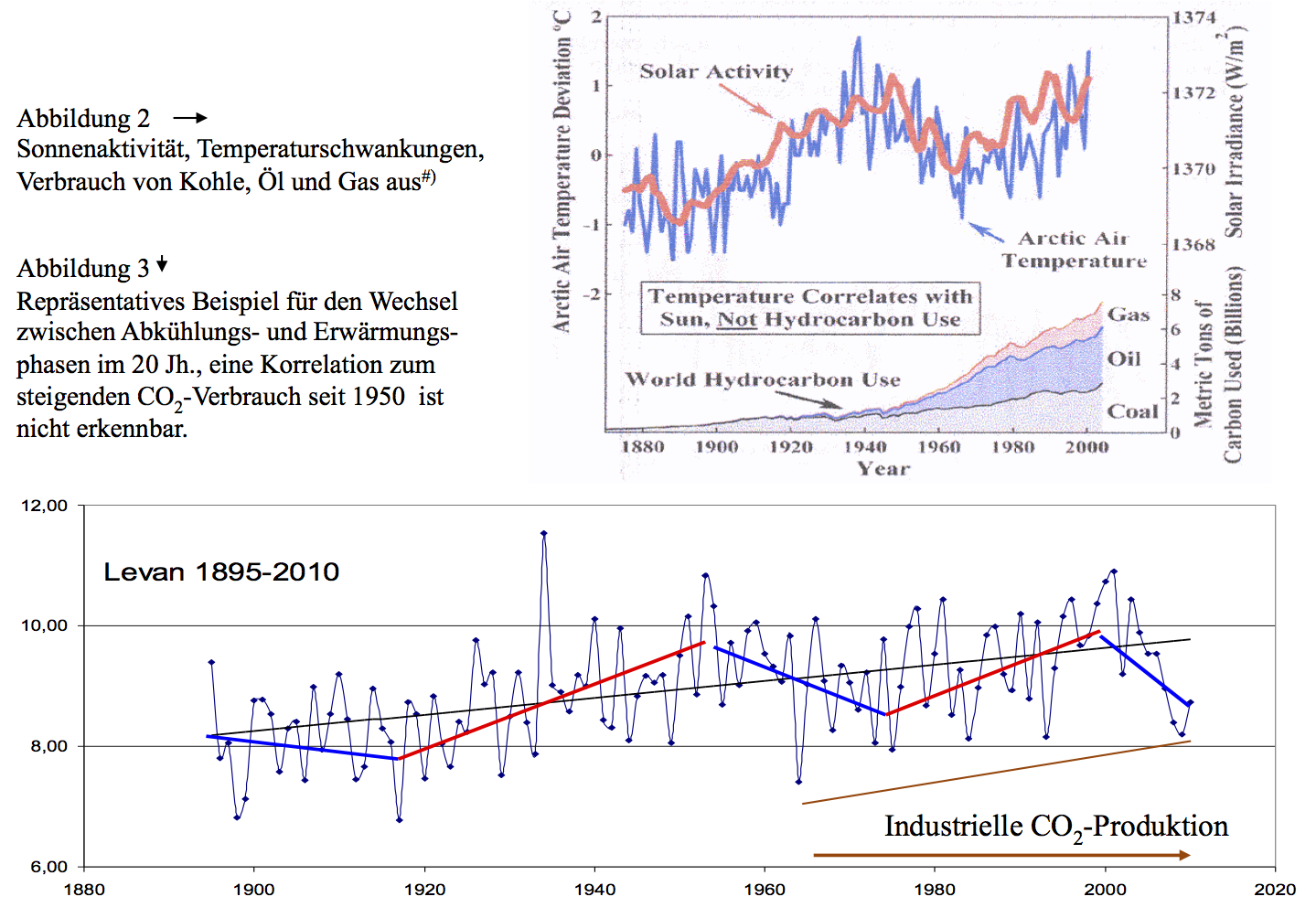
|
|
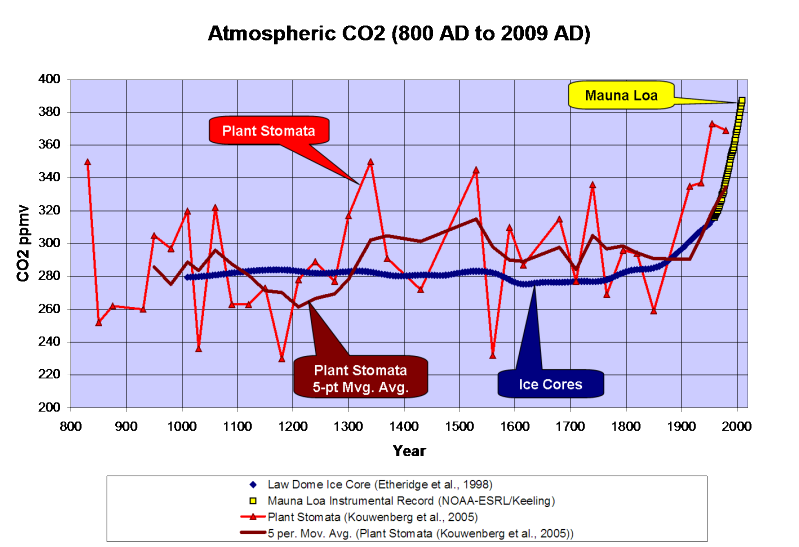
de Der historische CO₂ Gehalt der Atmosphäre en Historical CO₂ concentration fr Concentratiion du CO₂ historique Es ergeben sich überraschende Erkenntnisse Sie zeigen vor allem, dass die Konzentration des CO2 deutlich höher war als 280 ppm, wie es die Proben aus den Eisbohrkernen zeigen und dass die zeitliche Verzögerung zwischen Temperatur- und folgender CO2-Änderung viel geringer als 800 Jahre sein könnte. Sie zeigen aber auch, dass immer erst die Temperatur- und dann die CO2-Änderung erfolgte. |
|
|
de Die Daten aus Pflanzenstomata zeigen eine viel größere Variabilität des atmosphärischen CO₂-Gehaltes über die letzten 1000 Jahre als die Daten aus Eiskernen. Sie zeigen außerdem, dass der Gehalt während des vorigen Jahrtausends oft zwischen 300 und 340 ppmv lag, einschließlich eines Anstiegs um 120 ppmv vom späten 12. Jahrhundert bis zum mittleren 14. Jahrhundert. Die Stomatadaten deuten auch einen höheren CO₂-Gehalt an als die auf dem Mauna Loa gemessenen Werte; jedoch nähern sich beide Werte mit einem gleitenden Mittel über 5 Punkte ganz gut an ... |
en Plant stomata data show much greater variability of atmospheric CO₂ over the last 1,000 years than the ice cores and that CO₂ levels have often been between 300 and 340ppmv over the last millennium, including a 120ppmv rise from the late 12th Century through the mid 14th Century. The stomata data also indicate higher CO2 levels than the Mauna Loa instrumental record. |
|
|
de Eine Überprüfung historischer chemischer Analysen (Beck, 2007) zeigt sogar eine noch größere Variabilität des CO₂-Anteils in der Atmosphäre als die Daten aus den Pflanzenstomata ... en A survey of historical chemical analyses (Beck, 2007) shows even more variability in atmospheric CO2 levels than the plant stomata data since 1800. |
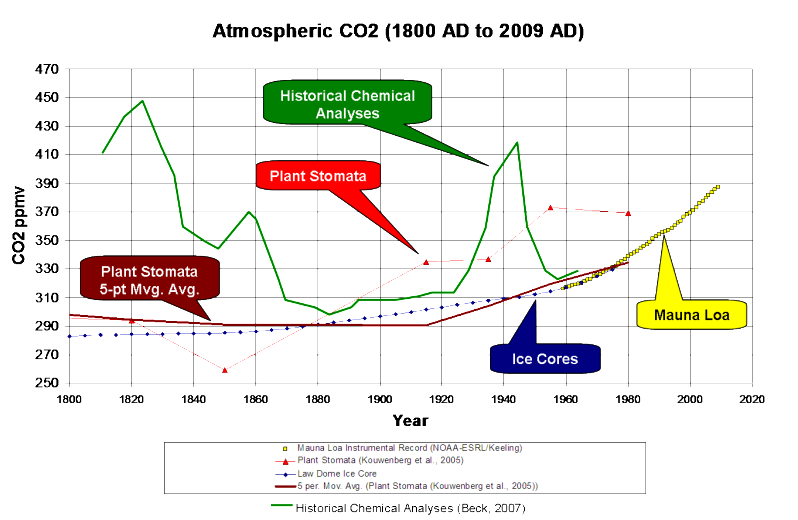
Forschungen der CO2-Konzentrationen in der Vergangenheit
en Research on CO2 concentrations in the past
fr Recherches sur la concentration du CO2 dans le passé
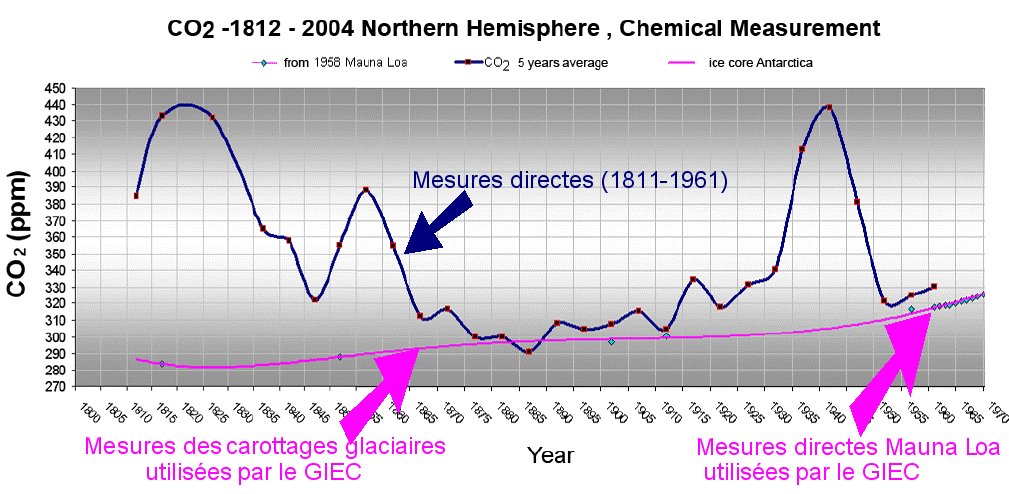
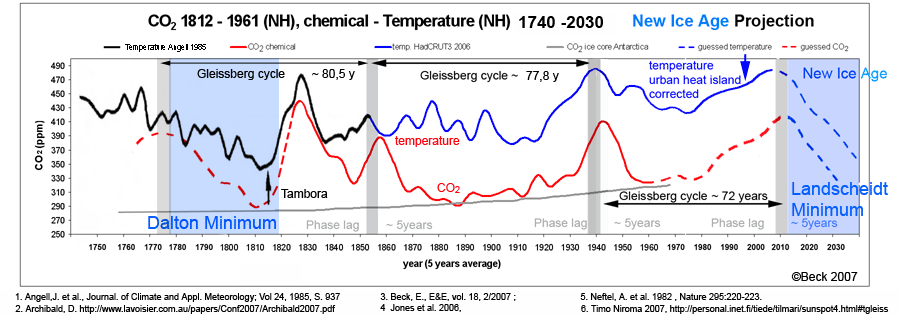
▶Ernst-Georg Beck: Forschungen der CO2-Konzentrationen in der Vergangenheit
|
de Diese Balken zeigen den zusätzlichen Erwärmungseffekt von je 20 ppm mehr CO2 in der Atmosphäre. en This graph shows the additional warming effect of each extra 20 ppm of atmospheric CO2. fr Ce graphique montre l'effet induit par chaque 20 ppm supplémentaires de CO2 sur la température de l'air. |
de Wenn die CO2-Konzentration zunimmt, hat es einen kleineren Erwärmungseffekt en As Carbon Dioxide increases it has less Warming Effect fr Lorsque la concentration du CO2 augmente, son effet de réchauffement diminue de Kohlendioxid absorbiert schon nahezu soviel es kann. Wir zeigen Ihnen, warum eine Verdoppelung von CO2 nicht viel Änderung bewirkt. Der Effekt heute ist vernachlässigbar, er ist nicht messbar. en Carbon dioxide is already absorbing almost all it can. Here's why it's possible that doubling CO2 won't make much difference. And the effect is already so small, it's unmeasurable. fr Le dioxyde de carbone absorbe déjà presque toute l'énergie possible. Voici pourquoi le doublement de la teneur en CO2 ne changera pas grand chose. L'effet est tellement faible qu'il n'est pas mesurable. |
|
|
de Diese Balken zeigen den zusätzlichen Erwärmungseffekt von je 20 ppm mehr CO2 in der Atmosphäre. en This graph shows the additional warming effect of each extra 20 ppm of atmospheric CO2. fr Ce graphique montre l'effet induit par chaque 20 ppm supplémentaires de CO2 sur la température de l'air. |
de
Die natürliche Erwärmung durch CO2 wird
durch die blauen Säulen dargestellt,
Jede Erhöhung des CO2-Niveaus um 20 ppm über
das vorindustrielle Niveau bringt einen Temperaturanstieg von etwa
0,03°C natürliche Erwärmung Um an diese globale Erwärmung zu glauben, ist ein "Sprung in den Glauben" nötig.
en
The natural heating effect of carbon dioxide is the blue bars
Each 20 ppm increment above 280 ppm provides about 0.03° C of
naturally occurring warming This is the leap of faith required to believe in global warming. |


|
|
de
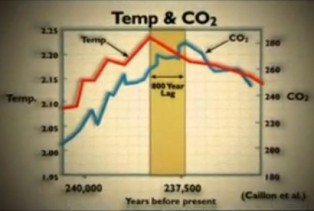
Zuerst steigt die Temperatur und erst nachher steigt das CO₂ Wichtig: Das CO2 kann also nicht der Grund für die Erwärmung sein! en First the temperature rises, CO₂ rises afterwards Important: Therefore CO2 cannot be the cause for global warming! fr D'abord c'est la température qui monte, le CO₂ monte seulement après Important: Le CO2 ne peut donc pas être la cause du rechauffement! |
|
|
Great Global Warming Swindle - Al Gore Excerpt
|
||
|
||
|
|
|
|
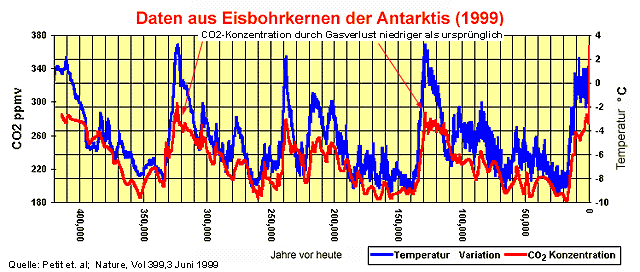
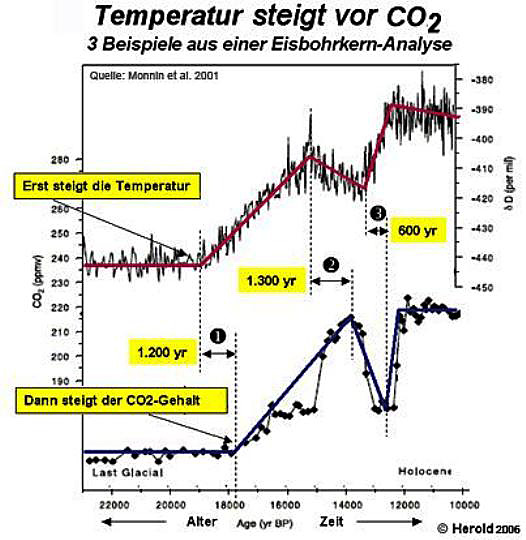
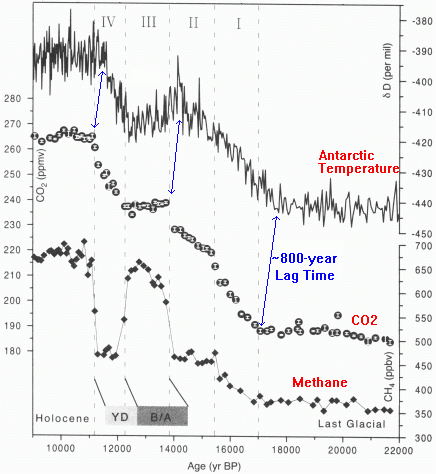
|
|
de Das CO2 steigt und die Temperaturen fallen en CO2 is rising and the temperatures are falling fr Le CO2 monte, les températures baissent de Das CO2 steigt, die Temperaturen fallen. Wenn das CO2 die Erwärmung erklärt, muss es auch die Abkühlung erklären ... en CO2 is rising, the temperatures are falling. If the CO2 explains the warming, it must also explain the cooling ... fr Le CO2 monte, les températures baissent. Si le CO2 explique le réchauffement, il doit aussi expliquer le refroidissement ... |
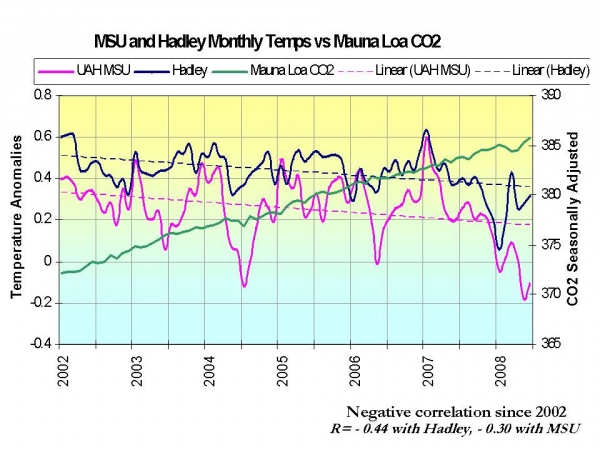
|
Solar Activity Variations |
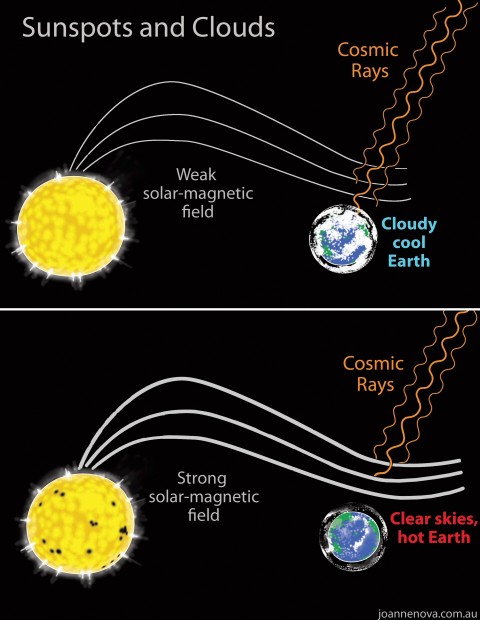
de Sonne, kosmische Strahlung und Wolkenbildung en Sun, Cosmic Rays and Cloud Cover fr Le soleil, les rayons cosmiques et la formation de nuages de Die Sonnenaktivität steuert die Kosmischen Strahlen und dadurch die Wolkenbildung. Mehr Sonnenaktivität → weniger Wolken → es wird wärmer. en The sun is influencing the cosmic rays and therefore the clouds cover. More solar activity → less clouds → warmer Earth. fr Le Soleil influence les rayons cosmiques est par cela les nuages sur la terre. Augmentation de l'activité solaire → moins de nuages → réchauffement de la terre. |
|
|
|
de Mehr Sonnenaktivität → weniger Wolken → es wird wärmer. Bei grosser Sonnenaktivität erreicht weniger Kosmische Strahlung die Erde. Mit weniger Kosmischer Strahlung werden weniger Wolken auf der Erde gebildet. Weniger Wolken lassen mehr Sonnenstrahlung auf die Erde, womit sich die Erde erwärmt. en More solar activity → less clouds → warmer Earth. A stronger wind from greater solar activity will reduce the flux of cosmic ray reaching Earth. Less cosmic rays means less cloud cover on the earth. Less cloud cover influences the terrestrial climate by higher solar radiation. fr Augmentation de l'activité solaire → moins de nuages → réchauffement de la terre. Une augmentation de l'activité solaire a comme effet une réduction du flux de rayons cosmiques atteignant la terre. Moins de rayons cosmiques produisent moins de nuages sur la terre. Moins de nuages laissent plus de rayons solaires réchauffer la terre. |

|
|
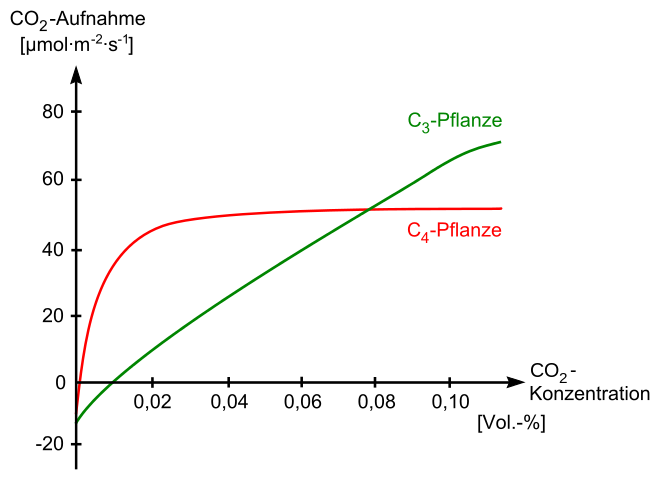
de Auswirkungen der CO2-Konzentration auf das Pflanzenwachstum en Impact of the CO2-Concentration on the plant growth fr Impacte de la concentration du CO2 sur la croissance des plantes
z. B. Bäume und Nutzpflanzen wie: Weizen, Roggen, Reis z. B. Gräser und Nutzpflanzen wie: Mais, Zuckerrohr, Hirse
de Falls der Verbrauch fossiler Treibstoffe nicht närrischerweise limitiert wird im Zuge eines abwegigen Versuches, den Klimawandel zu verhindern - zuvor globale Erwärmung genannt - wird die erwartete Zunahme der CO2-Emissionen in der Atmosphäre die Ernteerträge sowie die Wasser-Effizienz aller in der Welt erzeugten Nahrungsmittel deutlich verbessern. Dies erlaubt es uns die wachsende Weltbevölkerung weiter zu ernähren auch noch weit über das Jahr 2050 hinaus. Dann werden Berechnungen zufolge etwa 9 Milliarden Menschen auf der Erde leben, verglichen mit den heutigen 7,2 Milliarden. en I have found if fossil fuel usage is not foolishly restricted in a misguided attempt to prevent climate change - previously referred to as global warming - the expected increase in anthropogenic CO2 emissions will significantly enhance the yields and water-use efficiencies of essentially all of the world's food crops, allowing us to continue to feed the world's growing population up to and far beyond the year 2050, when it is expected to peak out at approximately nine billion people, compared to today's 7.2 billion. |


|
How not to make a climate photo op |
de Kommentar Pure Panikmache: MIT prognostiziert 7°C Temperaturanstieg bis 2100 "Wenn die Prognose dieser "Wissenschaftler" eines Temperaturanstiegs um 7°C bis 2100 auch mit dieser Methode entstanden ist, wundert mich nichts mehr. Immerhin gestehen diese Alarmisten mit der Einführung des Zufallselements (unbewußt?) zu, daß sie eben keine gesicherte Prognose aufstellen, sondern nur mit unvollständigen Computermodellen herumgespielt haben. Sie haben in Wirklichkeit keine Ahnung, wie sich das Klima künftig entwickeln wird." en Comments received MIT: Global Warming of 7°C 'Could Kill Billions This Century' Global temperatures could rise by more than 7C this century killing billions of people and leaving the world on the brink of total collapse, according to new research". The simple fact is that the source of these dire warnings come from computer "models" written by humans with a vested interest in a warming outcome. |

Der politogene Klimawandel
14. Antizensurkoalition 2017-11-25,
Video: 2017-12-26
-
Prof. Dr. Werner Kirstein / 14. Antizensurkoalition, 2017-11-25
2017-12-26 de
Der politogene Klimawandel
Seit über 30 Jahren wird mit "auserlesenen" Statistiken in Politik, Medien und Wissenschaft versucht, eine andauernde Klimaerwärmung nachzuweisen.
Überall ist von der "gegenwärtigen Klimakatastrophe" die Rede. Doch was wäre, wenn es Klimaschwankungen schon immer gegeben und der CO2-Ausstoß damit genau so wenig zu tun hätte, wie die Zunahme der Geburtenrate mit einer wachsenden Population von Störchen?
Alles reine Panikmache?
Der Klimatologe und Klimaexperte Prof. Dr. Werner Kirstein gibt Antworten auf diese Fragen.
Screenshots von EIKE sowie weitere Ergänzungen
-
EIKE Europäisches Institut für Klima und Energie
Helmut Kuntz
2018-01-03 de Vortragsvideo: Der politogene Klimawandel
Schreckung der Bevölkerung Art 258/1

-
Schweizerisches Strafgesetzbuch / SR 311.0
Zweites Buch: Besondere Bestimmungen
Zwölfter Titel: Verbrechen und Vergehen gegen den öffentlichen Frieden
de Art. 258/1: Schreckung der BevölkerungWer die Bevölkerung durch Androhen oder Vorspiegeln einer Gefahr für Leib, Leben oder Eigentum in Schrecken versetzt, wird mit Freiheitsstrafe bis zu drei Jahren oder Geldstrafe bestraft.

Klimawandel wird zum Rätsel
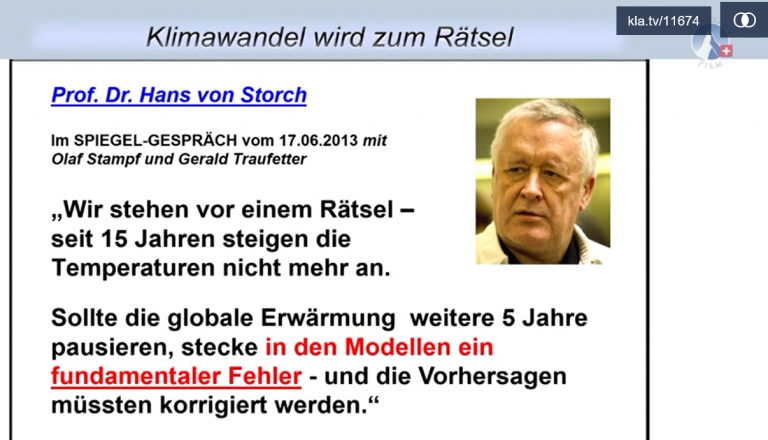 2013: SPIEGEL-GESPRÄCH "Wir stehen vor einem Rätsel"
| Hans von Storch |
Professor am Institut für Meteorologie der Universität Hamburg und
Leiter des "Instituts für Küstenforschung" am Helmholtz-Zentrum Geesthacht
- Zentrum für Material- und Küstenforschung in Geesthacht.
▶Hans von Storch: Who is who (Aktivisten der anthropogenen Globalen Erwärmung) |
| de | en | fr |
|---|---|---|
|
Klima: Diskussion Aussagen Klima Skandal: Evaluation Aussagen |
Climate change: Discussion Declarations Climate Scandal: Evaluation Declarations |
Climat: Discussion Déclarations Scandale: Évaluations Déclarations |
Anzahl Störche und Geburten in Deutschland

-
EIKE Europäisches Institut für Klima und Energie
Michael Limburg
2018-01-09 de Von Korrelationen, Trends bei Anomalien!Vielfach werden besonders gern in der Klimawissenschaft Korrelationen als Belege für Abhängigkeiten zweier Zeitreihen voneinander gezeigt.
Doch eine Korrelation ist nur eine notwendige aber nicht ausreichende Bedingung, um eine vermutete Ursache-Wirkungsbeziehumg zwischen diesen Variablen zu belegen.
Dieser ist aber für die Klimawirksamkeit von z.B. CO2 nicht erbracht.
Der folgende Beitrag beleuchtet die Zusammenhänge.
Er wurde zwar schon mal vor knapp 7 Jahren veröffentlicht, scheint aber weiterhin hoch aktuell zu sein.
| de | en | fr |
|---|---|---|
|
Klima: Wandel Klima-Beobachtungen Korrelationen mit der Sonne |
Climate: Change Climate Observations Correlations with the Sun |
Climat: Changement Observations sur le climat Corrélations avec le soleil |
 Weitere Screenshots aus diesem Video
Heilige Kuh Klimawandel - Prof. Dr. Werner Kirstein
-
2017-08-16 en
Heilige Kuh Klimawandel - Prof. Dr. Werner Kirstein
Seit über 30 Jahren wird uns eine Klimakatastrophe eingeredet
von bestimmten Teilen der Wissenschaft, von der Politik und von vielen Medien.
Der Mainstream berichtet regelmäßig über neue, vermeintliche Wärmerekorde.
Mit selektiver Statistik wird versucht, eine andauernde Erwärmung "nachzuweisen", für die anthropogene Emissionen verantwortlich sein sollen.
Die Fakten sprechen allerdings eine andere Sprache.
In Deutschland ist diese gezielte Panikmache besonders stark ausgeprägt.
Wie eine heilige Kuh wird uns der angeblich menschengemachte Klimawandel als unantastbar und nicht angreifbar präsentiert.
Ein stark übersteigertes Umweltbewusstsein hat den Schutz des Klimas zu einer Ersatzreligion werden lassen.
Kritische Stimmen werden dagegen als "Klimaleugner" diffamiert.
Nach dem Wunsch unserer Politiker soll Deutschland eine Vorreiterrolle als Weltretter beim sogenannten Klimaschutz übernehmen.
Im Vortrag wird gezeigt, dass Kohlendioxid alles andere als ein schädliches Spurengas ist
und mit welchen Methoden durch eine "drohende Klimakatastrophe" bei vielen Menschen Angst und Panik ausgelöst werden soll.
Auch hier geht es wieder mal unter anderem um viel Geld.
Die Politik hat schon oft im Gewand eines Gutmenschen ihre Ziele mit allen Mitteln durchzusetzen versucht, leider nicht selten mit wissenschaftlichen Helfern.
Viele sachkundige Kritiker halten weltweit mit Fakten dagegen und entlarven die drohende Klimakatastrophe als politisch-ideologische Strategie.
Klimawissenschaftler: Klimawandel nicht durch
CO2 verursacht
Klagemauer.TV: 2016-11-20
Zu Werner Kirstein: "Erdklima vs. Mainstram-Medien" 2016-06-14
-
Klagemauer.TV
2016-11-20 de
"Klimawissenschaftler: Klimawandel nicht durch
CO2 verursacht"
Zu Werner Kirstein: "Erdklima vs. Mainstrem-Medien" 2016-06-15
Quelle/Source:
-
Klagemauer TV
2016-11-18 de Klimawissenschaftler: Klimawandel nicht durch CO2 verursacht (Vortrag von Prof. Dr. Werner Kirstein)Vom 7. November bis zum 18. November 2016 findet die 22. UN-Klimakonferenz in Marrakesch, in Marokko, mit 195 Mitgliedsstaaten, statt.
Schwerpunktmäßig wird wieder diskutiert, wie man die beschlossene Begrenzung der Erderwärmung auf zwei Grad innerhalb dieses Jahrhunderts umsetzen kann.
Dazu legte Petteri Taalas, Generalsekretär der Weltorganisation für Meteorologie WMO, einer Sonderorganisation der Vereinten Nationen, die aktuellen Daten vor.
Er zeigte auf, dass im Schnitt die Temperaturen im Jahr 2016 1,2 Grad über dem Niveau vor dem Industriezeitalter liegen.
Das sei laut Herrn Taalas auch der Grund für mehr Wetterkatastrophen und - als unmittelbare Folge davon - für wirtschaftliche Einbußen größeren Ausmaßes.
Ursache seien die klimaschädlichen Treibhausgase.
1988 wurde der Weltklimarat IPCC von der UN ins Leben gerufen,
mit dem klaren Auftrag zu beweisen, dass ein Klimawandel vorliege,
und dieser menschengemacht sei.
Mit speziell geschriebenen Computerprogrammen sollte nachgewiesen werden, dass die Welt durch eine steigende Erderwärmung in einer Klimakatastrophe enden würde.
Hauptverursacher sei das angeblich umweltschädliche CO2, wie von Politikern und Hauptmedien seit Jahrzehnten gebetsmühlenartig vermittelt wird.
Eine Vielzahl namhafter Wissenschaftler weist Manipulationen in den Messungen und Auswertungen nach, und sieht für den Klimawandel aber ganz andere Ursachen und Zusammenhänge.
Prof. Dr. Werner Kirstein, ein erfahrener Klimatologe, ist eine dieser Gegenstimmen.
In seinem Vortrag "Erdklima versus Mainstream-Medien", den wir gleich im Anschluss zeigen, erklärt er fundiert und sehr anschaulich die Zusammenhänge von Erdklima, Klimaerwärmung und CO2 aus einer ganz anderen Sichtweise.
Die propagandamäßige Arbeitsweise der offensichtlich gleichgeschalteten Medien wird in diesem Vortrag ebenfalls beleuchtet.
Schauen Sie nun den Vortrag und bilden Sie sich Ihre eigene Meinung.
Erdklima vs. Mainstream-Medien
NuoViso.TV:Vortrag von Prof. Dr. Wernner Kirstein 2016-06-14
-
NuoViso.TV / Prof. Dr. Werner Kirstein
2016-06-14 de
Erdklima versus Mainstream-Medien
Ist der Klimawandel menschengemacht?
Ganz klar: JA - wenn man nach der Meinung der Mainstreammedien geht.
Die Wissenschaftlichen Fakten jedoch kommen zum gegenteiligen Ergebnis.
Als Klimageograph kennt Prof. Dr. Werner Kirstein die Daten der Klimaaufzeichnungen sehr genau.
Und so weiß er auch, dass der Gehalt von CO2 in unserer Atmosphäre
nicht nur einen historischen Tiefstand aufweist,
welcher nahezu kritische Auswirkungen auf die Flora haben,
sondern die Temperatur keinesfalls beeinträchtigt.
Viel mehr ergeben die Daten, dass der Prozess genau umgekehrt ist.
Der CO2-Gehalt passt sich an die Temperatur an.
Im Dezember 2015 trafen sich in Paris mehr als 50.000 Menschen, um an dem Weltklima-Gipfel teilzunehmen.
Besonders stolz war man darauf, dass sich alle teilnehmenden Nationen für eine Reduzierung von Kohlenstoffdioxid (CO2) ausgesprochen und sich verpflichtet haben zu Reduzieren.
Wieviel und nach welchen Maßstäben wurde nicht definiert.
Ziel des Ganzen sei,
durch den verminderten Aussoß von CO2 zu bewirken, dass sich die Erde nicht mehr als 2 Grad im Vergleich zum Beginn des Industrie-Zeitalters (ab Mitte des 19. Jhd.) erhöht.
Ein Grad davon haben wir bereits erreicht, so dass das Ergebnis des Klimagipfels letztlich die Absicht aussprach, dass der Mensch, nicht weiterhin das Klima so stark beeinflusst.
Klimawissenschaft und Klimapolitik stehen sich diametral gegenüber.
In diesem Vortrag zeigt Prof. Dr. Werner Kirstein auf, weshalb die Debatte um das Senken von CO2 ausschließlich politischen Zielen dient und keinesfalls der Umwelt, dem Weltklima oder den Menschen.
Die Medien spielen das Spiel brav mit, doch einem Faktencheck halten die von Spiegel, FAZ & Co verbreiteten Klimatheorien nicht stand.
Das klimapolitische Dogma des Zwei-Grad-Zieles
Prof. Dr. Werner Kirstein bei SteinZeit 2016-03-19
-
Prof. Dr. Werner Kirstein bei SteinZeit
2016-03-19 de
Das klimapolitische Dogma des Zwei-Grad-Zieles
Im Dezember 2015 trafen sich in Paris mehr als 50.000 Menschen, um an dem Weltklima-Gipfel teilzunehmen.
Als riesiger Erfolg wurden die Ergebnisse dieser Konferenz gefeiert.
Besonders stolz war man darauf, dass sich alle teilnehmenden Nationen für eine Reduzierung von Kohlenstoffdioxid (CO2) ausgesprochen und sich verpflichtet haben zu Reduzieren.
Wieviel und nach welchen Maßstäben wurde nicht definiert.
Ziel des Ganzen sei, durch den verminderten Aussoß von CO2 zu bewirken, dass sich die Erde nicht mehr als 2 Grad im Vergleich zum Beginn des Industrie-Zeitalters (ab Mitte des 19. Jhd.) erhöht.
Ein Grad davon haben wir bereits erreicht, so dass das Ergebnis des Klimagipfels letztlich die Absicht aussprach, dass der Mensch, nicht weiterhin das Klima so stark beeinflusst.
Der Klimageograph Prof. Dr. Werner Kirstein kann dabei nur den Kopf schütteln.
Die Teilnehmer der Konferenz seien keine Klimawissenschaftler, sondern Klimapolitiker.
Denn der Klimafachmann weiß genau: CO2 steuert nicht die Temperatur, sondern es ist umgekehrt.
Die Temperaturen bestimmen auch den CO2-Gehalt der Atmosphäre, was auch weltweit alle Messdaten bestätigen.
Die CO2-Verschwörung
Prof. Dr. Werner Kirstein bei SteinZeit 2014-09-13
-
Prof. Dr. Werner Kirstein bei SteinZeit
2014-09-13 de
Die CO2-Verschwörung
Werner Kirstein, Professor für Geographie an der Universität Leipzig beschäftigt sich seit Jahrzehnten schwerpunktmäßig mit dem Thema Klimageographie.
Als er in den 80er Jahren erstmals mit dem Klimawandel und dem vermeintlichen Verursacher Kohlenstoffdioxid (CO2) konfrontiert wurde, bekam er Zweifel an den Inhalten seines Studiums und auch seiner bisherigen Arbeiten und Forschungen in dieser Richtung, passten diese doch gar nicht zusammen.
In den Folgejahren wurde der "menschengemachte Klimawandel" immer weiter durch den Weltklimarat (IPCC) und die Medien propagiert, soweit dass von dieser These nahezu jeder restlos überzeugt war.
Prof. Werner Kirstein sah diese Entwicklung bereits von Anfang an skeptisch.
Während seine Forschungen und die einiger Kollegen zu völlig anderen Ursachen und Schlüssen kamen, fragte er sich dennoch warum dieses Thema so stark forciert wurde.
Heute, viele Jahre später erscheint vieles deutlich klarer.
Haben Sie sich schon einmal die Frage gestellt, welches die Hauptaufgabe der Politik ist?
Mit Sicherheit wird sehr häufig die Verantwortlichkeit für Wirtschaftswachstum genannt werden.
Unser derzeitiges Wirtschafts- und Finanzsystem setzt zwingend ein stetiges Wirtschaftswachstum voraus.
So wurde es uns immer wieder eingeprügelt, um die Menschheit vor dem "drohenden Klimakollaps" zu retten, seien die Kohlendioxid-Emissionen drastisch zu senken.
Weltweite CO2-Reduktionen sollen die befürchtete Temperaturerhöhung deshalb auf das politische "Zwei-Grad-Ziel" begrenzen.
Seither wurden unzählige Milliarden Euro (Dollar usw...) in Deutschland und vielen anderen westlichen Industrienationen in moderne Industriefilteranlagen und CO2-reduzierte Autotechnologien investiert.
In diesem Fall handelt es sich aber um eine Zwangsinvestition für alle per Gesetz, letztendlich ein gigantischer Konjunkturmotor.
In diesem Interview mit Robert Stein räumt Prof. Werner Kirstein mit der Klimalüge auf.
War er früher noch ein einsamer Streiter im Kampf gegen den menschengemachten Klimawandel, schließen sich heute immer mehr Experten dieser Auffassung an.
Wo bleibt der Klimawandel?
Ein Öffentliches Seminar an der Universität Leipzig 2010-10-10
-
Prof. Dr. Werner Kirstein
2010-10-10 de
Wo bleibt der Klimawandel?
Ein Öffentliches Seminar an der Universität Leipzig mit Prof. Dr. Klaus Landfried, Heidelberg, vormals Präsident der Hochschulrektorenkonferenz und Prof. Dr. Werner Kirstein, Institut für Geographie der Universität Leipzig
Hintergrund
Wo bleibt der Klimawandel?
Seit etwa 10 Jahren weist die Lufttemperatur weltweit einen insgesamt abnehmenden Trend auf, bei gleichzeitig ansteigendem CO2!
Nach den Klimamodellen des Weltklimarates (IPCC) sollten die Temperaturen insbesondere seit 2000 aber spürbar gestiegen sein.
Für diesen Widerspruch liefern die Modelle keine Erklärung.
Unter anderem auch deshalb gibt es heute in Wissenschaft und Politik zum Thema Klimawandel international immer weniger Konsens, auch wenn dies vor allem aus den Medien kaum zu entnehmen ist.
Viele Wissenschaftler auch bei uns haben inzwischen erhebliche und fundierte Zweifel an einer k a u s a l begründeten Reaktion der Lufttemperatur auf die fortwährende Zunahme des CO2 in der Atmosphäre.
In einigen Ländern wie z.B. in den USA, England oder Australien dreht sich der "Mainstream" bereits in die entgegengesetzte Richtung.
Nach Umfragen in den Vereinigten Staaten gingen im April 2008 ca. 47 % der Bürger davon aus, dass es einen vom Menschen gemachten Klimawandel gibt.
Im April 2010 waren es nur noch 33%.
Auf internationaler Ebene hat ein Umdenkprozess in der Klimawissenschaft und -politik begonnen, beschleunigt durch die groben Fehler und Manipulationen, die seit Climate-Gate beim IPCC bekannt geworden sind.
Dieser Trend wird in Deutschland von Medien und Politik weitgehend ignoriert.
| de | en | fr |
|---|---|---|
|
Klimawandel: Wissenschaft Der CO2-Treibhauseffekt |
Climate change: Science The CO2 Greenhouse Effect |
Changement climatique: Science L'éffet de serre du CO2 |
| Einleitung | Introduction | Introduction |
| Die Klimasensitivität von CO₂ | Climate sensitivity of CO₂ | La sensibilité climatique du CO₂ |
|
Die CO₂-Sättigung: Wenn die CO₂-Konzentration zunimmt, ist die Erwärmung wegen der Sättigung kleiner |
The CO₂ Saturation: As Carbon Dioxide increases it has less Warming Effect |
La saturation du CO₂: Lorsque la concentration du CO₂ augmente, son effet de réchauffement diminue |
| Der Streit um die Rückkopplungen | The argument about the feedbacks | L'argument des rétroactions |
| Der fehlende Hotspot (warme Zone) | The missing Hotspot | Le 'hotspot' (point chaud) manque |
| ERBE Earth Radiation Budget Experiment | ERBE Earth Radiation Budget Experiment | ERBE Earth Radiation Budget Experiment |
↑ e Hans H.J. Labohm
Hans H.J. Labohm | Independent economist and publicist |
|---|

de Klimakatastrophenzweifel, eine Einführung
-
AGW = Anthropogenic Global Warming (-Hypothese)
-
Weltweit haben Zehntausende Wissenschaftler vieler verschiedener Fachrichtungen, einschliesslich 72 Nobelpreisträgern, öffentlich Zweifel an der Anthropogenic Global Warming,-Hypothese (AGW) und der ihr zugrunde liegenden Wissenschaft geäussert.
-
Klimaskeptiker bezweifeln nicht den Klimawandel. Vielmehr ist Klimawandel seit Bestehen der Erde ein Normalzustand.
-
Nach der AGW-Hypothese müsste in den oberen Schichten der Troposphäre und an den Polen die Erwärmung stärker sein als an der Erdoberfläche. Messungen zeigen jedoch, dass dies nicht der Fall ist. Nach der wissenschaftlichen Methode müssen Hypothesen, die mit Beobachtungen nicht übereinstimmen, verworfen und durch andere Hypothesen ersetzt werden. Vertreter der AGW-Hypothese scheinen sich an diese Regel nicht zu halten.
-
Kürzlich hat der Astronom Khabibullo Abdusamatov vom Pulkovo Astronomic Observatory in St. Petersburg erklärt, die Erde werde, verursacht durch niedrige Sonnenaktivität, in der Mitte dieses Jahrhunderts eine Mini-Eiszeit erleben. Die Temperaturen werden etwa ab 2012 fallen, wenn die derzeitige globale Erwärmung, die durch relativ hohe Sonnenaktivität bedingt sei, ihren Höhepunkt erreicht habe. Die niedrigste Durchschnittstemperatur werde etwa in den Jahren 2035 bis 2045 zu vermelden sein. Diese Sicht wird auch durch den belgischen Astronomen Dirk Callebaut unterstützt, der in der Mitte des Jahrhunderts ein grosses Minimum erwartet, vergleichbar dem Maunder-Minimum (1650-1700), einer Periode, in der die Themse, die Seine und die holländischen Kanäle im Winter zugefroren waren.
-
Beobachtungen zeigen, dass die CO2-Konzentration in der Atmosphäre nach einem relativ warmen Jahr weiter steigt, während die Temperaturen sinken.
-
Wenn es tatsächlich eine globale Erwärmung gibt - und es wird oft von einem Temperaturanstieg von zwei Grad gesprochen -, sehen Skeptiker eher positive Folgen. Die landwirtschaftlichen Erträge könnten gesteigert und die Anbaugebiete, vor allem in der nördlichen Hemisphäre, ausgeweitet werden. Höhere CO2- Konzentrationen wirken sich wie durch die Luft übertragener Dünger aus und fördern somit das Pflanzenwachstum. Im Grossen und Ganzen, so argumentieren die Skeptiker, haben es Menschen immer geschafft, sich an unglaublich vielfältige Klimabedingungen anzupassen und erfolgreiche Lebensgemeinschaften zu bilden.
-
Die Angaben, die der IPCC in seinen jüngsten Berichten über den Anstieg des Meeresspiegels macht (9 bis 88 cm in diesem Jahrhundert) werden von Skeptikern als grobe Übertreibungen gesehen. In den vergangenen Jahrhunderten stieg der Meeresspiegel um 15 bis 20 cm während eines Zeitraums von 100 Jahren an. Bisher ist es nicht zu einer Beschleunigung des Anstiegs gekommen, obwohl man dies angesichts des menschlichen Beitrags zum Treibhauseffekt hätte annehmen können.
-
Häufig ist es einfacher, Mittel für Forschungen zu erhalten, die die AGW-Hypothesen stützen, als für Forschungsarbeiten, die dem Paradigma der vom Menschen verursachten globalen Erwärmung kritisch gegenüberstehen. Skeptiker sehen hierin einen Angriff auf die Unabhängigkeit und Integrität der Wissenschaft.
-
Durch die Umsetzung von Kioto wird immer mehr Autorität auf Brüssel übertragen, und die europäische Wirtschaft erhält Elemente einer zentralen Planwirtschaft.
-
Der vernachlässigbar kleine Netto- Reduktionseffekt von Kioto, in der zuletzt während der Klimakonferenz in Marrakesch geänderten Fassung (0,02 Grad Celsius im Jahr 2050), ist bisher in keinen offiziellen Dokumenten veröffentlicht worden.
-
Die Verfechter der AGW-Hypothese behaupten oft, die Wissenschaft sei gesichert, und alle Wissenschaftler seien sich einig. Die bis hierher präsentierte Übersicht zeigt, dass dies nicht der Fall ist.
-
Die Politik hat sich in den letzten 15 Jahren sehr stark engagiert, und ein Eingeständnis, dass man hier ohne solide wissenschaftliche Basis agiert und enorme Kosten bei minimalem Nutzen verursacht, wäre ein politisches Desaster, das die Klimaschutzprotagonisten auf jeden Fall verhindern wollen. Es liegt auch daran, dass die globale Erwärmung die Mutter aller Umweltängste ist. Es ist Teil einer weltlichen Religion, die für wissenschaftliche Argumente gänzlich unempfänglich ist.
-
Klimaskeptiker Info
de Hans Labohm: Klimakatastrophenzweifel - eine Einführung
-
Hans Labohm über die verschiedenen Argumente und Standpunkte
in der Klimadebatte
de Klimakatastrophenzweifel eine Einführung
-
Klimaskeptiker Info
de Gegentheorie?
-
Project Syndicate/Bjørn Lomborg
de en fr
Global Warning
de Klimahysterie
en Climate Hysteria
fr Hystérie climatique
↑ f Vahrenholt
 Professor Fritz Vahrenholt
de
Sonne und Treibhausgase - Ursachen des Klimawandels
(
Quelle 1,
Quelle 2)
en
Global Warming: Second Thoughts of an Environmentalist
A) Total Solar Irradiance (TSI)
B) Temperature Development
Two things are noteworthy:
-
Every time when solar activity was low, there were periods of cold weather.
Whenever the sun was strong (like in the current warm period, the Roman Warm Period and the Medieval Warm Period), there were warm periods.
-
Secondly, there is obviously a 1,000-year cycle with alternating hot and cold periods.
|
Fritz Vahrenholt
Homepage
KlimaNachrichten/Die Kalte Sonne
Wikipedia
|
Professor, Dr., Deutscher Politiker (SPD), Manager, Wissenschaftler
und Buchautor. ►Fritz Vahrenholt: Who is who (Skeptiker) ▶Fritz Vahrenholt: Präsentationen (Bilder & Grafiken) ▶Fritz Vahrenholt: Video-Präsentationen ▶Fritz Vahrenholt: Wikipedia (Opfer von Wikipedia) |
↑ g Wisnewski
-
Gerhard Wisnewski
2016-03-05 de
Die Klima Religion (Die Klima Lüge)
| de | en | fr |
|---|---|---|
|
Klimawandel: Probleme Glaube und Hysterie (Teile I-III) |
Climate change: Problems Climate Hysteria (Parts I-III) |
Climat: Problèmes Hystérie sur le climat (parties I-III) |
↑ h Heinrich Röck
-
Heinrich Röck
2010 de
Wissenschaft Klima Politik - Wohin ändert sich das Klima?
Zusammenfassung
Klima ist das statistische Konstrukt über 30 Jahre Wetter.
Klimawandel, schnell und langsam, war immer.
Was ist die Normalität des Klimas?
Klimaschutz ist eine Illusion.
Extreme Wetterereignisse haben seit 1850 nicht zugenommen.
Die Globaltemperatur hat sich seitdem schubweise um 0,8 ± 0,2 °C erhöht.
Die CO2-Konzentration in der Atmosphäre nahm kontinuierlich von 290 auf 385ppm zu.
Die Antriebe des Klimas sind Sonne, kosmische Strahlung, Aerosole, Wolken, Albedo, infrarotaktive Gase wie H2O, CO2, CH4, O3, N2O (Treibhausgase), Zyklen über 10 bis 10.000 Jahre, u.a.m.
Die etablierte Klimatologie benennt die anthropogenen CO2- und CH4-Emissionen seit der Industrialisierung (seit 1850) als die wesentliche Ursache des Anstiegs der Globaltemperatur; Kritiker erkennen die Sonne als wesentlichen Faktor.
Der anthropogene Treibhauseffekt ist nicht messbar.
Seine vermutbaren Wirkungen werden mit Hypothesen berechnet und in numerische Modelle des Klimas als Antrieb eingebaut.
Die Modelle des chaotischen Wetters bzw. Klimas sind Hypothesen ihrer Schöpfer über das Funktionieren des Wetters/Klimas, geeignet für Experimente am Computer, ungeeignet für Vorhersagen des realen Klimas.
Wie seit Jahrtausenden muss die Menschheit sich an den Klimawandel anpassen.
Wenn es nachgewiesene menschliche Ursachen gäbe, dann wären deren Wirkungen zu verringern oder zu vermeiden.
Wissenschaft ist das falsche Werkzeuig zur Lösung politischer Dispute.
Summary
Climate is the statistical construct based on 30 years of weather.
There has always been slow and fast climate change.
What is the normality of climate?
Protecting the climate is an illusion.
Extreme weather occurrences have not increased since 1850.
The global temperature during that intervall has increased in phases by 0,8±0,2 °C.
The CO2 concentration in the atmosphere has increased steadily from 290 to 385ppm.
Drivers of climate include the sun, cosmic radiation, aerosols, clouds, albedo, infrared-active gases such as H2O, CO2, CH4, O3, N2O (greenhouse gases), cycles lasting anywhere from 10 to 10.000 years, etc.
The climatology establishment attributes the increase in global temperature mainly to the anthropogenic CO2 and CH4 emissions since the beginnings of the industial age (around 1850); critics consider the sun to be the key factor.
The anthropogenic greenhouse effect is not measureable.
Its presumable effects are computed based on hypotheses and incorporated in numerical models of the climate.
Models of chaotic weather or climate are hypotheses of their creators about the functioning of weather/climate, appropriate for computer-experiments but not for predictions of the real climate.
Just as it has thousands of years, mankind must continue to adapt to climatic change.
If human causes can be proven, then their effects should be minimized or avoided.
Science is the wrong tool for solving political disputes.
↑ i Robert Stein
-
Regentreff 2018 / Robert Stein
2018-11-08 de
Energiewende am Ende: Der große Klimaschwindel
Der Schutz unserer Umwelt ist eines der größten und drängendsten Probleme unserer Zeit.
Wenn wir unseren Nachkommen einen lebenswerten Planet hinterlassen wollen, dann müssen wir jetzt handeln!
Riesige Plastikteppiche treiben in unseren Meeren, wir roden Waldflächen in gigantischem Ausmaß, wir entsorgen Gifte in der Natur und wissen nicht wohin mit unserem gefährlichen Atommüll.
Ein großes Artensterben hat längst begonnen.
Doch all dies wird von dem riesigen Thema CO2 und Klimawandel in den Hintergrund gedrängt.
Dabei ist dieses eines unserer geringsten Probleme, wenn es denn überhaupt eines ist, findet Robert Stein.
Diese Meinung hat er nicht explizit, sondern zehntausende Wissenschaftler sind der gleichen Ansicht.
Ihr Problem:
Der alles dominierende Weltklimarat bestimmt den öffentlichen Diskurs.
In diesem Vortrag zeigt Robert Stein nicht nur die Methoden, Propaganda und Fälschungen mit denen in der Klimawissenschaft gearbeitet wird, sondern er nennt Zahlen, Daten und Fakten zum CO2 und Klimawandel, welche von unabhängigen Wissenschaftlern publiziert werden.
Auch die deutsche Energiewende nimmt er dabei aufs Korn, welche in der restlichen Welt belächelt wird.
Anhand von Beispielen zeigt er die Absurditäten der deutschen Klimapolitik auf.
Das es langfristig einer Energiewende bedarf, da ist sich Robert Stein sicher, nur mit dem deutschen Weg kann er sich so gar nicht anfreunden.
⇧ 3 en Introduction
- a Interviews from the 2009 International Conference on Climate Change
- b Richard Lindzen
- c John Coleman
- d Walter Cunningham
- e William (Bill) M. Gray
- g S. Frederic (Fred) Singer
- f John R. Christy
↑ a Interviews from the 2009 International Conference on Climate Change
-
The Heartland Institute
2017-01-06 de
Global Warming: Was it Ever Really a Crisis?
Interviews from the 2009 International Conference on Climate Change
| AWI |
Alfred-Wegener-Institut
▶AWI: Who is who (Institute & Organisationen der Globalen Erwärmung) ▶Ausschluss und Maulkorb für Kritiker (Gleichschaltung des Direktoriums vom Alfred-Wegener-Institut in der Klima-Berichtserstattung) |
↑ b Richard Lindzen
Transcript
I'm an atmospheric physicist.
I've published more than 200 scientific papers.
For 30 years I taught at MIT, during which time the climate has changed remarkably little.
But the cry of "global warming" has grown ever more shrill. In fact, it seems that the less the climate changes, the louder the voices of the climate alarmists get.
So, let's clear the air and create a more accurate picture of where we really stand on the issue of global warming or, as it is now called - "climate change".
There are basically three groups of people dealing with this issue.
Groups one and two are scientists.
Group three consists mostly, at its core, of politicians, environmentalists and the media.
Group one is associated with the scientific part of the United Nation's International Panel on Climate Change or IPCC (Working Group 1).
These are scientists who mostly believe that recent climate change is primarily due to man's burning of fossil fuels-oil, coal and natural gas.
This releases CO2, carbon dioxide, into the atmosphere and, they believe, this might eventually dangerously heat the planet.
Group two is made up of scientists who don't see this as an especially serious problem.
This is the group I belong to. We're usually referred to as skeptics.
We note that there are many reasons why the climate changes - the sun, clouds, oceans, the orbital variations of the earth, as well as a myriad of other inputs.
None of these is fully understood, and there is no evidence that CO2 emissions are the dominant factor.
But actually there is much agreement between both groups of scientists.
The following are such points of agreement:
-
The climate is always changing.
-
CO2 is a greenhouse gas without which life on earth is not possible, but adding it to the atmosphere should lead to some warming.
-
Atmospheric levels of CO2 have been increasing since the end of the Little Ice Age in the 19th century.
-
Over this period (the past two centuries), the global mean temperature has increased slightly and erratically by about 1.8 degrees Fahrenheit or one degree Celsius; but only since the 1960's have man's greenhouse emissions been sufficient to play a role.
-
Given the complexity of climate, no confident prediction about future global mean temperature or its impact can be made.
The IPCC acknowledged in its own 2007 report that "The long-term prediction of future climate states is not possible."
Most importantly, the scenario that the burning of fossil fuel leads to catastrophe isn't part of what either group asserts.
So why are so many people worried, indeed, panic stricken about this issue.
Here's where Group Three comes in - the politicians, environmentalists, and media.
Global warming alarmism provides them, more than any other issue, with the things they most want:
For politicians it's money and power.
For environmentalists it's money for their organizations and confirmation of their near religious devotion to the idea that man is a destructive force acting upon nature.
And for the media it's ideology, money, and headlines.
Doomsday scenarios sell.
Meanwhile, over the last decade, scientists outside of climate physics have jumped on the bandwagon, publishing papers blaming global warming for everything from acne to the Syrian civil war.
And crony capitalists have eagerly grabbed for the subsidies that governments have so lavishly provided.
Unfortunately, group three is winning the argument because they have drowned out the serious debate that should be going on.
But while politicians, environmentalists and media types can waste a lot of money and scare a lot of people, they won't be able to bury the truth.
The climate will have the final word on that.
I'm Richard Lindzen, emeritus professor of atmospheric sciences at MIT, for Prager University.
|
Richard S. Lindzen *1940-02-08 |
Alfred P. Sloan Professor of Meteorology, Department of Earth,
Atmospheric and Planetary Sciences US-Klimatologe, Massachussets Institute of Technology (MIT), Membre de l'Académie des sciences américaine et ex-représentant auprès du GIEC ▶Richard S. Lindzen: Who is who (Skeptiker) ▶Richard S. Lindzen: Who is who (Skeptische Wissenschaftler des IPCC) ▶Richard S. Lindzen: Video (Präsentationen) ▶Ausschluss und Maulkorb für Kritiker (Richard Lindzen und das IPCC) ▶Ausschluss und Maulkorb für Kritiker (Das renommierte amerikanische Museum für nationale Geschichte (AMNH) in New York Opfer des Klimakriegs) |
↑ c John Coleman
John Stewart Coleman |
Founder of The Weather Channel, Chief Meteorologist of KUSI-TV in San Diego |
|---|
Mit folgendem Link wird von anderen Webseiten auf diese Seite verwiesen.
|
John Stewart Coleman *1934-10-15 †2018-01-20 |
Founder of The Weather Channel, Chief Meteorologist of KUSI-TV in San Diego ▶John Stewart Coleman: Who is who (Skeptiker) ▶John Stewart Coleman: Video (Präsentationen) |
2014
-
9th International Conference on Climate Change 2014
2014-07-08 en
John Coleman Keynote - ICCC9 July 8, 2014
2011
-
John Coleman
2011-04-29 en
Global Warming: Meltdown (Parts 1-9)
This portion of the program quickly recaps my skeptical position about carbon dioxide being a significant green house warming gas in our atmosphere.
2009
2008
-
2008-03-20 en
Founder of The Weather Channel Slams Global Warming!
-
2008-11-12 en
Al Gore sued for fraud: Global Warming is not man-made
Global warming is not caused by humans. The hysteria about global warming is one big fraud. Learn more at these sites.
- KUSI News San Diego en John Coleman
The future of our civilization lies in the balance.
-
It is shocking, but true, to learn that the entire Global Warming
frenzy is based on the environmentalist's attack on fossil fuels,
particularly gasoline. All this big time science, international
meetings, thick research papers, dire threats for the future; all
of it, comes down to their claim that the carbon dioxide in the exhaust
from your car and in the smoke stacks from our power plants is
destroying the climate of planet Earth. What an amazing fraud;
what a scam.
According to Mr. Gore the polar ice caps will collapse and melt and sea levels will rise 20 feet inundating the coastal cities making 100 million of us refugees. Vice President Gore tells us numerous Pacific islands will be totally submerged and uninhabitable. He tells us global warming will disrupt the circulation of the ocean waters, dramatically changing climates, throwing the world food supply into chaos. He tells us global warming will turn hurricanes into super storms, produce droughts, wipe out the polar bears and result in bleaching of coral reefs. He tells us tropical diseases will spread to mid latitudes and heat waves will kill tens of thousands. He preaches to us that we must change our lives and eliminate fossil fuels or face the dire consequences.
With a preacher's zeal, Mr. Gore sets out to strike terror into us and our children and make us feel we are all complicit in the potential demise of the planet.
Here is my rebuttal
-
There is no significant man made global warming.
There has not been any in the past, there is none now and there is no
reason to fear any in the future. The climate of Earth is changing.
It has always changed. But mankind's activities have not overwhelmed or
significantly modified the natural forces.
Through all history, Earth has shifted between two basic climate regimes: ice ages and what paleoclimatologists call "Interglacial periods". For the past 10 thousand years the Earth has been in an interglacial period. That might well be called nature's global warming because what happens during an interglacial period is the Earth warms up, the glaciers melt and life flourishes. Clearly from our point of view, an interglacial period is greatly preferred to the deadly rigors of an ice age. Mr. Gore and his crowd would have us believe that the activities of man have overwhelmed nature during this interglacial period and are producing an unprecedented, out of control warming.
Well, it is simply not happening. Worldwide there was a significant natural warming trend in the 1980's and 1990's as a Solar cycle peaked with lots of sunspots and solar flares. That ended in 1998 and now the Sun has gone quiet with fewer and fewer Sun spots, and the global temperatures have gone into decline. Earth has cooled for almost ten straight years. So, I ask Al Gore, where's the global warming?
The cooling trend is so strong that recently the head of the United Nation's Intergovernmental Panel on Climate Change had to acknowledge it. He speculated that nature has temporarily overwhelmed mankind's warming and it may be ten years or so before the warming returns. Oh, really. We are supposed to be in a panic about man-made global warming and the whole thing takes a ten year break because of the lack of Sun spots. If this weren't so serious, it would be laughable.
I love this civilization. I want to do my part to protect it.
- If Al Gore and his global warming scare dictates the future policy of our governments, the current economic downturn could indeed become a recession, drift into a depression and our modern civilization could fall into an abyss. And it would largely be a direct result of the global warming frenzy.
- Watts Up With That? (Antony Watts) en Weather Channel Founder Makes Another Challenge to Gore
-
Watts Up With That? (Antony Watts)
2008-05-05 en An open letter to environmentalists
- Pensée unique fr John Coleman
↑ d Walter Cunningham
- Walter Cunningham en Homepage
In Science, Ignorance is not Bliss
-
NASA has played a key role in one of the greatest periods of scientific
progress in history. It is uniquely positioned to collect the most
comprehensive data on our biosphere.
For example, recently generated NASA data enabled scientists to finally understand the Gulf Stream warming mechanism and its effect on European weather. Such data will allow us to improve our models, resulting in better seasonal forecasts.
NASA's Aqua satellite is showing that water vapor, the dominant greenhouse gas, works to offset the effect of carbon dioxide (CO2).
This information, contrary to the assumption used in all the warming models, is ignored by global warming alarmists.
Climate understanding and critical decision making require comprehensive data about our planet's land, sea, and atmosphere. Without an adequate satellite system to provide such data, policy efforts and monitoring international environmental agreements are doomed to failure. Our satellite monitoring capability is being crippled by interagency wrangling and federal budget issues. As much as a third of our satellites need replacing in the next couple of years.
NASA should be at the forefront in the collection of scientific evidence and debunking the current hysteria over human-caused, or Anthropogenic Global Warming (AGW). Unfortunately, it is becoming just another agency caught up in the politics of global warming, or worse, politicized science. Advocacy is replacing objective evaluation of data, while scientific data is being ignored in favor of emotions and politics.
There are excellent correlations between the regular fluctuations of the Sun and the Earth's temperature, while scientists cannot find a relationship between industrial activity, energy consumption, and global temperatures. But global warming is an issue no longer being decided in the scientific arena.
Saying the Earth is warming is to state the obvious.
Since the end of the ice age, the Earth's temperature has increased approximately 16 degrees Fahrenheit and sea levels have risen a total of 300 feet.
That is certain and measurable evidence of warming, but it is not evidence of AGW-human-caused warming.
We can track the temperature of the Earth back for millennia. Knowing the temperature of the Earth, past or present, is a matter of collecting data, analyzing it, and coming up with the best answer to account for the data. Collecting such data on a global basis is a NASA forte.
I believe in global climate change, but there is no way that humans can influence the temperature of our planet to any measurable degree with the tools currently at their disposal. Any human contribution to global temperature change is lost in the noise of terrestrial and cosmic factors.
Our beautiful home planet has been warming and cooling for the last 4.8 billion years. Most recently, it has been warming-be it ever so slightly-but there is nothing unusual about it! The changes and rates of change in the Earth's temperature, just since the Industrial Revolution, have occurred many times in our climatic history. While climate scientists generally agree that the Earth's temperature is always changing, not many of them would say that humans are responsible for those changes.
None of this is to say there are not legitimate reasons to restrict emissions of any number of chemicals into the atmosphere. We should just not fool ourselves into thinking we will change the temperature of the Earth by doing so.
In a December 2007 Senate report, 400 prominent scientists signed a letter pointing out that climate change was a well-known natural phenomenon, and that adapting to it is far more sensible than attempting to prevent it. Their ranks included experts in climatology, geology, oceanography, biology, glaciology, biogeography, meteorology, economics, chemistry, mathematics, environmental sciences, engineering, physics, and paleo-climatology. Their message: When changes are gradual, man has an almost infinite ability to adapt and evolve.
The fearmongers of global warming base their case on the correlation between CO2 and global temperature, even though we cannot be sure which is cause and which is effect. Historically, temperature increases have preceded high CO2 levels, and there have been periods when atmospheric CO2 levels were as much as 16 times what they are now, periods characterized not by warming but by glaciation. You might have to go back half a million years to match our current level of atmospheric CO2, but you only have to go back to the Medieval Warming Period, from the 10th to the 14th Century, to find an intense global warming episode, followed immediately by the drastic cooling of the Little Ice Age. Neither of these events were caused by variations in CO2 levels.
Even though CO2 is a relatively minor constituent of "greenhouse gases," alarmists have made it the whipping boy for global warming (probably because they know how fruitless it would be to propose controlling other principal constituents, H2O, CH4, and N2O). Since human activity does contribute a tiny portion of atmospheric CO2, they blame us for global warming.
Other inconvenient facts ignored by the activists:
Carbon dioxide is a nonpolluting gas, essential for plant photosynthesis. Higher concentrations of CO2 in the atmosphere produce bigger harvests.
In spite of warnings of severe consequences from rising seas, droughts, severe weather, species extinction, and other disasters, the U.S. has not been stampeded into going along with the recommendations of the UN Panel on Climate Change-so far. Even though evidence supports the American position, we have begun to show signs of caving in to the alarmists.
With scientific evidence going out of style, emotional arguments and anecdotal data are ruling the day. The media subjects us to one frightening image of environmental nightmare after another, linking each to global warming. Journalists and activist scientists use hurricanes, wildfires, and starving polar bears to appeal to our emotions, not to our reason. They are far more concerned with anecdotal observations, such as the frozen sea ice inside the Arctic Circle, than they are with understanding why it is happening and how frequently it has occurred in the past.
After warnings that 2007 would be the hottest year on record and a record year for hurricanes, what we experienced was the coolest year since 2001 and, by some measures, the most benign hurricane season in the Northern Hemisphere in three decades.
Even though recent changes in our atmosphere are all within the bounds of the Earth's natural variability, a growing number of people are willing to throw away trillions of dollars on fruitless solutions. Why do we allow emotional appeals and anecdotal data to shape our conclusions and influence our expenditures with the science and technology we have available at our fingertips?
The situation is complex, but the sad state of scientific literacy in America today is partially to blame for belief in AGW. When a 2006 National Science Foundation survey found 25 percent of Americans not knowing the Earth revolves around the Sun, you know that science education is at a new low and society is vulnerable to the emotional appeal of AGW. And don't underestimate the role of politics and political correctness.
The public debate should focus on the real cause of global temperature change and whether we can do anything about it. Is global warming a natural inevitability, or is it AGW-human caused?
The conflict over AGW has deteriorated into a religious war; a war between true believers in human-caused global warming and nonbelievers; between those who accept AGW on faith and those who consider themselves more sensible and better informed. "True believers" are beyond being interested in evidence; it is impossible to reason a person out of positions they have not been reasoned into.
It doesn't help that NASA scientist James Hansen was one of the early alarmists claiming humans caused global warming. Hansen is a political activist who spreads fear even when NASA's own data contradict him.
Warming in the upper atmosphere should occur before any surface warming effect, but NASA's own data show that has not been happening. Global temperature readings-accurate to 0.1 degree Celsius-are gathered by orbiting satellites. Interestingly, in the 18 years those satellites have been recording global temperatures, they have actually shown a slight decrease in average temperatures.
Hansen is currently calling for a reduction of atmospheric CO2 by 10 percent and a moratorium on coal-fired power plants, while claiming the Bush administration is censoring him. Other so-called scientists are saying the world must bring carbon emissions to near zero to keep temperatures from rising.
In today's politically correct environment, many are reluctant to dispute the popular wisdom; when they do, they are frequently ignored.
When NASA Administrator Michael Griffin, Hansen's boss and a distinguished scientist in his own right, attempted to draw a distinction between Hansen's personal and political views and the science conducted by his agency, he was soon forced to back off.
It is the true believers who, when they have no facts on their side, try to silence their critics.
When former NASA mathematician Ferenc Miskolczi pointed out that "greenhouse warming" may be mathematically impossible, NASA would not allow him to publish his work. Miskolczi dared to question the simplifying assumption in the warming model that the atmosphere is infinitely thick. He pointed out that when you use the correct thickness-about 65 miles-the greenhouse effect disappears! Ergo: no AGW. Miskolczi resigned in disgust and published his proof in the peerreviewed Hungarian journal Weather.
For nearly a decade now, there has been no global warming. Even though atmospheric CO2 has continued to accumulate-up about 4 percent in the last 10 years-the global mean temperature has remained flat. That should raise obvious questions about CO2 being the cause of climate change.
Instead, AGW enthusiasts are embracing more regulation, greater government spending, and higher taxes in a futile attempt to control what is beyond our control-the Earth's temperature. One of their political objectives, unstated of course, is the transfer of wealth from rich nations to poor nations or, as the social engineers put it, from the North to the South, which may be their real agenda.
At the Bali Conference on Climate Change in December 2007, the poor nations insisted that the costs of technology to limit emissions and other impacts of climate change on their countries be paid by the rich nations. Most anticipated a windfall of money flowing into their countries to develop technology or purchase carbon credits. In this scenario, selling allotments for CO2 emissions would provide a temporary boost to their own cash flow, while severely limiting the economic development of those countries purchasing the carbon credits.
In the face of overwhelming evidence for natural temperature variation, proponents of AGW are resorting to a precautionary argument: "We must do something just in case we are responsible, because the consequences are too terrible if we are to blame and do nothing." They hope to stampede government entities into committing huge amounts of money before their fraud is completely exposed-before science and truth save the day.
Politicians think they can reverse global warming by stabilizing CO2 emissions with a cockamamie scheme of "cap and trade." A government entity would sell CO2 allocations to those industries producing it. The trillions of dollars in new taxes and devastation to the economy would be justified by claiming it will lower the temperature of the Earth. This rationalization is dependent on two assumptions: (1) that CO2 is responsible for the cause of changes in the Earth's temperature, and (2) a warmer Earth would be bad for humanity.
The reality is that atmospheric CO2 has a minimal impact on greenhouse gases and world temperature. Water vapor is responsible for 95 percent of the greenhouse effect. CO2 contributes just 3.6 percent, with human activity responsible for only 3.2 percent of that.
That is why some studies claim CO2 levels are largely irrelevant to global warming.
Without the greenhouse effect to keep our world warm, the planet would have an average temperature of minus 18 degrees Celsius. Because we do have it, the temperature is a comfortable plus 15 degrees Celsius. Based on the seasonal and geographic distribution of any projected warming, a good case can be made that a warmer average temperature would be even more beneficial for humans.
For a tiny fraction of the trillions of dollars a cap-and-trade system would eventually cost the United States, we could pay for development of clean coal, oil-shale recovery systems, and nuclear power, and have enough left over to pay for exploration of our solar system.
By law, NASA cannot involve itself in politics, but it can surely champion the role of science to inform politicians. With so many uninformed and misguided politicians ignoring the available science, NASA should fill the void. NASA is synonymous with science. Allowing our priorities to drift away from hard science is tantamount to embracing decadence. NASA will surely suffer; and politicizing science is killing it.
I do see hopeful signs that some true believers are beginning to harbor doubts about AGW. Let's hope that NASA can focus the global warming discussion back on scientific evidence before we perpetrate an economic disaster on ourselves.
-
Launch Magazine Online
2008-08-02 en In Science, Ignorance is not Bliss
-
Watts Up With That? (Antony Watts
2008-08-01 en Award-winning Astronaut Slams Hansen - Urges NASA to 'Debunk the current hysteria' over Warming
↑ e William (Bill) M. Gray
-
Wikipedia
de
William M. Gray
en William M. Gray
fr -
- Pensée unique fr Bill Gray
2014
-
EIKE Europäisches Institut für Klima und Energie
2014-12-30 de Ein Weihnachtsgeschenk von Bill GraySchlussfolgerung:
Hiermit sollten wir erwarten, dass die wirkliche Größenordnung der globalen Erwärmung aufgrund einer CO2-Verdoppelung höchstens 0,2°C bis 0,3°C betragen muss, das sind 5 bis 10 Prozent der Erwärmung, die von vielen globalen Modellen mit 2°C bis 4°C simuliert worden ist.
Die AGW-Bedrohung und vor allem die katastrophale AGW (CAGW) kann keine realistische Abbildung dessen sein, wie das Klimasystem des Planeten funktioniert.
-
Real Science (Steven Goddard)
2014-12-24 en A Christmas Gift From Dr. Bill GrayConclusion:
We show that there is a very modest degree of negative water-vapor feedback of 0.1 to 0.2oC. With this occurring we should expect that the real amount of global warming that will occur from a doubling of CO2 would be only about 0.2-0.3°C or about 5-10 percent the amount projected by the many global models of 2-4°C.
The AGW threat and especially the catastrophic AGW (or CAGW) threat cannot be a realistic assertion of how the planet's climate system functions.
2011
-
EIKE / William M. Gray
2011-01-03 de Mainstream-Medien helfen bei der Gehirnwäsche
-
Real Science (Steven Goddard)
2011-01-02 en Bill Gray - 20062006: "four years from now, the globe will start to cool again, as it did from the middle '40s to the middle '70s."
Other professors at CSU tried to run him out of the department for his heresy.
Looks like he may be the best climatologist in the world.
2010
-
Coloradoan / William M. Gray
2010-12-21 en Mainstream media helps to brainwash
2008
-
2008-03-08 en
Climatology, Ocean Circulation & Climate Change
Dr Bill Gray attacks the IPCC models because there is no climatology put into the models. He explains the only effect CO2 will have is 0.5 degrees in the next 100 years.
Dr. William Gray and Bill Clinton with Al Gore
-
In a September, 2005, article from Discovery Magazine, Dr. William Gray, now an emeritus professor of atmospheric science at Colorado State University and a former president of the American Meteorological Association, was asked if funding problems that he was experiencing and has been experiencing could be traced to his skepticism of man-made global warming.
His response: "I had NOAA money for 30 years, and then when the Clinton administration came in and Gore started directing some of the environmental stuff, I was cut off.
I couldn't get any money from NOAA.
They turned down 13 straight proposals from me."
This man is one of the most prominent hurricane experts in the world, cut off during the Clinton-Gore administration because he had been skeptical of global warming.
-
Watts UP With That? (Anthony Watts)
2008-06-05 en Regarding the Lieberman-Warner Debate, Rep. Rohrabacher: "Do you really think the world is filled with morons?"From the Congressional Record, this speech was given on the floor of the U.S. House of Representatives. It is worth reading and posting elsewhere.
Lieberman-Warner Debate: Congressman Rohrabacher's Floor Speech on Global Warming
-
Dana Rohrabacher
2008-05-14 en Congressman Rohrabacher's Floor Speech on Global Warming (Wayback‑Archiv)MAN-MADE GLOBAL WARMING
House of Representatives - May 14, 2008
2006
en Interview 2006-05-28
-
Global warming is a hoax
-
It is a planet where global warming isn't happening -- or, if it is happening, isn't happening because of human beings. Or, if it is happening because of human beings, isn't going to be a big problem. And, even if it is a big problem, we can't realistically do anything about it other than adapt.
-
Now look at the ice in Antarctica: Getting thicker in places!
-
Sea level rise? It's actually dropping around certain islands in the Pacific and Indian oceans.
-
The models can't even predict the weather in two weeks, much less 100 years, he says.
-
Gray says the recent rash of strong hurricanes is just part of a cycle. This is part of the broader skeptical message: Climate change is normal and natural. There was a Medieval Warm Period, for example, long before Exxon Mobil existed.
-
The skeptics have a final trump in the argument: Climate change is actually good. Growing seasons will be longer. Plants like carbon dioxide. Trees devour it. This demonized molecule, CO2, isn't some kind of toxin or contaminant or pollutant -- it's fertilizer.
-
Lewis says the snows of Kilimanjaro have been in retreat since the 1880s. The climate there is not getting warmer, it's getting drier. Just won't snow.
-
The most famous anomaly, long cited by skeptics, was the satellite data. It didn't show the warming of the lower atmosphere.
-
"Carbon dioxide: They call it pollution. We call it life."
-
Or their kids come home from school and say, 'Daddy, why are you killing the planet?
-
In 20 years, he likes to say, the world will have cooled, and everyone will know he was right all along. When that happens, he says, he hopes someone will put flowers on his grave.
-
He is often called the World's Most Famous Hurricane Expert
Washingoon Post 2006-05-28 en It shohuld be glorious to be Bill Gray
↑ f S. Frederic (Fred) Singer
S. Frederic (Fred) Singer |
de
Prof. Dr. S. Fred Singer stammt aus Wien und ist Atmosphären-
und Raumfahrtphysiker und Gründer und Vorsitzender des Science
and Environmental Policy Project (SEPP) und Professor emeritus im Fachbereich Umweltwissenschaften an der Universität Virginia. en PhD, Professor Emeritus of Environmental Sciences, University of Virginia; Former director Weather Satellite Service; Founder and President of the Science & Enviromental Policy Project. Distinguished Research Professor, George Mason University. |
|---|
Mit folgenden Links wird von anderen Webseiten auf diese Seite verwiesen:
|
S. Frederic (Fred) Singer *1924-09-27 †2020-04-20 |
de
Prof. Dr. S. Fred Singer stammt aus Wien und ist Atmosphären-
und Raumfahrtphysiker und Gründer und Vorsitzender des Science
and Environmental Policy Project (SEPP) en PhD, Professor Emeritus of Environmental Sciences, University of Virginia; Former director Weather Satellite Service; Founder and President of the Science & Enviromental Policy Project ▶S. Frederic (Fred) Singer: Who is who (Skeptiker) ▶S. Frederic (Fred) Singer: Video (Präsentationen) ▶S. Frederic (Fred) Singer: Wikipedia (Opfer) ▶Ausschluss und Maulkorb für Kritiker (Jean-Pascal van Ypersele ⬌ Prof. Dr. Fred Singer) |
de Allgemein en General fr Générale
-
Wikipedia
de
Fred Singer
en Fred Singer
de Singer wirkte als leitender Wissenschaftler im US-Verkehrsministerium (1987-89),
als deputy assistant administrator for policy im US-Bundesumweltamt (1970-71)
und als deputy assistant secretary für Wasserqualität und Forschung im US-Innenministerium (1967-70).
Er war Gründungsdekan der School of Environmental and Planetary Sciences (Fakultät für die Wissenschaft der Umwelt und der Planeten) an der Universität von Miami (1964-67),
erster Direktor des National Weather Satellite Service (der Nationale Wettersatellitendienst, 1962-64)
und als Direktor des Center for Atmospheric and Space Physics (Zentrum für Physik der Atmosphäre und der Raumfahrt) an der Universität Maryland (1953-62).
In den 1980er Jahren war Singer fünf Jahre lang Stellvertretender Vorsitzender des National Advisory Committee for Oceans and Atmosphere (der Nationale Beratungsausschuß für Ozeane und Atmosphäre, NACOA).
Er leitet zur Zeit das gemeinnützige Science and Environmental Policy Project, das er 1990 gegründet hat.
- Pensée unique fr S. Fred Singer
de Verzeichnis en Contents fr Sommaire
- Aussagen/Statements/Déclarations
- 2020
- de Fred Singer (1924-2020): Abschied von einem Pionier des Klimarealismus
- 2014
- de Eine Übersicht der Klimadebatte
- 2010
- de
Die Natur und nicht der Mensch bestimmen das Klima
en
Nature, Not Human Activity, Rules the Climate
fr
C'est la nature et non l'activité humaine qui détermind le climat
- 2009
- de
Zweite Internationale Klimakonferenz in Berlin
en Second Conference on Climate in Berlin 2009-12-04 - 2008
- en
Professor Fred Singer on Climate Change
- 2007
- de
Klimaforschung - Anspruch und Wirklichkeit - Prof. Fred Singer
de Text en Text fr Texte
⇧ Aussagen / Statements / Déclarations
de Aussagen
-
Der Trend zur Erwärmung ist einfach ein Teil des natürlichen Zyklus der Klimaerwärmung und Wiederabkühlung, welche man in den Eisbohrkernen, in den Tiefseesedimenten und Stalagmiten sieht, und in Hunderten wissenschaftlichen Arbeiten veröffentlicht wurden.
Über den Mechanismus, welcher die Klimaveränderung verursacht, wird noch diskutiert, hat aber höchstwahrscheinlich mit der Veränderung des Sonnenwindes zu tun, im Zusammenspiel mit dem Erdmagnetfeld, welches den Einfall der Kosmischenstrahlen auf die Erde beeinflusst.
Diese Strahlen wiederum steuern die Wolkenbildung und beeinflussen die Menge an Sonnenlicht, welches auf die Erde fällt und somit auch das Klima verändert.
Unsere Forschungen zeigen, dass die Erhöhung des CO2-Anteils in der Atmosphäre nur einen minimalen Einfluss auf die Klimaveränderung hat.
Wir müssen deshalb daraus schliessen, dass alle Versuche die CO2-Emmissionen zu kontrollieren uneffektiv und sinnlos sind... aber sehr teuer werden.
en Statements
-
The current warming trend is simply part of a natural cycle of climate warming and cooling that has been seen in ice cores, deep-sea sediments, stalagmites, etc., and published in hundreds of papers in peer-reviewed journals.
The mechanism for producing such cyclical climate changes is still under discussion; but they are most likely caused by variations in the solar wind and associated magnetic fields that affect the flux of cosmic rays incident on the earth's atmosphere.
In turn, such cosmic rays are believed to influence cloudiness and thereby control the amount of sunlight reaching the earth´s surface and thus the climate.
Our research demonstrates that the ongoing rise of atmospheric CO2 has only a minor influence on climate change.
We must conclude, therefore, that attempts to control CO2 emissions are ineffective and pointless - but very costly.
fr Déclarations
-
Le réchauffement actuel fait simplement partie du cycle naturel de réchauffements et du refroidissements qui a été observé dans les carottages glaciaires, les sédiments océaniques profonds, les stalagmites etc... et dont les conclusions ont été publiées dans des centaines d'articles scientifiques soumis au contrôle par les pairs.
Le mécanisme qui induit de tels changements climatiques est encore l'objet de discussions, mais il est probable qu'ils résultent majoritairement des variations du vent solaire et des champs magnétiques associés qui affectent le flux de rayons cosmiques incidents (NDLR : C'est la thèse des "solaristes", voir ici pour les détails) qui parviennent dans l'atmosphère.
On pense que ces rayons cosmiques influent sur l'ennuagement et ainsi contrôlent l e flux lumineux issu du soleil qui parvient à la surface et donc, modifient le climat.
⇧ 2020
↑ Fred Singer (1924-2020): Abschied von einem Pionier des Klimarealismus
-
Die kalte Sonne (Fritz Vahrenholt & Sebastian Lüning)
Sebastian Lüning
2020-04-16 de Fred Singer (1924-2020): Abschied von einem Pionier des KlimarealismusAm 7. April 2020 starb der bekannte Klimarealist Prof. Dr. Fred Singer im hohen Alter von 95 Jahren.
Singer war einer der Pioniere in der Bewegung gegen den Klimaalarmismus.
Auszug aus einem Nachruf von Michael Limburg auf EIKE:
Fred Singer war zunächst - nach seiner Promotion 1947 in Princeton -
in der US-Botschaft in London als wissenschaftlicher Verbindungsbeamter (1950-53) tätig
und dann eines von 12 Mitgliedern der American Astronautical Society der 300 besten Wissenschaftler des Landes (1954-56).
Danach wurde er Direktor des Center for Atmosphere- and Spacephysic der University of Maryland (1953-62);
dann erster Direktor des Nationalen Wettersatellitendienstes (1962-64);
dann Gründungsdekan der School of Environmental and Planetary Sciences der University of Miami (1964-67);
stellvertretender Sekretär für Wasserqualität und Forschung im US-Innenministerium (1967-70);
stellvertretender Administrator für Politik, US-Umweltschutzbehörde (1970-71);
stellvertretender Vorsitzender des Nationalen Beratenden Ausschusses für Ozeane und Atmosphäre (NACOA) (1981-86);
und Chefwissenschaftler am US-Verkehrsministerium (1987-89).
Seine wissenschaftlichen Arbeiten wurden außerdem über 200 Mal in führenden wissenschaftlichen Fachzeitschriften veröffentlicht.
1954 erhielt er von Präsident Eisenhower für seine Arbeit sogar einen Sonderpreis des Weißen Hauses.
Ohne jede Übertreibung kann angemerkt werden, dass man S. Fred Singer als Vater der US-Wettersatelliten bezeichnen darf.
Atmosphärenphysik war seine Domäne.
Weil er sah, dass die aufkommende Umweltbewegung besonders mit der Politik eine für die Demokratie höchst gefährliche Symbiose anstrebte,
gründete er bereits 1990 das Science and Environmental Policy Project (SEPP)
und 2008 in Wien das Nongovernmental International Panel on Climate Change (NIPCC).
Beide Institutionen waren aktiv in der Gewinnung und Verbreitung wissenschaftlicher Fakten, gegen die zunehmende Ideologisierung der Umweltidee - und der aufkommenden Panikmache wg. des vermeintlich menschgemachten Klimawandels.
Eine Fülle von wissenschaftlichen Büchern
(Climate Change Reconsidered,
oder Unstoppable Global Warming, Every 1,500 Years, zusammen mit Dennis Avery)
und viele Arbeiten, die in dieser fruchtbaren Zeit, vielfach mit Unterstützung von Heartland und Cfact entstanden, legen davon ein beredtes Zeugnis ab.
Weiterlesen auf EIKE
Sebastian Lüning
Im Jahr 2009 nahm ich am New York Marathon teil.
In den Tagen vor dem Rennen streifte ich durch Manhattan und landete dabei durch Zufall auch in einer Buchhandlung.
Mehr gelangweilt als zielstrebig nach etwas suchend stieß ich beim Stöbern auf ein Buch mit einem interessanten Titel:
Unstoppable Global Warming: Every 1,500 Years
Das Buch war damals gerade erst 2 Jahre alt und nannte als Autoren S. Fred Singer und Dennis T. Avery.
Über den Klimawandel hatte ich damals nur als Zeitungsleser ab und zu gelesen, aber richtig interessiert hatte mich das Thema bis dahin nicht.
Als ausgebildeter Geologe hatte ich zwar das Grundlagenwissen, aber noch nicht die Gelegenheit, mich näher mit der Materie zu beschäftigen.
Hier war nun die Möglichkeit, dies zu ändern.
Ich investierte die knapp 20 Dollar und ratterte am Abend samt Buch und Startnummer im Rucksack mit der U-Bahn zu meiner Unterkunft zurück.
Wie jeder Marathonläufer weiß, sollten sich Sportler die letzten zwei Tage vor dem Einsatz schonen.
So verbrachte ich viel Zeit auf einem New Yorker Sofa und begann im neu erstandenen Buch zu blättern.
Die Lektüre entpuppte sich als hochspannend.
Ich lernte, dass es einen 1500-Jahreszyklus in der Klimaentwicklung gab, der durch zahlreiche wissenschaftliche Arbeiten belegt war.
Als Wissenschaftler schätzte ich es sehr, dass Singer und Avery auch gleich die Literaturzitate als Fußnote mitlieferten.
So konnte ich die Arbeiten später zuhause unabhängig überprüfen.
Zu meiner Überraschung stellte sich heraus, dass die beiden Autoren nicht übertrieben hatten.
Der klimatische Millenniumspuls war real und nicht etwa ausgedacht.
Das war der Startschuss, mein Interesse war geweckt.
In der Folge las ich mich tief in das Thema ein.
Zunächst über Sekundärliteratur, dann aber immer mehr über die Originalpublikationen.
Im Februar 2012 fassten Fritz Vahrenholt und ich unseren Kenntnisstand in der "kalten Sonne" zusammen.
In den meisten Punkten hatten wir Recht, wie wir heute im Rückblick beruhigt feststellen können.
Im Recherche-Vorfeld hatte ich das große Glück, Fred Singer persönlich in Hamburg kennenzulernen.
Neben einem kurzen Gespräch signierte er mir auch sein Buch:
Später trafen wir uns noch ein oder zwei Mal auf Konferenzen, wo wir uns weiter austauschten.
Ein bewundernswerter Mann mit viel Weitsicht.
1924 in Wien als Kind einer jüdischen Familie geboren, verließ er nach der Annexion Österreichs 1938 durch Nazideutschland im zarten Alter von 14 Jahren seine Heimat, floh zunächst in die Niederlande, wo er bei einem Optiker in die Lehre ging, um von dort weiter über England in die USA zu emigrieren.
Nach seinem Dienst in der US Navy studierte er schließlich in Princeton Physik und promovierte 1947.
Später studierte er auch noch Elektrotechnik an der Ohio State University und schloss dort mit einem Diplom ab.
Fred sprach außer Englisch auch Deutsch, Schwedisch und Niederländisch.
Im Dezember 2011 veröffentlichte der Biologe Prof. Andreas Fischlin von der ETH Zürich im Magazin Schweizer Monat eine Kritik an den Klimathesen von Fred Singer.
Fischlin war am zweiten und vierten IPCC Bericht jeweils als Leitautor beteiligt und verteidigte in seinem Text die Arbeit des Weltklimarats vehement.
Sein Artikel ist dabei in einem hochemotionalen, teilweise aggressiven Stil abgefasst, der eine fruchtbare wissenschaftliche Diskussion eher behindert.
Ausgangspunkt der Debatte war ein Interview des Schweizer Monat mit Fred Singer in der gleichen Ausgabe.
Im Juni 2012 unterzogen wir hier im Blog Fischlins Argumentation einem Faktencheck.
Waren seine harten Vorwürfe gegen Singer wirklich gerechtfertigt?
Das Ergebnis der wissenschaftlichen Überprüfung von Fischlins Beweisführung war ernüchternd.
Alles deutete darauf hin, dass sich der ehemalige IPCC-Autor kräftig verrannt hatte.
Die detaillierte Analyse ausgewählter Passagen aus Fischlins Schmähschrift können Sie hier nachlesen.
Fred Singer hat die realistische Seite der Klimadebatte geprägt wie kaum ein anderer.
In vielen Bereichen hatte er den richtigen Riecher und konnte unberechtigten Klimaalarm 10 Meilen gegen den Wind wahrnehmen.
Seine motivierende und ruhige Art stellte einen Gegenpol zum aufgeregten Endzeitgesang der Alarmgemeinde dar.
Er lag bei vielen Themen goldrichtig, aber natürlich auch nicht bei allen. Nobody is perfect.
Ich danke Fred Singer (und natürlich auch Dennis Avery, den ich auch einmal treffen durfte) für ihr aufrüttelndes Buch und die Motivation, Aussagen zum Klimawandel zu hinterfragen.
Nach 95 ereignisreichen und produktiven Jahren erreichte Fred nun die Ziellinie im Marathon seines Lebens.
Ruhe in Frieden, Fred.
Währenddessen stampft der lange Klimazyklus unablässig weiter durch die Zeit, unbeirrt vom Lärm der aufgeregten Klimadebatte. Warm, kalt, warm, kalt, warm ... .
-
EIKE Europäisches Institut für Klima und Energie
Michael Limburg
2020-04-08 de Wir trauern um Dr. S.Fred SingerGestern verstarb - friedlich und still - unser Mentor und guter Freund, der herausragende Wissenschaftler S. Fred Singer im Alter von 95 Jahren.
Ohne die beständig Ermutigung, die wir von diesem außerordentlichen Naturwissenschaftler von Anfang an erhielten, wäre die Gründung von EIKE, und unser Festhalten an der Verbreitung der - auch durch ihn und seine außergewöhnlichen Forschungen - gewonnenen wissenschaftlichen Fakten zum Klimawandel, nicht möglich gewesen.
Dr. Singer war Hauptredner auf unserer allerersten Klimakonferenz in Berlin im Jahre 2007 in den Räumen des Instituts für Unternehmerische Freiheit (IUF) am 30.5.2007 unmittelbar nach unserer Gründung.
Und hielt uns auch in allen Folgejahren die Treue, auch wenn in den letzten Jahren, seine körperliche Beschaffenheit weite Reisen von seinem Wohnsitz in Virginia USA zunehmend beschwerlicher machten.
Doch sein unbändiger Willen, die Wissenschaft nicht zu einem Wasserträger der Politik verkommen zu lassen, was sich besonders in der zunehmenden Vereinnahmung der Umweltwissenschaften durch diese zeigte, erlaubte ihm seinem Körper alles abzuverlangen.
Zu unser aller Glück machte der das auch fast 1 ½ Jahrzehnte lang mit.
Denn keiner wäre mehr prädestiniert gewesen als er, genau diese Vereinnahmung zu sehen, denn er kam direkt aus der Wissenschaft und wirkte dort immer an herausragender Stelle, wie ein kurzer und auch nur auszugsweiser Blick auf seine außerordentliche Vita zeigt:
Fred Singer war zunächst - nach seiner Promotion 1947 in Princeton - in der US-Botschaft in London als wissenschaftlicher Verbindungsbeamter (1950-53) tätig
und dann eines von 12 Mitgliedern der American Astronautical Society der 300 besten Wissenschaftler des Landes (1954-56).
Danach wurde er Direktor des Centre for Atmosphere- and Spacephysic der University of Maryland (1953-62); dann erster Direktor des Nationalen Wettersatellitendienstes (1962-64);
dann Gründungsdekan der School of Environmental and Planetary Sciences der University of Miami (1964-67);
stellvertretender Sekretär für Wasserqualität und Forschung im US-Innenministerium (1967-70);
stellvertretender Administrator für Politik, US-Umweltschutzbehörde (1970-71);
stellvertretender Vorsitzender des Nationalen Beratenden Ausschusses für Ozeane und Atmosphäre (NACOA) (1981-86);
und Chefwissenschaftler am US-Verkehrsministerium (1987-89).
Seine wissenschaftlichen Arbeiten wurden außerdem über 200 Mal in führenden wissenschaftlichen Fachzeitschriften veröffentlicht.
1954 erhielt er von Präsident Eisenhower für seine Arbeit sogar einen Sonderpreis des Weißen Hauses.
Ohne jede Übertreibung kann angemerkt werden, dass man S.Fred Singer als Vater der US-Wettersatelliten bezeichnen darf.
Atmosphärenphysik war seine Domäne.
Weil er sah, dass die aufkommende Umweltbewegung besonders mit der Politik eine für die Demokratie höchst gefährliche Symbiose anstrebte, gründete er bereits 1990 das Science and Environmental Policy Project (SEPP) und 2008 in Wien das Nongovernmental International Panel on Climate Change (NIPCC).
Beide Institutionen waren aktiv in der Gewinnung und Verbreitung wissenschaftlicher Fakten, gegen die zunehmende Ideologisierung der Umweltidee - und der aufkommenden Panikmache wg. des vermeintlich menschgemachten Klimawandels.
Eine Fülle von wissenschaftlichen Büchern (Climate Change Reconsidered, oder Unstoppable Global Warming, Every 1,500 Years, zusammen mit Dennis Avery) und viele Arbeiten, die in dieser fruchtbaren Zeit, vielfach mit Unterstützung von Heartland und Cfact entstanden, legen davon ein beredtes Zeugnis ab.
Unser Freund, mein guter Freund S. Fred Singer, war außerdem ein lebendes Beispiel für die unsägliche Zerrissenheit und Grausamkeit unseres Kontinents im vorigen Jahrhundert.
1924 in Wien als Kind einer jüdischen Familie geboren, verließ er nach der Annexion Österreichs 1938 durch Nazideutschland im zarten Alter von 14 Jahren seine Heimat, floh zunächst in die Niederlande, wo er bei einem Optiker in die Lehre ging, um von dort weiter über England in die USA zu emigrieren.
Nach seinem Dienst in der US Navy studierte er schließlich in Princeton Physik und promovierte 1947.
Später studierte er auch noch Elektrotechnik an der Ohio State University und schloss dort mit einem Diplom ab.
Fred sprach außer Englisch auch Deutsch, Schwedisch und Niederländisch.
Doch weder seine Vita noch seine außerordentlichen wissenschaftlichen Meriten hielten seine wachsende Gegnerschaft aus dem grün-linken Lager davon ab ihn, statt mit Argumenten, mit unsäglichen Diffamierungen und Lügen anzugreifen und mundtot machen zu wollen.
Eine besonders schlimme Auswahl bietet dafür die deutsche WIKIPEDIA Ausgabe (hier) ihren Lesern.
Wikipedia
Fred SingerZitate:
"Aufgrund dieser jahrzehntelangen Tätigkeiten für diverse Industriebranchen wurde Singer
als der "produktivste" der "universell einsetzbaren käufliche[n] Leugner" wissenschaftlicher Erkenntnisse bezeichnet.""Ebenso arbeitete Singer auch für eine Vielzahl durch die Fossilenergieindustrie finanzierter konservativer Denkfabriken, für die er die Erkenntnisse der Klimaforschung abstritt.
"Auch bei der 1990 von Singer selbst gegründeten SEPP handelt es sich um eine Klimaleugnerorganisation,
die sich selbst als unabhängiges Bildungsprojekt für Umweltfragen beschreibt und Sorgen vor Umweltgefahren als übertrieben darstellt."
...Singer zählte zu den aktivsten und unverblümtesten Klimaleugnern,
die den menschengemachten Klimawandel bestreiten,
...Belege:
-
"Großvater der Klimawandelleugner" Fred Singer gestorben.
In: Der Standard,
13. April 2020.
Abgerufen am 19. April 2020.
-
Naomi Oreskes, Erik M. Conway:
Die Machiavellis der Wissenschaft.
Das Netzwerk des Leugnens.Wiley-VCH, Weinheim 2014, u. a. S. 347.
-
James Lawrence Powell:
The Inquisition of Climate Science.
New York 2012, S. 54-58.
-
Michael E. Mann, Tom Toles:
Der Tollhauseffekt.
Wie die Leugnung des Klimawandels unseren Planeten bedroht,
unsere Politik zerstört
und uns in den Wahnsinn treibt.Erlangen 2018, S. 83-86.
...
Immer wiederholt wird dabei u.a. die Lüge, dass Singer sich von der Tabaklobby hätte kaufen lassen, weil er
- selber sein Leben lang Nichtraucher und Vorsitzender einer Nichtrauchervereinigung -
wahrheitsgemäß festgestellt hatte, dass die Krebs erzeugende Wirkung des Passivrauchens wissenschaftlich nicht hätte nachgewiesen werden können.
Mein letzter Mailkontakt mit ihm datiert auf den 8. Oktober 2019, bei dem wir, der Vorstand von EIKE, ihm zu seinem 95. Geburtstag gratulierten.
Eine Antwort darauf erhielten wir schon nicht mehr, sein Geist war wie wir wissen noch wach, aber der Körper wollte schon nicht mehr.
Leb wohl, guter alter Freund, ruhe in Frieden.
Du hast soviel für diese Gesellschaft geleistet.
Ich bin sehr stolz Dich zum Freund gehabt zu haben.
-
-
EIKE Europäisches Institut für Klima und Energie
2020-04-14 de In Memoriam S. Fred Singer (27. September 1924 bis 6. April 2020)The Science and Environmental Policy Project SEPP www.SEPP.org
Einführung des Übersetzers:
Hier folgen noch zwei von vielen weiteren Nachrufen auf den großen Wissenschaftler und Menschenfreund S. Fred Singer.
Sein Leben und seine Leistungen wurden und werden von vielen (echten!) Wissenschaftlern weltweit gewürdigt.
Der eigene Nachruf des EIKE ist hier zu finden. - Ende Einführung
Zitat der Woche:
"Bei Fragen der Wissenschaft ist die Autorität Tausender nicht so viel wert wie die bescheidene Argumentation eines Individuums". - Galileo [International Space Hall of Fame]
Das Haupt-Markenzeichen der Reise Fred Singers durch die physikalische Wissenschaft war endlose Neugier sowie die feste Überzeugung, dass physikalische Beweise (Daten) und nicht die Theorie das Maß aller Dinge sind, um Kontroversen in der Wissenschaft aufzulösen.
Im Alter von 16 Jahren nahm er sich die schwierigen Maxwell-Gleichungen vor, welche die Grundlage des Elektromagnetismus' bilden, deren sichtbarer Anteil das Licht ist.
In seiner Promotion zum Ph.D. bei Princeton befasste er sich mit den damals noch kaum verstandenen kosmischen Strahlen.
Sein Doktorvater war John Wheeler, der zusammen mit Niels Bohr daran gearbeitet hatte, die Kernfusion mittels Quantenmechanik zu erklären.
(Alle Studenten bei Wheeler waren ein ganz außerordentlicher Kader, darunter der spätere Nobelpreisträger Richard Feynman).
Zuvor hatten Bohr und Albert Einstein im Bereich Quantenphysik einen berühmten Disput, nachdem Einstein den allgemein üblichen probabilistischen Standpunkt abgelehnt hatte, welcher präzise Prognosen unmöglich macht.
Bohrs Ansichten wurden allgemein anerkannt, und die große Bewunderung, die beide jeweils füreinander hatten, blieb davon unberührt.
Dies ist ein herausragendes Beispiel dafür, dass Wissenschaftler unterschiedliche Standpunkte öffentlich diskutieren - ohne die persönlichen Angriffe, die heute nur allzu oft vorherrschend sind.
Singer war ein Pionier bei der Erforschung des Weltalls, besonders bei den obersten Schichten der Atmosphäre.
Er maß die Charakteristiken kosmischer Strahlung in der oberen Atmosphäre und entdeckte das hoch-atmosphärische Ozon sowie die äquatoriale 'Electrojet' - Strömung, welche das geomagnetische Feld intensiviert.
Er prognostizierte die geomagnetische Strahlung, die später von Van Allen auch entdeckt worden ist.
Ein Beispiel des umfassenden Wissens von Fred Singer als Wissenschaftler ist seine Konzeption, Definition und dann sein Eintreten für ein Verfahren an die mögliche Erforschung des Mars' durch den Menschen, indem er die Schwerkraft der Marsmonde Deimos und Phobos als Zwischenstation beim Abstieg zur Marsoberfläche und beim Aufstieg von der Marsoberfläche nutzt.
Die geringere Schwerkraft der Monde reduziert die benötigten Treibstoffe und die damit verbundenen Kosten.
Singers Sorgen um Erde und Menschheit manifestierten sich, als er operationelle Systeme zur Datengewinnung einrichtete mittels Fernerkundung der Atmosphäre, der Ozeane und Landflächen sowie durch seine Führung als erster Direktor des National Weather Satellite Center.
Unter seinen über 400 technischen Veröffentlichungen und Monographien sowie über 200 Beiträge ist auch die Herausgabe des Buches "The Ocean in Human Affairs" (1990).
Darin geht es darum, dass unser Planet der einzige im Sonnensystem mit Ozeanen aus flüssigem Wasser ist und vor allem darum, dass deren Bedeutung für Klima, Evolution und Konservierung von Lebensformen häufig übersehen wird.
Vor etwa 3,5 Millionen Jahren beispielsweise schloss sich im Zuge der Plattentektonik der Central American Seaway zwischen dem Atlantik und den Pazifik.
Dadurch änderte sich die Ozean-Zirkulation, was möglicherweise zur gegenwärtigen Periode häufiger Vereisungen auf der Nordhemisphäre führte.
Diese Perioden der Vereisung werden durch kurze Warmzeiten unterbrochen, in deren jüngster wir jetzt gerade leben.
Singer erkannte, dass nicht Kohlendioxid, sondern Wasserdampf das bedeutendste Treibhausgas ist, dessen Änderungen zu oft ignoriert werden.
Ohne Treibhausgase wäre das Leben auf diesem Planeten ganz anders, wobei die meisten großen Landmassen des nachts gefrieren und komplexes Leben darauf fast unmöglich machen würden.
Singer glaubte fest daran, dass die Prinzipien des wissenschaftlichen Verfahrens auch bzgl. Umweltvorschriften angewendet werden müssen, vor allem bei der Fehlerbeseitigung.
Im Jahre 1990 gründete er das Science and Environmental Policy Project (SEPP), um das wissenschaftliche Verfahren zur Evaluierung der Umwelt- und Energiepolitik anzuwenden.
Eine Anzahl bedeutender Wissenschaftler sprang ihm bei diesen Bemühungen bei.
Schwer besorgt darüber, dass die UN eine verengte, einseitige Sichtweise der extrem komplexen Prozesse verbreitete, welche Wetter und Klima der Erde verändern bei gleichzeitiger Ignoranz der umfassenden, von Satelliten gemessenen Temperaturtrends
gründete Singer im Jahre 2007 das Nongovernmental International Panel on Climate Change (NIPCC),
um der Ansicht der UN entgegen zu treten, wonach menschliche Emissionen von Kohlendioxid das Klima kontrollieren.
Hunderte Wissenschaftler weltweit haben zu den NIPCC-Berichten beigetragen, was besonders für die jüngste Reihe von Veröffentlichungen gilt, als da wären
Climate Change Reconsidered II;
The Physical Science;
Biological Impacts;
Why Scientist Disagree about Global Warming und Fossil Fuels.
Diese Berichte präsentieren extensive Daten, die belegen,
dass zunehmende Konzentrationen von Kohlendioxid eine bedeutende Rolle spielen bei der Zunahme von Biodiversität
und der beobachteten Ergrünung der Erde,
wohingegen es kaum eine Rolle bzgl. der Änderungen der Temperatur des Planeten spielt.
Als ein Streiflicht, welches sein breites Interesse an der Zivilisation belegt, hielt Singer Vorträge über die antiken Sprachen des Nahen Ostens und zeigte Parallelen auf zu anderen antiken Sprachen wie griechisch, phönizisch und andere semantische Sprachen.
Jene, die ihn kannten, werden sich immer an seinen brillanten, wissbegierigen Geist und seine Menschlichkeit erinnern.
Im Sommer 2019 unterzeichneten 150 hauptamtliche Wissenschaftler anlässlich seines 95. Geburtstages ein Dokument, in dem es u. A. heißt:
"Wir, die Unterzeichneten, wollen unserer tief empfundene Dankbarkeit Ausdruck verleihen für deine außerordentliche führende Rolle im Bereich Klimawissenschaft viele Jahrzehnte lang.
Wir stehen tief in deiner Schuld.
Du warst für Viele von uns der 'Mentor'.
Von dir haben wir nicht nur Wissenschaft gelernt, sondern auch Geduld und Ausdauer im Umgang mit Anderen.
Mit Lob, Zuneigung und Liebe sagen wir: Danke, Dr. Fred Singer!"
Nachruf auf Fred Singer
Von seinem Freund William Happer
11. April 2020, Princeton, New Jersey
Fred Singer hat einen großartigen Kampf ausgefochten, ist seinen Weg gegangen und hat immer seinen Glauben behalten.
Jetzt wird die Geschichte über ihn urteilen.
Mit den Jahren bin ich sicher, dass Freds positive Beiträge an seine Generation immer breiter und mehr anerkannt werden.
Freds Weg durch das Leben war nicht einfach.
Alles, was er erreichte, ist seiner eigenen Intelligenz und seinem unbeugsamen Geist geschuldet.
Er hatte keine mächtige Familie oder mächtige Gönner hinter sich.
Das hat ihn nie gestört, vielleicht weil er so viele Freunde gewann, die seine Courage bewunderten.
Obwohl er immer wieder ungerechten Angriffen ausgesetzt war, schien er nie irgendwelche Ressentiments zu hegen.
Nur wenige von uns können auf die Art und Weise vergeben und vergessen wie Fred es getan hat.
Es scheint angemessen, diesen Nachruf auf Fred zu schließen mit dem, was ich ihm zu Ehren seines 90. Geburtstages geschrieben habe:
"Es ist mir eine Ehre, ein paar Worte anlässlich des 90. Geburtstages von Fred Singer zu schreiben.
Fred ist ein guter Wissenschaftler, ein Mann mit großen Mut, unerschütterlichem Optimismus und enormer Energie".
Als Jugendlicher ist Fred Singer vor der Nazi-Herrschaft in seinem Geburtsland Österreich geflohen.
Zunächst fand er Unterschlupf in England.
Während der 1940er Jahre kam er dann in seine Wahlheimat USA, um an der Princeton University zu promovieren.
Dort erwarb er seinen Ph.D. in Physik mit Arbeiten über kosmische Strahlung.
Sein Doktorvater John Wheeler war ein Schüler von Niels Bohr.
Er leistete einen bedeutenden Beitrag zur Entwicklung der Wasserstoffbombe.
In Freds Dissertation ging es um kosmische Strahlen, welche die Erde aus den Tiefen des Weltraumes bombardieren.
Und Fred hat sich ein Leben lang für Atmosphäre, Weltraum und -erkundung interessiert.
Er half die ersten Erdbeobachtungs-Satelliten zu entwickeln einschließlich von Instrumenten zur Messung des atmosphärischen Ozons.
Während der letzten Jahre konzentrierte er sich darauf, wie die Rate der Temperaturänderung mit der Höhe in der Atmosphäre abhängt.
Für Klimamodelle ist dieser Bereich heikel, prophezeien diese doch viel mehr Erwärmung in der mittleren Troposphäre als tatsächlich beobachtet wird.
Er veröffentlichte auch interessante Studien zum Ursprung der Monde von Erde und Mars.
Nebenbei hat Fred Expertenwissen angesammelt hinsichtlich einer erstaunlichen Anzahl von Themen - "of shoes and ships and sealing wax, of cabbages and kings".
Bei einem Besuch von Princeton machte mich Fred mit seinem alten Freund Ephraim Isaac bekannt, einem ausgezeichneten Experten antiker semitischer Sprachen.
Ephraim wurde in Äthiopien geboren und erwarb dort einen großen Teil seiner Bildung.
Wissenschaftler und Akademiker lieben es, sich ihrer coolen Objektivität zu rühmen, aber tatsächlich kann man für unabhängige Gedanken einen hohen Preis zahlen, worauf nur wenige vorbereitet sind.
Plato zufolge war Sokrates die "Bremse" [gadfly] des antiken Athens.
Fred war eine effektive Bremse des wissenschaftlichen Establishments unserer Generation.
Einige Jahre, nachdem ich Fred kennengelernt hatte, lud ich ihn während meiner Zeit als Direktor des Office of Energy Research im US-Energieministerium zu einem Vortrag über globale Erwärmung an der Princeton University ein.
Nach der öffentlichen Ankündigung von Freds Vortrag kam ein Physik-Kollege und Nobelpreisträger in mein Büro und tadelte mich mit obszönen Worten, wobei ich überrascht war, dass er diese überhaupt kannte.
Dies sorgte dafür, dass mein Ansehen des Kollegen zu Bruch ging, der fast nichts wusste über die Physik des Klimas, während gleichzeitig meine Achtung vor Fred stieg.
Viele Akademiker sind frustrierte "philosopher kings" - verbittert, weil die Gesellschaft als Ganzes ihnen nicht die Reverenz erweist, die zu verdienen sie glauben.
Vielleicht als Reaktion darauf schauen Viele nach innen und verbünden sich mit gleichgesinnten Akademikern, während sie der übrigen Gesellschaft mit Geringschätzung und sogar Hass begegnen.
Gruppendenken ist bei verschiedenen Themen vorprogrammiert.
Akademische Groupies verurteilen Fox News und preisen die New York Times.
Sie sind sich sicher, dass der fortgesetzte Verbrauch fossiler Treibstoffe den Planeten zerstören wird.
Es gibt kaum einen Akademiker, der auch nur einen Bruchteil davon versteht, was Fred über die Klimawissenschaft weiß, aber die Groupies schreien immer wieder mit größter Sicherheit heraus, dass Freds Standpunkte bzgl. Klima falsch sind.
All ihre Freunde stimmen ihnen zu.
Das erinnert mich an das Märchen von Hans Christian Andersen "Des Kaisers neue Kleider":
"Nicht nur waren ihre Farben und Muster ungewöhnlich fein, sondern die aus diesem Stoff hergestellten Kleidungsstücke hatten auch eine wunderbare Möglichkeit, für jeden unsichtbar zu werden, der für sein Amt ungeeignet oder ungewöhnlich dumm war"*.
Wie viele andere von uns hatte Fred große Schwierigkeiten, die neuen Klima-Kleider zu erkennen, die geheiligtes Dogma für die Groupies sind.
Er wurde übel angegriffen, weil er auf die Probleme des Klima-Dogmas hinwies.
Zu seiner Ehre muss gesagt werden, dass er erfolgreich einen besonders verleumderischen Gefolgsmann von Al Gore wegen Rufschädigung verklagte.
Ein Sprichwort aus seiner Heimat lautet "Viel Feind, viel Ehr'".
Viele Jahre lag hat Fred seine Mitbürger über Entwicklungen in der Klimawissenschaft informiert, und zwar in Gestalt eines regelmäßigen Rundbriefes mit dem Titel "The Week That Was".
Ich freue mich immer wieder auf diesen Rundbrief, enthält er doch neue wissenschaftliche Erkenntnisse bzgl. Klima, politische Entwicklungen bzgl. Klimawandel sowie Kommentare von Fred selbst und seinem Mitherausgeber Ken Haapala.
Es gibt viele gute Rundbriefe und Blogs bzgl. Klima, aber "The Week That Was" ragt dabei besonders heraus wegen seiner Grundlage ordentlicher Wissenschaft [sound science].
Was sonst würde man von Fred erwarten, einem akademischen Enkelsohn von Niels Bohr?
Freds Leben wird sehr gut durch ein altes Volkslied zusammengefasst, welches immer wieder von tapferen Anti-Nazis in Deutschland angestimmt wurde:
Die Gedanken sind frei, wer kann sie erraten?
Sie fliehen vorbei, wie nächtliche Schatten.
Kein Mensch kann sie wissen, kein Jäger erschießen,
Es bleibet dabei: die Gedanken sind frei.*
[*Originaltext des Volksliedes.
Im englischen Original stand es auch in Deutsch, aber in einer fehlerhaften Übersetzung.
Dort ist auch eine Übersetzung ins Englische beigefügt. Anm. d. Übers.]
-
Watts UP With That? (Anthony Watts) / Charles Rotter
2020-04-07 en IP: Award-Winning Atmospheric Scientist Dr. Fred Singer Dies - Pioneering Scientist & The Dean of Climate Skeptical ScientistsMarc Morano's personal note: "I have known Fred Singer for almost two decades.
He was as kind as he was brilliant.
He had an encyclopedic acknowledge of people, facts, institutions, and science.
I was honored to be his friend and attend Fred's 95th birthday in the fall of 2019.
In 2018, Craig Rucker and I presented Fred CFACT's 2018 'DAUNTLESS Purveyor of Climate Truth' Lifetime Achievement Award.
I traveled with Fred to the UN Paris climate summit in 2015 and we met up at many international destinations to fight the UN's corruption of climate science.
My condolences to Fred's family and my condolences the world of science.
You lost a great one.
Rest in Peace Fred, you earned it.
Cheers to an honorable man of science and a life well-lived.
You will be missed Fred."
-
Watts UP With That? (Anthony Watts) / xxx
2020-04-13 en Weekly Climate and Energy News Roundup #405 Guest Blogger / 5 days ago April 13, 2020A Quest for Knowledge:
Show me your best data. (physical evidence)
Fred Singer's journey through physical science was marked by endless curiosity and the belief that physical evidence (data), not theory, were needed to resolve controversies in science.
At the age of 16 he tackled the difficult Maxwell Equations that are the foundation of electromagnetism, of which visible light is a part. Singer's Ph.D. thesis at Princeton was on then-poorly understood cosmic rays.
His advisor was John Wheeler, who had worked with Niels Bohr in explaining nuclear fission with quantum physics.
(All Wheeler's students were a very exceptional cadre, including the Nobel laureate Richard Feynman.)
Earlier, Bohr had a noted public dispute with Albert Einstein on quantum physics, after Einstein objected to the probabilistic view used, making precise prediction impossible. Bohr's views are generally accepted and the great admiration he and Einstein had for each other remained.
This is an outstanding example of scientists disagreeing publicly, without personal accusations, which are too common today.
Singer was a pioneer in exploration of space, particularly the upper reaches of the atmosphere.
He measured characteristics of cosmic radiation in the upper atmosphere, and discovered, or co-discovered, upper-atmospheric ozone, and the equatorial 'electrojet current' which intensifies the geomagnetic field.
He predicted geomagnetic radiation, later discovered by Van Allen.
An example of Fred Singer's breadth as a scientist is his conceiving, defining, and then championing an approach to the eventual human exploration of Mars by using the gravity of Mars' moons Deimos and Phobos as a way station during descent to and ascent from surface of Mars.
The lesser gravity of the moons reduces the propellants needed and associated costs.
Singer's concern with the earth and humanity was manifested in his establishing operational systems for gathering data by remote sensing of the atmosphere, oceans, and land surfaces, and his leadership as the first director of the National Weather Satellite Center.
His more than 400 technical publications and monographs and more than 200 editorials and articles include editing the book "The Ocean in Human Affairs" (1990).
The book discusses that our planet is the only one in the solar system with liquid-water oceans, and in particular, how their importance in climate, evolution, and the preservation of life is frequently overlooked.
For example, about 3.5 million years ago plate tectonics closed the Central American Seaway between the Atlantic and the Pacific Oceans, changing ocean circulation and possibly setting up the current period of frequent glaciation in the Northern Hemisphere.
These periods of glaciation are interrupted by brief warm periods, the latest one is the period in which now we are living.
Singer recognized that the most important greenhouse gas is not carbon dioxide, but water vapor, the changes in which are too often ignored.
Without greenhouse gases, life on this planet would be far different, with most major land masses deeply freezing at night, making complex life on them nearly impossible.
Singer strongly believed that the principles of the scientific method should apply to environmental regulations, especially in eliminating error.
In 1990, he formed the Science and Environmental Policy Project to use the scientific method to evaluate environmental and energy policies.
A number of distinguished scientists joined him in this effort.
Concerned that the UN was presenting a narrow, one-sided view of the extremely complex processes changing the earth's weather and climate, while ignoring the comprehensive temperature trends compiled from satellite data, in 2007 Singer formed the Nongovernmental International Panel on Climate Change (NIPCC) to counter the UN view that human emissions of carbon dioxide control climate.
Hundreds of scientists world-wide have participated in NIPCC reports especially in the last series:
Climate Change Reconsidered II;
The Physical Science;
Biological Impacts;
Why Scientist Disagree about Global Warming;
and Fossil Fuels. These reports present extensive data that increasing concentrations of carbon dioxide have an important role in increasing biodiversity and the observed greening of the earth, while have only a minor role altering the planet's temperatures.
Nature, natural variation, dominates.
All the reports were published by The Heartland Institute.
As a sidelight that demonstrates his wide interest in civilization, Singer gave lectures on the ancient languages of the Mid-East, showing parallels in ancient languages such as ancient Greek, Phoenician and other Semantics languages.
Those who knew him will always remember his brilliant, inquisitive mind and his humanity.
In the summer of 2019, with his 95th birthday approaching, over 150 professional scientists signed a document reading:
"We, the undersigned, write to express our deep gratitude for your outstanding leadership in the field of climate science over many decades.
We are greatly indebted to you.
You have been the 'mentor' to many of us.
From you we have learned not only science, but patience and endurance in dealing with others.
With praise, affection and love, we say:
Thank you, Dr. Fred Singer.
⇧ 2014
↑ Eine Übersicht der Klimadebatte
-
EIKE Europäisches Institut fü Klima und Energie
2014-10-05 de Eine Übersicht der KlimadebatteHier präsentiere ich eine persönliche Einschätzung der beiden hauptsächlichen wissenschaftlichen Aspekte, um die es allgemein verbreitet geht.
Der erste hat zu tun mit zukünftigen Temperaturen und der zweite mit dem zukünftigen Anstieg des Meeresspiegels (SLR).
Ich zeige das praktisch vollständige Fehlen irgendwelcher menschlichen Einflüsse - was im Gegensatz steht zu Behauptungen des IPCC.
|
Nongovernmental International Panel on Climate Change (Internationale Nichtregierungskommission zum Klimawandel) ▶NIPCC: Organisation ▶NIPCC: Who is who (Skeptische Institute & Organisationen) ▶NIPCC: Präsentationen (Bilder & Grafiken) ▶NIPCC: Webseiten (Deutsch) ▶NIPCC: Webseiten (English) |
⇧ 2010
↑
Die Natur und nicht der Mensch bestimmen das Klima
en
Nature, Not Human Activity, Rules the Climate
fr
C'est la nature et non l'activité humaine qui détermind le climat
-
S. Fred Singer
2010-02-14 en
Nature, Not Human Activity, Rules the Climate
Prof. S. Fred Singer discusses Nature-Not Human Activity-Rules the Climate, lecture given in the Faculty of Physics on Feb. 14, 2010
-
NIPCC-Report / S. Fred Singer
2008-04 en
Nature, Not Human Activity, Rules the Climate
-
2008-04 fr
C'est la nature et non l'activité humaine qui détermind le climat
⇧ 2009
↑
Zweite Internationale Klimakonferenz in Berlin
en
Second Conference on Climate in Berlin 2009-12-04
| de | en | fr |
|---|---|---|
|
Manifeste Zweite Klimakonferenz in Berlin 2009-12-04 |
Manifestos Second Conference on Climate in Berlin 2009-12-04 |
Manifestations Deuxième conférence sur le climat à Berlin 2009-12-04 |
⇧ 2008
↑ Professor Fred Singer on Climate Change
⇧ 2007
↑ Klimaforschung - Anspruch und Wirklichkeit - Prof. Fred Singer
-
2007 de
Klimaforschung - Anspruch und Wirklichkeit - Prof. Fred Singer
In einer anschaulichen Präsentation zeigt Prof. Dr. Singer, dass kein kausaler Zusammenhang zwischen der CO2 Emission und der globalen Erwärmung besteht.(51:58)
Ganz am Schluss des Videos zeigt Singer folgendes Diagramm
-
Watts UP With That? (Anthony Watts) / Michael Pacnik
2012-04-11 en Does CO₂ correlate with temperature history? - A look at multiple timescales in the context of the Shakun et al. paperCorrelation between CO₂ and temperature
If CO₂ does not usually correlate well with temperatures on the scale of variation over shorter time intervals, what does?
A look at a reconstruction of Indian ocean temperatures is fitting:

| de | en | fr |
|---|---|---|
|
Klimawandel: Wissenschaft Steigende Temperatur bewirkt CO2-Anstieg (nicht umgekehrt! - zuerst kommt die Temperatur!) |
Climate Change: Science Temperature responsible for CO2 rise (not the other way round!) |
Changement climatique: Science La température fait monter le CO2 (pas le contraire!) |
↑ g John R. Christy
John R. Christy |
He is the Distinguished Professor of Atmospheric Science and
Director of the Earth System Science Center at the University
of Alabama in Huntsville. He was appointed Alabama's State Climatologist in 2000. For his development of a global temperature data set from satellites he was awarded NASA's Medal for Exceptional Scientific Achievement, and the American Meteorological Society's "Special Award." In 2002. Christy was elected Fellow of the American Meteorological Society. Christy was a lead author for the 2001 report by the Intergovernmental Panel on Climate Change and the US CCSP report Temperature Trends in the Lower Atmosphere - Understanding and Reconciling Differences. He received his Ph.D. in Atmospheric sciences from the University of Illinois. He also has a master's degree in divinity from Golden Gate Baptist Theological Seminary. |
|---|
Mit folgendem Link wird von anderen Webseiten auf diese Seite verwiesen.
| John R. Christy |
He is the Distinguished Professor of Atmospheric Science and
Director of the Earth System Science Center at the University
of Alabama in Huntsville. He was appointed Alabama's State Climatologist in 2000. For his development of a global temperature data set from satellites he was awarded NASA's Medal for Exceptional Scientific Achievement, and the American Meteorological Society's "Special Award." In 2002. Christy was elected Fellow of the American Meteorological Society. ▶John R. Christy: Who is who (Skeptiker) ▶John R. Christy: Video (Präsentationen) |
de Allgemein en General fr Générale
- Wikipedia en: John R. Christy
- Pensée unique fr John R. Christy
de Verzeichnis en Contents fr Sommaire
- 2018
- de
@NYT lügt hinsichtlich Klima - indem die Vergangenheit
verschwiegen wird
en @NYT lies about climate - by omitting the past - 2016
- de
Wissenschaftler entlarvt schonungslos die Klima Behauptung
der NOAA
en Senate testimony 2016 / NOAA temperatures - 2015
- en John Christy: Climatologist - Science, Politics and Morality
- 2009
- de
Die Moral des Klimawandels
en The Morality of Climate Change - 2007
- en No consensus on IPCC's level of ignorance
- en IPCC Scientist Rejects Nobel Prize, Global Warming Hoax
- 2003
- de
Stellungnahme von Dr. John Christy vom 13. Mai 2003 gegenüber
dem Ressourcenausschuss des US-Repräsentantenhauses
en Senate testimony 2003
de Text en Text fr Texte
⇧ 2018
↑
@NYT lügt hinsichtlich Klima - indem die Vergangenheit
verschwiegen wird
en
@NYT lies about climate - by omitting the past
-
EIKE Europäisches Institut für Klima und Energie
Dr. John Christy, Alabama State Climatologist / Chris Frey
2018-09-15 de @NYT lügt hinsichtlich Klima - indem die Vergangenheit verschwiegen wirdDer meteorologische Sommer (Juni, Juli und August) ist vorbei, und es ist Zeit für einen Vergleich des Sommers dieses Jahres mit anderen Jahren.
Für ein Forschungsprojekt vor ein paar Jahren entwickelten wir einen Sommertemperaturen-Index für vier Gebiete mit einem Durchmesser von 100 Meilen [ca. 161 km].
Im jeweiligen Zentrum dieser Gebiete lagen die großen Städte dieses Staates: Mobile, Montgomery, Birmingham und Huntsville.
Der Index reicht zurück bis in das Jahr 1883.
Der vergangene Sommer wird in diese Datenbasis und in die offiziellen Aufzeichnungen der NASA als etwas kühler als im Mittel eingehen.
In irgendeinem Zusammenhang dazu sandte mir ein Leser einen Link zu einer interaktiven Website der New York Times, welche von sich behauptet, die Anzahl der Tage mit einer Temperatur über 32°C [in US-Einheiten ist das eine Art 'magische Schwelle' von 90°F. Anm. d. Übers.] pro Jahr für Städte im ganzen Land zu listen.
Die Ergebnisse werden für die Times zusammengestellt von einer Institution (man könnte es auch eine Umwelt-Propagandagruppe nennen) mit der Bezeichnung Climate Impacts Lab.
New York Times
 Für Huntsville sind hier die entsprechenden Ergebnisse -
irgendwie Angst erzeugend.
Es scheint, dass die Anzahl der Tage mit über 32°C
auf das höchste Niveau jemals gestiegen ist.
 Um das alles noch ängstigender zu machen, beziehen sie
Klimamodell-Projektionen bis zum Jahr 2090 mit ein,
um mir zu sagen, dass wenn ich im Jahre 2040 80 Jahre alt werde
es 73 derartige heiße Tage in Huntsville geben wird, siehe Graphik. Hilfe!

Dr. John Christy, Alabama State Climatologist
Klimadaten für Alabama begannen im 19. Jahrhundert,
nicht erst im Jahre 1960.
Im Jahre 2016 veröffentlichten Dr. Richard McNider (mein Vorgänger) und ich selbst eine sorgfältig konstruierte Zeitreihe der Sommertemperaturen für den Staat ab 1883 unter Einbeziehung zahlreicher Stationsaufzeichnungen.
Ich habe diese Arbeiten aktualisiert bis einschließlich Sommer 2018 - das Ergebnis zeigt die Graphik unten.
Diese zeigt nicht nur, dass die Tagestemperaturen im Sommer im Verlauf der letzten 136 Jahre nicht nur nicht gestiegen,
sondern sogar gesunken sind.
Hmmm ... wenn man sich diese Graphik so betrachtet -
warum wohl hat Climate Impact Lab das Jahr 1960 als Startjahr seiner Graphik gewählt?

Wir gingen in jener Studie noch einen Schritt weiter und wiesen nach, dass Klimamodelle komplett falsch lagen bei der Replikation des Abwärtstrends der Temperatur in Alabama während der letzten 120 Jahre - 76 unterschiedliche Modelle mit einer Fehlerquote von 100%.
Sollte man diesen gleichen Modellen trauen, dass sie uns so Auskunft über die Zukunft geben wie die Times es behauptet?
Warum nur hat man die Modelle nicht auf deren Validität untersucht?
Was ist nun also mit den "heißen" (oder, wie wir in Alabama sagen "typischen") Tagen mit einer Temperatur über 32°C?
Für Alabama und die gesamte Nation habe ich seit 1895 die mittlere Anzahl pro Station für jedes Jahr berechnet.
Die Ergebnisse unten sprechen für sich
(es gibt keine Zunahme der Anzahl von Tagen mit über 32°C) -
und sie stellen die Falschinformation bloß, welche die Times hinaus posaunt.
 Genaue Informationen hinsichtlich des Klimas in Alabama zu verbreiten
ist genau das, was wir in unserem Büro machen.
Genaue Informationen hinsichtlich des Klimas in Alabama zu verbreiten
ist genau das, was wir in unserem Büro machen.
Tatsächlich kann ich bei Heranziehen der realen Daten nicht einmal ansatzweise die Bilder reproduzieren, mit denen das Climate Impact Lab aufwartet und welchen zufolge die Zehnerjahre dieses Jahrhunderts die meisten Tage mit 32°C verzeichnete - ich vermute mal, sie verwenden mehr theoretische Ergebnisse als sich an Beobachtungen zu orientieren.
Man beachte, wie glatt ihre Graphik ist im Vergleich zu den realen Daten - das sieht mir sehr unecht aus.

Dies ist ein wunderbarer Staat, in dem wir leben, in dem Menschen das Leben genießen und Industrien sich entfalten können -
und unsere Klimabedingungen sind einer der Gründe, warum wir so erfolgreich sind bzgl. des Zuzugs weiterer Menschen.
Gelegentlich jedoch kommen Zeiten, in welchen ich Behauptungen von jenen entgegen treten muss,
deren Absicht nicht die Information ist, sondern das Schüren falschen Alarms -
dies ist normalerweise dann der Fall, wenn Umwelt-Interessengruppen eine Presseerklärung fabrizieren, deren dramatische Inhalte von willigen Medien verbreitet werden (ohne jede Fakten-Recherche).
Jetzt ist eine solche Zeit, und ich bin sicher, dass es nicht das letzte Mal ist.
-
Watts UP With That? (Antony Watts) / Dr. John Christy, Alabama State Climatologist
2018-09-12 en @NYT lies about climate - by omitting the pastMeteorological summer (June, July and August) is now over and it's time to check how the summer temperatures compare with other years.
For a research project a few years ago we developed a statewide summer temperature index for four 100-mile diameter regions centered on the major cities of the state, Mobile, Montgomery, Birmingham and Huntsville going back to 1883.
This summer will go down in that database and in NOAA's official records as being slightly cooler than average.
Somewhat related to this, a reader sent me a link to a New York Times interactive website that claims to provide the number of days above 90°F each year for cities across the country.
The results are produced for the Times by an outfit (some might call it an environmental pressure group) called the Climate Impacts Lab.
| NYT |
New York Times
▶NYT: Who is who (Medien der Globalen Erwärmung) |
⇧ 2016
↑
de
Wissenschaftler entlarvt schonungslos die Klima Behauptung der NOAA
en
Senate testimony 2016 / NOAA temperature
-
EIKE Europäisches Institut für Klima und Energie
2016-02-10 en Wissenschaftler entlarvt schonungslos die Klima Behauptung der NOAAAngesichts der intensiven Kritik von alarmistischen Wissenschaftlern, ging Dr. John Christy in einer Kongressanhörung ins Detail, warum die von Satelliten abgeleiteten Temperaturen sehr viel zuverlässigere Indikatoren für die Erwärmung [der Erde] gegenüber Oberflächenthermometern sind.
-
Watts Up With That? (Antony Watts)
2016-02-03 en In defense of satellite temperature data - Dr. John Christy's powerful Senate testimony yesterday2016-02-02 en
Dr John Christy: NOAA data shows downward trend of extreme high temps
since 1930s
Testifying before Congress, atmospheric scientist Dr John Christy illustrates that
NOAA's own data clearly shows that many more 100 degree days occurred in the 1930's than today.
Dr. Christy: "When you look at the United States record of extreme high temperatures
you do not see an upward trend at all.
In fact, it's slightly downward.
That does fly in the face of climate model projections."
Paris Climate Promise: A Bad Deal For America
US House Committee on Science, Space, and Technology
February 2, 2016U.S. House Committee on Science, Space & Technology
2016-02-02 en
Testimony of John R. Christy University of Alabama in Huntsville.
⇧ 2015
↑ John Christy: Climatologist - Science, Politics and Morality
Science, Politics and Morality
-
2015-12-08 en
John Christy: Climatologist - Science, Politics and Morality
Professor John Christy, Alabama state climatologist speaks on science, politics and morality as they relate to climate change "action".
⇧ 2009
↑
de
Die Moral des Klimawandels
en
The Morality of Climate Change
en The Morality of Climate Change
-
2009-07-18 en
The Morality of Climate Change
One has to know all the facts to determine the morality of an issue.
⇧ 2007
↑ en No consensus on IPCC's level of ignorance
|
|
We should always begin our scientific pronouncements with this
statement:
|
↑ en IPCC Scientist Rejects Nobel Prize, Global Warming Hoax
-
Moonbattery.com / IPCC member John Christy
2007-11-01 en IPCC Scientist Rejects Nobel Prize, Global Warming Hoax
⇧ 2003
↑
de
Stellungnahme von Dr. John Christy vom 13. Mai 2003 gegenüber
dem Ressourcenausschuss des US-Repräsentantenhauses
en
Senate testimony 2003
de Aussagen:
-
de
Angesichts der derzeitigen heftigen Kontroverse über die
Frage aus Satellitendaten abgeleiteter Troposphärentemperaturen
geben wir an dieser Stelle im Interesse der Öffentlichkeit und mit
Dr. Christys Erlaubnis die schriftliche Stellungnahme wieder,
die er zu diesem Thema gegenüber dem Ressourcenausschuss des
US-Repräsentantenhauses abgab.
Die beobachteten Erwärmungsmuster, durch den Vergleich der Temperatur am Boden und in der Atmosphäre, zeigen nicht die typischen Merkmale eines Treibhauseffekts. Man kann nicht die Tatsache leugnen, der Einfluss des Menschen ist nicht entscheidend und die Zunahme des CO2 ist ein vernachlässigbarer Faktor bei der Klimaerwärmung.
de
Stellungnahme von Dr. John Christy vom 13. Mai 2003 gegenüber
dem Ressourcenausschuss des US-Repräsentantenhauses
en Statements:
- The observed pattern of warming, comparing surface and atmospheric temperature trends, does not show the characteristic fingerprint associated with greenhouse warming. The inescapable conclusion is that the human contribution is not significant and that observed increases in carbon dioxide and other greenhouse gases make only a negligible contribution to climate warming.
-
The concentration of carbon dioxide (CO2) is increasing in the
atmosphere due primarily to the combustion of fossil fuels.
Fortunately (because we produce so much of it) CO2 is not a pollutant.
As an aside, it is clear that other emissions may be called pollutants, e.g. sulfur oxides, nitrogen oxides and mercury. Controlling these is a completely separate issue from controlling emissions of CO2 and so will not be discussed here.
The conclusion in IPCC 2001 that human induced global warming was clearly evident was partly based on a depiction of the Northern Hemisphere temperature since 1000 A.D. This depiction showed little change until about 1850, then contains a sharp upward rise, suggesting that recent warming was dramatic and linked to human effects.
Since IPCC 2001, two important papers have shown something else.
Using a wider range of information from new sources these studies now indicate large temperature swings have been common in the past 1000 years and that temperatures warmer than today's were common in 50-year periods about 1000 years ago.
These studies suggest that the climate we see today is not unusual at all.
John R. Christy : U.S. House Committee on Resources, 13 May 2003
en Written Testimony
-
John R. Christy : U.S. House Committee on Resources, 13 May 2003
en Written Testimony
⇧ 4 fr Introduction
↑ a Pensée unique
fr Petite histoire du réchauffement planétaire et le débat en cours ...
Historique
-
Voici l'historique résumé de cette affaire de réchauffement
climatique qui fait la une des médias et mobilise les discours
de nos hommes politiques qui battent leur coulpe en affirmant
que l'homme en est le seul responsable...
... martelée jours après jours, on est arrivé au point que plus personne ne met en doute la véracité de ce qui nous est affirmé. Jusqu'à établir des bilans chiffrés de cette catastrophe écologique "si nous ne faisons rien" qui se montent jusqu'à des milliers de milliards (comme en 1970 où on prévoyait un nouvel âge glaciaire) ! (Rapport de Sir Stern, UK). -
En 1988 a été créé, avec les soutien actif des américains, le GIEC
(IPCC en anglais), le Groupe Intergouvernemental d'Experts pour
l'Etude du Climat.
Initialement créé sans à priori scientifique, il évolue rapidement sous l'influence de James Hansen et recentre ses efforts sur les conséquences possibles des rejets de gaz carbonique CO2 anthropique (résultant de l'activité humaine) sur l'évolution du climat.
Cet organisme, qui impliquait de nombreux et éminents scientifiques, tenait jusqu'en 1995 des propos très mesurés. Les choses ont évolué depuis lors.
Les politiques ont pris le dessus. Restent, en tant que scientifiques, des experts en botanique, économie, sociologie, biologie, environnement et autres sciences s'intéressant aux conséquences d'un réchauffement climatique.
Par contre, les climatologues de renom y sont devenus minoritaires et plusieurs d'entre eux ( Richard Lindzen, Christopher Landsea, Pielke, Christy et Reiter par exemple) en ont démissionné au motif "que le processus est motivé par des objectifs préconçus et qu'il est scientifiquement non fondé".
Le rapport du GIEC (IPCC)
-
Le GIEC (IPCC) rédige périodiquement un
rapport résumé destiné
aux politiques. Ce rapport est intitulé "Summary for policymakers".
Deux phrases clefs (pour les scientifiques du GIEC) ont été délibérément supprimées, au tout dernier moment, du "résumé pour les politiques" qui est sorti en 1996. ces deux phrases sont significatives d'une part de l'honnêteté et de la retenue des climatologues du GIEC (de l'époque) dans cette matière de réchauffement climatique et d'autre part de la volonté politique de quelques uns (dont le président lui-même) de dramatiser les conclusions de ce rapport.
Voici ce deux phrases retirées du rapport final:
- Aucune des études citées dans ce rapport n'a démontré clairement que nous pouvons attribuer le changement climatique observé aux gaz à effet de serre. (NDLR : c'est à dire le CO2, le méthane etc.)
- A ce jour, il n'existe aucune étude prouvant que tout ou partie du changement climatique résulte des activités humaines.
NDLR : Ces deux phrases qui relèvent de l'honnêteté des scientifiques avaient déplu à certains rédacteurs du rapport final "pour les politiques". Notons qu'à l'aube de 2007, l'effet de serre d'origine humaine n'a toujours pas été prouvé, contrairement aux affirmations répétées de nombreux hommes politiques, écologistes et autres comme Al Gore, Stern et Hulot qui vous disent que cela ne fait aucun doute... et qu'il faut consacrer des milliards à l'écologie (et aux produits dérivés)!
- Pensée unique fr Petite histoire du réchauffement planétaire
Le débat en cours
- La température au sol de notre planète se réchauffe progressivement depuis au moins un siècle. Typiquement +0,7 °C en 100 ans. Cela semble être un fait, aux erreurs de mesure près. Cela s'est déjà produit à plusieurs reprises dans l'histoire de la terre mais les tenants de l'effet de serre affirment que cela résulte, cette fois-ci, de l'effet de serre provoqué par le CO2 résultant de l'industrie humaine. Ils proposent de limiter ou d'arrêter les émissions de ce gaz à effet de serre avec les conséquences que l'on imagine.
- Les opposants à la théorie de l'effet de serre affirment que l'homme n'y est pour rien et que le réchauffement provient de causes parfaitement naturelles (dont ils donnent une explication), que des phénomènes identiques se sont déjà produit plusieurs fois au cours des millénaires passés. Ils ajoutent que limiter la production de CO2 n'aura aucune conséquence positive sur le climat mais que celle-ci peut être négative en limitant la croissance des végétaux et en nuisant à l'environnement.
Le SOLEIL
-
Ne faisons pas durer le suspense. Disons le tout de suite :
pour les opposants à la théorie de l'effet de serre,
le grand responsable du réchauffement actuel (et aussi des
réchauffements et des refroidissements passés), c'est tout
simplement... le SOLEIL !
Pour eux encore, le CO2 émis par l'homme n'a qu'une influence négligeable dans cette affaire !
La bombe H
- Tout est de la faute aux éruptions solaires que vous voyez nettement sur l'image comme des taches plus brillantes que le reste de l'astre. Vous ne pouvez évidemment les voir à l'oeil nu car cela vous brûlerait la rétine.
-
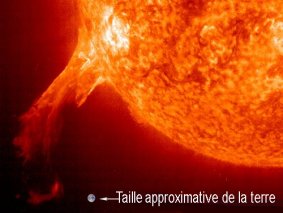
- De fait, le soleil n'est rien d'autre qu'une gigantesque bombe atomique, une bombe H pour être précis. Une bombe H dont la taille est d'un million de fois celle de la terre et qui brûle 600 millions de tonnes d'hydrogène par seconde. C'est d'ailleurs ce que nous essayons de reproduire, à toute petite échelle, sur terre dans le projet ITER à Cadarache. Ce sera sans doute très difficile, mais c'est un enjeu extraordinaire pour le futur du genre humain. Si l'homme parvient à domestiquer l'énergie de fusion (après avoir domestiqué celle de fission), les problèmes d'énergie seront résolus pour longtemps sur notre planète.
Corrélation entre la durée des cycles solaires et la température du globe
- Des chercheurs astrophysiciens Danois qui travaillent depuis une dizaine d'années sur ce problème ont eu l'idée originale de tracer sur un même graphique la température moyenne du globe de 1750 à 2000 (courbe blanche ci-contre) et la durée des cycles solaires pendant la même période (en jaune sur le même graphique).
-

- A moins d'être aveugle, on voit que cela a bien l'air d'être le cas !
- Pensée unique fr Le débat en cours sur le réchauffement climatique sous la loupe ...
L'effet de serre remis en question par des physiciens théoriciens !
- Le crédo de l'effet de serre est très sérieusement contesté par des physiciens théoriciens et thermodynamiciens qui expliquent que la théorie de l'effet de serre ne tient pas la route, viole les lois fondamentales de la physique et que certains calculs de température qui ont conduits aux chiffres mille fois répétés, sont absolument faux...
- Pensée unique fr L'effet de serre remis en question par des physiciens théoriciens!
- Pensée unique fr Paroles de grands chercheurs sur le réchauffement climatique
- Pensée unique fr Sept bonnes raisons de douter de l'effet de serre anthropogénique
Le climat : équilibrer ou affronter
-
Philosophie et Société
2009-10-16 fr
Le climat : équilibrer ou affronter
Source: Café Philo: Comptes rendus
↑ b Vincent Courtillot
-
Vincent Courtillot
2009-11-30 fr
La Terre et le réchauffement climatique
|
Vincent Courtillot *1948-03-06 |
Professeur de géophysique à l'université Denis-Diderot-Paris-VII. Directeur de l'Institut de Physique du Globe de Paris Membre de l'Académie des sciences ▶Vincent Courtillot: Who is who () (Skeptiker/Climat sceptique) ▶Vincent Courtillot: Video (Präsentationen) ▶Vincent Courtillot: Sites web (français) |
⇧ 5 de Präsentationen
S. Frederic (Fred) Singer | PhD, Professor Emeritus of Environmental Sciences, University of Virginia and former director Weather Satellite Service; Founder of the Science & Enviromental Policy Project |
|---|
-
de
Klimaforschung - Anspruch und Wirklichkeit - Prof. Fred Singer
In einer anschaulichen Präsentation zeigt Prof. Dr. Singer, dass kein kausaler Zusammenhang zwischen der CO2 Emission und der globalen Erwärmung besteht.
Verschiedene Professoren und Meteorologen |
|---|
Professor Philip Stott and others
-
en/fr sous-tiré
Climat in the past / climat dans le passé
de In diesem Video wird die wundervolle mittelalterliche Warmzeit (Medieval Warm Period) beschrieben, in der mit grossem Reichtum Kathedralen gebaut wurden.
In der darauffolgenden grausigen kleinen Eiszeit (Little Ice Age) herrschten Hungesnöte und es wurden "Hexen" verbrannt, denen, wie heute den CO2 Verursachern eine Schuld am Klima zugeschrieben wurde.
Vor diesen beiden Perioden gab es die noch mehrere wärmere, über 3'000 Jahre dauernde Perioden, wie das Holicene Maximum, in denen auch die Eisbären überlebt haben.
Es wird auch darauf hingewiesen, dass unmittelbar nach 1940, in der das vom Menschen verursachte CO2 stark zunahm, die Temperatur sank.
Es ist also auch heute nicht der Mensch, der
für den Klimawandel verantwortlich ist.
-
en/fr sous-tiré
L'arnaque du réchauffement climatique (partie 3)
Der Wasserplanet (Ernst-Georg Beck)
Der Wasserplanet war im Original auf dem Server von ZUM gespeichert.
Die Dateien wurden von Lehrern des ZUM entfernt,
die Dateinamen wurden belassen
(damit auch gleich Propaganda für ZUM gemacht werden kann)
Die Links führen heute nur noch auf die Homepage
von ZUM
auf denen nur noch der Mensch für den Klimawandel verantwortlich
gemacht wird.
Alle Hinweise auf natürliche Ursachen des
Klimawandels wurden gelöscht
(vom Server entfernt).
| ZUM | Zentrale für Unterrichtsmedien in Internet |
URL-Fehler: Falls Sie die richtige Seite finden, bitte URL senden.
Warum wurden diese Seiten gelöscht?
Bitte melden!
Wayback-Archiv: Suche gelöschter Webseiten
Zeichenerklärung: Links (Verweise) auf Seiten von ▷Wasserplanet │ ▶Vademecum
- Teile abschreiben und das Original entfernen ??
- die gleichen Links führen nun auf die neuen Seiten der Aktivisten des Verlags.
- Der Wasserplanet war das Lebenswerk von Ernst-Georg Beck, das er auch seinen ehemaligen Schülern hinterlassen wollte.
▶Der Wasserplanet (Ernst-Georg Beck)
▷Wasserplanet: Home (Wayback‑Archiv)
Vorwort zum Wasserplanet
Diese Seiten sollen umfassend über die Ursachen des Klimas und dessen Veränderung im Lauf der Erdgeschichte informieren.
Auch die Veränderung der Ozonschicht wird besprochen.
Heute wird allgemein der "Treibhauseffekt" bzw. der Mensch als Ursache angesehen und eine Klimakatastrophe an die Wand gemalt.
Es ist nicht Ziel dieser Seite die Bemühungen zu untergraben, die Umweltverträglichkeit der menschlichen Zivilisation zu verbessern sondern u.a. den derzeitigen Mißbrauch der Wissenschaft aufzuzeigen.
Dabei wurden Hunderte Quellen der letzten 200 Jahre der Naturwissenschaftsgeschichte ausgewertet.
Kaum eine wissenschaftliche Theorie hat in den letzten Jahrzehnten eine derartig schnelle Verbreitung in der Bevölkerung gefunden und dies, obwohl eine der größten wissenschaftlichen Irrlehren des 20. Jahrhunderts zugrunde liegt.
Der Wasserplanet / Ernst-Georg Beck
de
- Die letzten 10'000 Jahre
- Die letzten 450'000 Jahre
- Die letzten 100 Millionen Jahre
- Die letzten 600 Millionen Jahre
- Teile abschreiben und das Original entfernen ??
- die gleichen Links führen nun auf die neuen Seiten der Aktivisten des Verlags.
- Der Wasserplanet war das Lebenswerk von Ernst-Georg Beck, das er auch seinen ehemaligen Schülern hinterlassen wollte.
▶Der Wasserplanet (Ernst-Georg Beck)
Der Wasserplanet / Ernst-Georg Beck
de
▷Klimänderung heute
(Wayback ohne Bilder)
- Meßdaten (Thermometer Erde, Ballon und Satellit)
- Teile abschreiben und das Original entfernen ??
- die gleichen Links führen nun auf die neuen Seiten der Aktivisten des Verlags.
- Der Wasserplanet war das Lebenswerk von Ernst-Georg Beck, das er auch seinen ehemaligen Schülern hinterlassen wollte.
▶Der Wasserplanet (Ernst-Georg Beck)
Der Wasserplanet / Ernst-Georg Beck
de
▷Spuren aus der Vergangenheit - Proxydaten
(Wayback ohne Bilder)
- Direkte Messungen von Klimaparametern
- Historische Daten von Klimaindikatoren
- Eisbohrkerne
- Jahresringe von Bäumen (Dendrochronologie)
- Höhlenablagerungen (Speleotherme; Stalagmiten/Stalagtiten)
- Paläozeanographie (Ozeanische Sedimente, Planktonfossilien usw.)
- Teile abschreiben und das Original entfernen ??
- die gleichen Links führen nun auf die neuen Seiten der Aktivisten des Verlags.
- Der Wasserplanet war das Lebenswerk von Ernst-Georg Beck, das er auch seinen ehemaligen Schülern hinterlassen wollte.
▶Der Wasserplanet (Ernst-Georg Beck)
Der Wasserplanet / Ernst-Georg Beck
de
▷Historische Daten zum Klima und zum "Treibhauseffekt"
(Wayback ohne Bilder)
- Der Treibhauseffekt hat eine fast 200 jährige Geschichte
- Teile abschreiben und das Original entfernen ??
- die gleichen Links führen nun auf die neuen Seiten der Aktivisten des Verlags.
- Der Wasserplanet war das Lebenswerk von Ernst-Georg Beck, das er auch seinen ehemaligen Schülern hinterlassen wollte.
▶Der Wasserplanet (Ernst-Georg Beck)
▶Klimawandel-Einführung ▶Historische Daten zum Klima und zum "Treibhauseffekt
Der Wasserplanet / Ernst-Georg Beck
de
▷Der offizielle Treibhauseffekt
(Wayback ohne Bilder)
- Zitat: "Es ist billiger, jetzt alternative Energien zu fördern als im Jahr 2050 pausenlos Gewitterschäden zu beseitigen." (Prof. Dr. Mojib Latif, Institut für Meereskunde Kiel)
- Teile abschreiben und das Original entfernen ??
- die gleichen Links führen nun auf die neuen Seiten der Aktivisten des Verlags.
- Der Wasserplanet war das Lebenswerk von Ernst-Georg Beck, das er auch seinen ehemaligen Schülern hinterlassen wollte.
▶Der Wasserplanet (Ernst-Georg Beck)
Der Wasserplanet / Ernst-Georg Beck
de
▷Dichtung und Wahrheit
(Wayback ohne Bilder)
- Der Begriff "Treibhauseffekt"
- Naturgesetze, Klimageschichte und tausende wissenschaftliche Studien;
- Den derzeit offiziell beschriebenen "Treibhauseffekt" gibt es nicht!!!
- Es gibt außer Wasserdampf in der Atmosphäre keinen anderen wirksamen Wärmetransporter !!!
- Die Temperaturvariabilität der Erdgeschichte ist ein natürlicher Prozess
- Die aktuelle Klimapolitik (siehe Kyoto-Protokoll) ist vernunftswidrig
- Die Begriffe "Treibhauseffekt" und "Treibhausgase", Klimakiller, Klimaschutz,
Klimarettung sind unzutreffende Bezeichnungen
- Die Ursachen der globalen Erwärmung sind nur in paläoklimatischen Zusammenhängen zu sehen
und weitgehend solaren und astrophysikalischen Ursprungs
- Die steigenden CO₂-Konzentrationen sind wesentlich eine Folge der Verschiebung des C-Gleichgewichtes
bzw. einer Erwärmung der Ozeane und positiv für die Natur
- Die Wärmespeicherfähigkeit der Ozeane spielen eine entscheidende Rolle beim globalen Klima.
- Teile abschreiben und das Original entfernen ??
- die gleichen Links führen nun auf die neuen Seiten der Aktivisten des Verlags.
- Der Wasserplanet war das Lebenswerk von Ernst-Georg Beck, das er auch seinen ehemaligen Schülern hinterlassen wollte.
▶Der Wasserplanet (Ernst-Georg Beck)
▶Aspekt: Kritik am Treibhauseffekt und an der Gegenstrahlung
▶Effekt: Kritik am Treibhauseffekt und an der Gegenstrahlung
▶Ernst-Georg Beck: Wasserplanet / Dichtung und Wahrheit:
Stefan Rahmstorf
Der Wasserplanet / Ernst-Georg Beck
de
▷Junk Science und Kritik
(Wayback ohne Bilder)
- Daten aus Eisbohrkernen der Antarktis
- Die Hockey-Stick-Kurve!
- Teile abschreiben und das Original entfernen ??
- die gleichen Links führen nun auf die neuen Seiten der Aktivisten des Verlags.
- Der Wasserplanet war das Lebenswerk von Ernst-Georg Beck, das er auch seinen ehemaligen Schülern hinterlassen wollte.
▶Der Wasserplanet (Ernst-Georg Beck)
▶Fehler der Klimamacher ( I ⁄ II ) ►Klima-Modelle ▶IPCC-Probleme
Der Wasserplanet / Ernst-Georg Beck
de
▷Ursachen des Klimawandels
(Wayback‑Archiv)
- Milankovitch-Zyklen (Periodendauer von ca. 41 000 Jahren)
- Klimabeeinflussung durch Variation der Sonnenaktivitäten
(Abschirmeffekt des Sonnenwindes
vor den kosmischen Strahlen)
- Klimabeeinflussung durch kosmische Strahlung
Bei größerer Sonnenaktivität wächst auch das Magnetfeld
der Sonne
und kosmische Strahlung wird von der Erde weggelenkt.
(Dadurch entstehen weniger tiefliegende Wolken
und die Erde wird wärmer)
- Teile abschreiben und das Original entfernen ??
- die gleichen Links führen nun auf die neuen Seiten der Aktivisten des Verlags.
- Der Wasserplanet war das Lebenswerk von Ernst-Georg Beck, das er auch seinen ehemaligen Schülern hinterlassen wollte.
▶Der Wasserplanet (Ernst-Georg Beck)
Der Wasserplanet / Ernst-Georg Beck
de
▷Was ist Klima und wodurch wird es gesteuert?
(Wayback‑Archiv)
- Klima ist Wetter/Zeit!
- Grundlegende Klimaelemente
- Die Erde als "Wasserplanet"
- Der Kohlenstoffzyklus
- Daten aus Eisbohrkernen der Antarktis
- Zuerst kam die Wärme, dann die CO₂-Ausgasung!
- Das zyklisches Auftreten von Kalt- und Warmzeiten
- Teile abschreiben und das Original entfernen ??
- die gleichen Links führen nun auf die neuen Seiten der Aktivisten des Verlags.
- Der Wasserplanet war das Lebenswerk von Ernst-Georg Beck, das er auch seinen ehemaligen Schülern hinterlassen wollte.
▶Der Wasserplanet (Ernst-Georg Beck)
Der Wasserplanet / Ernst-Georg Beck
de
▷Wetterentstehung und Klima
(Wayback ohne Bilder)
- Klima = Wetter/Zeit; Wie entsteht das Wetter ?
- Klimazonen der Erde
- Wetterphänomen El Nino
- Teile abschreiben und das Original entfernen ??
- die gleichen Links führen nun auf die neuen Seiten der Aktivisten des Verlags.
- Der Wasserplanet war das Lebenswerk von Ernst-Georg Beck, das er auch seinen ehemaligen Schülern hinterlassen wollte.
▶Der Wasserplanet (Ernst-Georg Beck)
Der Wasserplanet / Ernst-Georg Beck
de
▷Atmosphäre und Wetterentstehung
(Wayback ohne Bilder)
- Die Erde besitzt im Gegensatz zu Mars und Venus eine Stickstoffatmosphäre.
Die Atmosphäre der anderen beiden Planeten enthält fast zu
100% Kohlenstoffdioxid.
- Die Struktur der Erdatmosphäre
- Zusammensetzung trockener Luft in Vol%
- Relative Luftfeuchtigkeit
Der Wasserplanet / Ernst-Georg Beck
de
▷Sonnenwind & kosmische Strahlung
(Wayback‑Archiv)
- Sonnenflecken - Sonnenwind
- Gleissbergzyklus (83 Jahre)
Dieser Zyklus ist die 2. harmonische Schwingung eines
166-jährigen Zyklus
und moduliert den 11-jährigen Sonnenzyklus.
- Sonnenwind
Bestehend hauptsächlich aus geladenen Teilchen, d.h.
Ionen, Alpha-Teilchen und Elektronen.
- Kosmische Strahlung
Sie stammen hauptsächlich von entfernten Bereichen unserer
Milchstraße (ca. 100'000/sec)
- Wolkenbildung
In der Atmosphäre entstehen unter der Einwirkung kosmischer
Strahlung z.B. Wolken, bevorzugt in der unteren Troposphäre.
Eine Verstärkung der unteren Wolkenbildung sorgt so für globale
Kühlung.
- Teile abschreiben und das Original entfernen ??
- die gleichen Links führen nun auf die neuen Seiten der Aktivisten des Verlags.
- Der Wasserplanet war das Lebenswerk von Ernst-Georg Beck, das er auch seinen ehemaligen Schülern hinterlassen wollte.
▶Der Wasserplanet (Ernst-Georg Beck)
Der Wasserplanet / Ernst-Georg Beck
de
▷Was ist Wärme?
(Wayback‑Archiv)
- Es gibt 3 Arten von Wärme
- Temperatur
- Wärme
- Teilchenbewegung (Diffusion)
- Fazit aus der Thermodynamik und Quantentheorie:
- In 11 Km Höhe strahlt CO₂ zwar, jedoch die Konzentration
ist insgesamt bekanntlich so klein,
daß eine Erwärmung durch CO₂ in der Atmosphäre minimal
ist.
- CO₂ wirkt wegen der geringen Konzentration und
Strahlungsemission in Erdnähe nur minimal als Treibhausgas!!!
Methan, Ozon usw. sind aus denselben Gründen fast wirkungslos!!!
- Teile abschreiben und das Original entfernen ??
- die gleichen Links führen nun auf die neuen Seiten der Aktivisten des Verlags.
- Der Wasserplanet war das Lebenswerk von Ernst-Georg Beck, das er auch seinen ehemaligen Schülern hinterlassen wollte.
▶Der Wasserplanet (Ernst-Georg Beck)
Der Wasserplanet / Ernst-Georg Beck
de
▷Wärme an der Erdoberfläche
(Wayback‑Archiv)
- Wärme an der Erdoberfläche
- Strahlung der Sonne
- Sonnenwind - Sonneneruptionen
- Wolken, Aerosole
- Geothermische Wärme
- Zellatmung der Organismen
- Teile abschreiben und das Original entfernen ??
- die gleichen Links führen nun auf die neuen Seiten der Aktivisten des Verlags.
- Der Wasserplanet war das Lebenswerk von Ernst-Georg Beck, das er auch seinen ehemaligen Schülern hinterlassen wollte.
▶Der Wasserplanet (Ernst-Georg Beck)
Der Wasserplanet / Ernst-Georg Beck
de
▷Kohlenstoff-Kreislauf
(Wayback ohne Bilder)
- Kohlenstoff-Kreislauf
- 1. Biosphäre/Atmosphären-Zyklus
- 2. Lithosphären/Platten-Zyklus
- 3. Gesteinszyklus
- Kohlenstoff-Zyklus
- Grundsätzliche Analyse des globalen C-Gleichgewichts
- Teile abschreiben und das Original entfernen ??
- die gleichen Links führen nun auf die neuen Seiten der Aktivisten des Verlags.
- Der Wasserplanet war das Lebenswerk von Ernst-Georg Beck, das er auch seinen ehemaligen Schülern hinterlassen wollte.
▶Der Wasserplanet (Ernst-Georg Beck)
Der Wasserplanet / Ernst-Georg Beck
de
▷Chemische Eigenschaften CO2
(Wayback ohne Bilder)
- Chemische Eigenschaften CO₂
- Lithosphären-Plattenzyklus
- Kalkgleichgewicht
- Teile abschreiben und das Original entfernen ??
- die gleichen Links führen nun auf die neuen Seiten der Aktivisten des Verlags.
- Der Wasserplanet war das Lebenswerk von Ernst-Georg Beck, das er auch seinen ehemaligen Schülern hinterlassen wollte.
▶Der Wasserplanet (Ernst-Georg Beck)
Der Wasserplanet / Ernst-Georg Beck
de
▷CO2, ein essentieller Naturstoff
(Wayback ohne Bilder)
- Physikalische Eigenschaften
- Löslichkeit in Wasser
- Strahlungseigenschaften von CO₂
- Absorptionsspektrum von CO₂ und Wasserdampf
- Messungen und Rekonstruktionen der CO₂-Konzentration und des CO₂-Flusses
- Daten aus Eisbohrkernen der Antarktis
- CO₂-Zyklus auf dem Mars
- Teile abschreiben und das Original entfernen ??
- die gleichen Links führen nun auf die neuen Seiten der Aktivisten des Verlags.
- Der Wasserplanet war das Lebenswerk von Ernst-Georg Beck, das er auch seinen ehemaligen Schülern hinterlassen wollte.
▶Der Wasserplanet (Ernst-Georg Beck)
▶Kohlenstoffdioxid (CO2) ▶Biosphäre (Auswirkung auf Lebewelt)
Der Wasserplanet / Ernst-Georg Beck
de
▷CO2, ein essentieller Naturstoff
(Wayback ohne Bilder)
- Die Photosynthese
- Die grünen Lungen der Erde
- Die derzeitige CO₂-Konzentration ist für Pflanzen unteroptimal
- Aus den Photosyntheseprodukten wird die gesamte Biomasse einer Pflanze gebildet
- CO₂ dient zur Aufrechterhaltung des Blut-pH- Wertes
- Harnstoffzyklus, Entgiftung des Ammoniaks
- CO₂ wird von den meisten Organismen ausgeatmet
- Berechnung der durch Menschen ausgeatmeten CO₂-Menge/Jahr
(Dies ist ca. 7 % der weltweit emittierten zivilisatorischen
CO₂-Menge!
- Teile abschreiben und das Original entfernen ??
- die gleichen Links führen nun auf die neuen Seiten der Aktivisten des Verlags.
- Der Wasserplanet war das Lebenswerk von Ernst-Georg Beck, das er auch seinen ehemaligen Schülern hinterlassen wollte.
▶Der Wasserplanet (Ernst-Georg Beck)
Der Wasserplanet / Ernst-Georg Beck
de
▷Strahlung und Materie I
(Wayback‑Archiv)
- Was ist elektromagnetische Strahlung?
- Strahlungsgesetze (Kirchhoff)
Merksatz: Die Energie der Strahlung steigt, je kürzer die
Wellenlänge ist.
- Reflektion - Absorption - Transmission
- Absorption - Emission
- Teile abschreiben und das Original entfernen ??
- die gleichen Links führen nun auf die neuen Seiten der Aktivisten des Verlags.
- Der Wasserplanet war das Lebenswerk von Ernst-Georg Beck, das er auch seinen ehemaligen Schülern hinterlassen wollte.
▶Der Wasserplanet (Ernst-Georg Beck)
Der Wasserplanet / Ernst-Georg Beck
de
▷Strahlung und Materie II
(Wayback‑Archiv)
- Temperaturstrahlung verschiedener Objekte
- Wasserdampf ist mit Abstand wirkungsvollstes Treibhausgas.
- Die "Treibhauswirkung" der Spurengase ist deshalb minimal.
- Teile abschreiben und das Original entfernen ??
- die gleichen Links führen nun auf die neuen Seiten der Aktivisten des Verlags.
- Der Wasserplanet war das Lebenswerk von Ernst-Georg Beck, das er auch seinen ehemaligen Schülern hinterlassen wollte.
▶Der Wasserplanet (Ernst-Georg Beck)
Der Wasserplanet / Ernst-Georg Beck
de
▷Der hydrologische Zyklus
(Wayback‑Archiv)
- Historische Daten zu Ozon
- Es gibt keinen atmosphärischen "Treibhauseffekt"!
- Der fiktive Treibhauseffekt
- Anthropogener "Treibhauseffekt"
Da die durch die Zivilisation eingebrachten Gase nur einen
Bruchteil der gesamten natürlichen Konzentrationen ausmachen
ist die Wirkung dieser Spurengase nachweislich minimal
im Vergleich zu anderen Faktoren vor allem Wolken.
- Spurengase sind nicht klimawirksam
- Druckgradient der Atmosphäre
- Teile abschreiben und das Original entfernen ??
- die gleichen Links führen nun auf die neuen Seiten der Aktivisten des Verlags.
- Der Wasserplanet war das Lebenswerk von Ernst-Georg Beck, das er auch seinen ehemaligen Schülern hinterlassen wollte.
▶Der Wasserplanet (Ernst-Georg Beck)
Der Wasserplanet / Ernst-Georg Beck
de
▷Pole, Gletscher, Meeresspiegel
(Wayback ohne Bilder)
- Pole (Arktis, Antarktis) und Grönland:
- Die Arktis
- Grönland
- Antarktis
- Gletscher
- Messungen der Meerespiegel
- Theoretische Betrachtung
- Teile abschreiben und das Original entfernen ??
- die gleichen Links führen nun auf die neuen Seiten der Aktivisten des Verlags.
- Der Wasserplanet war das Lebenswerk von Ernst-Georg Beck, das er auch seinen ehemaligen Schülern hinterlassen wollte.
▶Der Wasserplanet (Ernst-Georg Beck)
Der Wasserplanet / Ernst-Georg Beck
de
▷Historische Daten zu Ozon
(Wayback ohne Bilder)
- OZON hat eine 220 jährige Geschichte
- Teile abschreiben und das Original entfernen ??
- die gleichen Links führen nun auf die neuen Seiten der Aktivisten des Verlags.
- Der Wasserplanet war das Lebenswerk von Ernst-Georg Beck, das er auch seinen ehemaligen Schülern hinterlassen wollte.
▶Der Wasserplanet (Ernst-Georg Beck)
Der Wasserplanet / Ernst-Georg Beck
de
▷Ozon in der Stratosphäre Teil I
(Wayback ohne Bilder)
- Entstehung
- Ozonzyklus
- Blitze, NOx und Ozon
- Zweifel an diesen Behauptungen ...
Die Wirkung ist millionenmal stärker als bisher angenommen.
- Teile abschreiben und das Original entfernen ??
- die gleichen Links führen nun auf die neuen Seiten der Aktivisten des Verlags.
- Der Wasserplanet war das Lebenswerk von Ernst-Georg Beck, das er auch seinen ehemaligen Schülern hinterlassen wollte.
▶Der Wasserplanet (Ernst-Georg Beck)
Der Wasserplanet / Ernst-Georg Beck
de
▷Mechanismen der Ozonschwankung
(Seite gelöscht, kein Wayback)
- Teile abschreiben und das Original entfernen ??
- die gleichen Links führen nun auf die neuen Seiten der Aktivisten des Verlags.
- Der Wasserplanet war das Lebenswerk von Ernst-Georg Beck, das er auch seinen ehemaligen Schülern hinterlassen wollte.
▶Der Wasserplanet (Ernst-Georg Beck)
Der Wasserplanet / Ernst-Georg Beck
de
▷Zusammenfassung: Basis für Politik und Weltanschauung
(Wayback ohne Bilder)
-
▷ Die offizielle Theorie als Basis für Politik
und Weltanschauung
Auszüge aus den obigen aktuellen Broschüren des Umweltbundesamtes
und Ihre Widerlegung
-
▷ 4 Killer-Points zum "Treibhauseffekt"
Warum es keinen Treibhauseffekt gibt!
- CO₂ ist lebensnotwendig für Mensch und Natur!
- Klimawandel ist ein natürlicher Prozess!
- Die offiziellen Klimamodelle übertreiben, sind spekulativ und ungenau!
- Warum es KEINEN Treibhauseffekt gibt!
- Warum der Mensch NICHT die Ozonschicht zerstört!
- Naturwissenschaftliche Objektivität hängt nicht von der Verbreitung in den Medien oder in der Bevölkerung ab!
- Teile abschreiben und das Original entfernen ??
- die gleichen Links führen nun auf die neuen Seiten der Aktivisten des Verlags.
- Der Wasserplanet war das Lebenswerk von Ernst-Georg Beck, das er auch seinen ehemaligen Schülern hinterlassen wollte.
▶Der Wasserplanet (Ernst-Georg Beck)
Der Wasserplanet / Ernst-Georg Beck
de
▷Fazit (die Realität gegen den Trend)
(Wayback‑Archiv)
- Der Mensch beeinflußt NICHT das globale Klima!
- Der Mensch zerstört NICHT die Ozonschicht!
- Argumente gegen die Verdummung
- Teile abschreiben und das Original entfernen ??
- die gleichen Links führen nun auf die neuen Seiten der Aktivisten des Verlags.
- Der Wasserplanet war das Lebenswerk von Ernst-Georg Beck, das er auch seinen ehemaligen Schülern hinterlassen wollte.
▶Der Wasserplanet (Ernst-Georg Beck)
Der Wasserplanet / Ernst-Georg Beck
de
▷Quellen: Links zum Wasserplanet
(Wayback‑Archiv)
- Strahlung
- Wärme und Physik
- Temperatur und Klima auf der Erde
- Fernerkundung:
- Ursache der Klimaschwankungen
- Alles zu CO₂
- Offizieller Treibhauseffekt
- Geschichte des Treibhauseffektes
- Ozonproblematik:
- Teile abschreiben und das Original entfernen ??
- die gleichen Links führen nun auf die neuen Seiten der Aktivisten des Verlags.
- Der Wasserplanet war das Lebenswerk von Ernst-Georg Beck, das er auch seinen ehemaligen Schülern hinterlassen wollte.
▶Der Wasserplanet (Ernst-Georg Beck)
Der Wasserplanet / Ernst-Georg Beck
de
▷Der Autor
(Wayback‑Archiv)
Ernst-Georg Beck, Jahrgang 1948 verbrachte den ersten Teil seiner Jugend in seiner Geburtsstadt Karlsruhe.
1960 zog er mit seinen Eltern nach Freiburg im Breisgau, wo er am Rotteck-Gymnasium 1968 das Abitur machte.
Anschließend begann er an der Freiburger Albert-Ludwigs-Universität das Studium der Biologie,
was - unterbrochen durch eine 18 monatige Wehrzeit - 1976 mit dem Diplom abgeschlossen wurde.
Seit 1969 beschäftigte er sich intensiv mit Elektroakustik und seit 1980 mit Informatik.
Seit seinem Eintritt in den Schuldienst 1978 arbeitet er als Lehrer für Biologie, Chemie, Ernährungslehre und Informatik an einem beruflichen Gymnasium.
Diese Dokumentation findet (*) man im Internet unter: http://www.egbeck/treibhaus/
Weitere Bücher des Autors im Internet:
Biokurs 2003 (http://www.biokurs.de/skripten/bkurse1.htm)
und Chemiekurs 2002 (http://www.biokurs.de/chemkurs/skripten/ckurse1.htm)
(*fand)
- Teile abschreiben und das Original entfernen ??
- die gleichen Links führen nun auf die neuen Seiten der Aktivisten des Verlags.
- Der Wasserplanet war das Lebenswerk von Ernst-Georg Beck, das er auch seinen ehemaligen Schülern hinterlassen wollte.
▶Der Wasserplanet (Ernst-Georg Beck)
Diverse Publikationen aus dem Wasserplaneten, hier mit Bildern
-
Dimag / Ernst-Georg Beck
2003-08-01 de ▷ 4 Killer-Points zum "Treibhauseffekt"Die Erde ist kein Treibhaus!
CO₂ ist lebensnotwendig für Mensch und Natur!
Der Klimawandel ist ein natürlicher Prozess!
Die offiziellen Klimamodelle übertreiben, sind spekulativ und ungenau!
Aus dem Wasserplaneten, hier aber mit Bildern:
Der Wasserplanet / Ernst-Georg Beck
de ▷Zusammenfassung: Basis für Politik und Weltanschauung (Wayback ohne Bilder)- ▷ Die offizielle Theorie als Basis für Politik und Weltanschauung
Auszüge aus den obigen aktuellen Broschüren des Umweltbundesamtes und Ihre Widerlegung- ▷ 4 Killer-Points zum "Treibhauseffekt"
Warum es keinen Treibhauseffekt gibt!
- CO₂ ist lebensnotwendig für Mensch und Natur!
- Klimawandel ist ein natürlicher Prozess!
- Die offiziellen Klimamodelle übertreiben, sind spekulativ und ungenau!
- Warum es KEINEN Treibhauseffekt gibt!
- Warum der Mensch NICHT die Ozonschicht zerstört!
- Naturwissenschaftliche Objektivität hängt nicht von der Verbreitung in den Medien oder in der Bevölkerung ab!
Der Wasseplanet von Ernst-Georg Beck wurde anscheinend nach dem Ableben von Beck von der Zentrale für Unterrichtsmedien (ZUM) aus offensichtlich ideologischen Gründen mit sämtlichen Spuren zu Beck vom ZUM-Server gelöscht.
- Teile abschreiben und das Original entfernen ??
- die gleichen Links führen nun auf die neuen Seiten der Aktivisten des Verlags.
- Der Wasserplanet war das Lebenswerk von Ernst-Georg Beck, das er auch seinen ehemaligen Schülern hinterlassen wollte.
▶Der Wasserplanet (Ernst-Georg Beck)
-
Dimag / Ernst-Georg Beck
2004-06 de ▷ Die offizielle Theorie als Basis für Politik und WeltanschauungAuszüge aus den obigen aktuellen Broschüren des Umweltbundesamtes und Ihre Widerlegung
Aus dem Wasserplaneten, hier aber mit Bildern:
Der Wasserplanet / Ernst-Georg Beck
de ▷Zusammenfassung: Basis für Politik und Weltanschauung (Wayback ohne Bilder)- ▷ Die offizielle Theorie als Basis für Politik und Weltanschauung
Auszüge aus den obigen aktuellen Broschüren des Umweltbundesamtes und Ihre Widerlegung- ▷ 4 Killer-Points zum "Treibhauseffekt"
Warum es keinen Treibhauseffekt gibt!
- CO₂ ist lebensnotwendig für Mensch und Natur!
- Klimawandel ist ein natürlicher Prozess!
- Die offiziellen Klimamodelle übertreiben, sind spekulativ und ungenau!
- Warum es KEINEN Treibhauseffekt gibt!
- Warum der Mensch NICHT die Ozonschicht zerstört!
- Naturwissenschaftliche Objektivität hängt nicht von der Verbreitung in den Medien oder in der Bevölkerung ab!
Der Wasseplanet von Ernst-Georg Beck wurde anscheinend nach dem Ableben von Beck von der Zentrale für Unterrichtsmedien (ZUM) aus offensichtlich ideologischen Gründen mit sämtlichen Spuren zu Beck vom ZUM-Server gelöscht.
- Teile abschreiben und das Original entfernen ??
- die gleichen Links führen nun auf die neuen Seiten der Aktivisten des Verlags.
- Der Wasserplanet war das Lebenswerk von Ernst-Georg Beck, das er auch seinen ehemaligen Schülern hinterlassen wollte.
▶Der Wasserplanet (Ernst-Georg Beck)
Weitere gelöschte Webseiten
Ernst-Georg Beck
▷Temperaturdaten 1000 Jahre
(Wayback ohne Bilder)
⇧ 6 en Presentations
Friends of Science |
|---|
-
en
Video on the influence of the sun, Climate History and temperature curves.
de Dies ist die Neuausgabe eines Vidoos, das die Kontroverse sehr gut beschreibt. Es werden auch die Forschungen der CO2-Analysen der Vergangenheit von Ernst-Georg Beck berücksichtigt, die nachweisen, dass das Kyoto-Protokoll auf falschen Annahmen basiert.
Climate Catastrophe Cancelled (second edition)
1/3 (09:46) en
Influence of the sun/
Einfluss der Sonne
2/3 (09:57) en
Wrong temperature curves/
Falsche Temperaturkurven
3/3 (10:15) en
IPCC fiasco/
IPCC Fehlschlag
Nature, Not Human Activity, Rules the Climate
Professor S. Frederic (Fred) Singer
-
S. Fred Singer
2010-02-14 en
Nature, Not Human Activity, Rules the Climate
Prof. S. Fred Singer discusses Nature-Not Human Activity-Rules the Climate, lecture given in the Faculty of Physics on Feb. 14, 2010
-
NIPCC-Report / S. Fred Singer
2008-04 en
Nature, Not Human Activity, Rules the Climate
-
2008-04 fr
C'est la nature et non l'activité humaine qui détermind le climat
|
Nongovernmental International Panel on Climate Change (Internationale Nichtregierungskommission zum Klimawandel) ▶NIPCC: Organisation ▶NIPCC: Who is who (Skeptische Institute & Organisationen) ▶NIPCC: Präsentationen (Bilder & Grafiken) ▶NIPCC: Webseiten (Deutsch) ▶NIPCC: Webseiten (English) |
|
S. Frederic (Fred) Singer *1924-09-27 †2020-04-20 |
de
Prof. Dr. S. Fred Singer stammt aus Wien und ist Atmosphären-
und Raumfahrtphysiker und Gründer und Vorsitzender des Science
and Environmental Policy Project (SEPP) en PhD, Professor Emeritus of Environmental Sciences, University of Virginia; Former director Weather Satellite Service; Founder and President of the Science & Enviromental Policy Project ▶S. Frederic (Fred) Singer: Who is who (Skeptiker) ▶S. Frederic (Fred) Singer: Video (Präsentationen) ▶S. Frederic (Fred) Singer: Wikipedia (Opfer) ▶Ausschluss und Maulkorb für Kritiker (Jean-Pascal van Ypersele ⬌ Prof. Dr. Fred Singer) |
Science & social aspects of climate change
Professor Robert (Bob) M. Carter
-
en
5 Tests of CO2
Part 1 Part 2 -
en
Science & social aspects of climate change
Part 1 Part 2 Part 3 -
en
Climate Change - Is CO2 the cause?
Part 1 Part 2 Part 3 Part 4
⇧ 7 fr Présentations
Marcel Leroux |
Professeur de climatologie PhD, Professor Emeritus of Climatology, University Jean Moulin of Lyon, France; former director of Laboratory of Climatology, Risks and Environment, CNRS |
|---|
-
fr
Marcel Leroux, Climatologue
Le professeur de climatologie Marcel Leroux conteste l'idée qu'il existe un climat unifié dont la modification serait principalement due au gaz carbonique émis par les activités humaines. Dans cette vidéo réalisée par resiliencetv.fr, Marcel Leroux expose, argumente, avec beaucoup de pédagogie et d'exemples amusants. (19:23)
Commentaire fr Interview de Marcel Leroux, climatologue anti-effet de serre
C'est la nature et non l'activité humaine qui détermind le climat
-
Le rapport de NIPCC
2008 fr
C'est la nature et non l'activité humaine qui détermind le climat
Le changement climatique est-il d'origine humaine?
-
Climate Skeptic
2008-11-18 fr
Le changement climatique est-il d'origine humaine?
⇧
8 Wettbewerb: Die Herausforderung
en The Ultimate Global Warming Challenge (UGWC)
fr L'enjeu
JunkScience.com:
en The Ultimate Global Warming Challenge (UGWC)
$500,000 will be awarded to the first person to prove, in a scientific manner, that humans are causing harmful global warming. The winning entry will specifically reject both of the following two hypotheses:
UGWC Hypothesis 1
- Manmade emissions of greenhouse gases do not discernibly, significantly and predictably cause increases in global surface and tropospheric temperatures along with associated stratospheric cooling.
UGWC Hypothesis 2
-
UGWC Hypothesis 2
The benefits equal or exceed the costs of any increases in global temperature caused by manmade greenhouse gas emissions between the present time and the year 2100, when all global social, economic and environmental effects are considered.
-
JunkScience.com
2007-08-07 en The Ultimate Global Warming Challenge (UGWC)
| de | en | fr |
|---|---|---|
|
Klima-Skandal: Evaluation Herausforderung |
Climate Scandal: Evaluation Challenge |
Scandale climatique: Évaluation Provocation |