5.1.6 Voraussagen einer neuen Kälteperiode
en Predictions of a New Cold Period
fr Prédictions d'une nouvelle periode froide
| ⇨ | Klima: Wandel│ Fragen│ Wissenschaft│ Probleme│ Beurteilung│ Diskurse│ Auswirkungen | |||
| ⇩ | Klima-Skandal: Manipulation│ Realität│ Angst | |||
| ⇩ | Neue Kälteperiode: Kaltzeit│ Auswirkung | |||
Mit folgenden Links wird von anderen Webseiten auf diese Seite verwiesen:
▶Voraussagen einer neuen Kälteperiode
| de | en | fr |
|---|---|---|
|
Neue Kälteperiode Kaltzeit |
New Cold Period Cold Period |
Nouvelle periode froide Periode froide |
| Voraussagen | Predictions | Prédictions |
| Kälte: Warnungen | Cooling: Warnings | Refroidissement: Avertissements |
| Erwärmung: Entwarnung | Warming: All-Clear | Réchauffement: Fin de l'alerte |
| Eiszeiten | Ice Ages | Glaciations |
- Verzeichnis │ Allgemein │ Text
⇧ de Verzeichnis en Contents fr Sommaire
- 2023
- de
Globale Erwärmung wird eine Pause einlegen
Fritz Vahrenholt / Vaherholts Newsletter (2023-01-07)
neueste wissenschaftliche Untersuchungen zeigen für Europa,
dass es erst einmal 15-20 Jahre leicht bergab gehen wird.
- 2021
- de
Hochwasser als Ankündigung und Charakteristikum der Kleinen Eiszeit?
Axel Robert Göhring (EIKE) 2021-08-30) - de
 Wie lang dauert das solare Minimum?
(Klimaschau 50) - 2020
- de Kommt ein Dürresommer? Eine experimentelle Prognose auf Basis der schwankenden Sonnenaktivität
- de
Die wirkliche Klimakrise ist nicht die globale Erwärmung,
sondern globale Abkühlung - und vermutlich hat sie bereits begonnen
en The Real Climate Crisis Is Not Global Warming, It Is Cooling, And It May Have Already Started - 2019
- de
AMO-Zyklus auf dem absteigenden Ast:
Rotes Meer wird sich in den kommenden Jahrzehnten wohl abkühlen
en Natural Climate Oscillations may Counteract Red Sea Warming Over the Coming Decades - de Scientists for Future und der Club of Rome
- de Krankheiten: Fürchtet die Kälte, nicht die Wärme
- de Schnee im Mai 2019 - ein Vorbote der Klima-Abkühlung? ÿ2018
- de
Klimasensitivität - Wer rechnet hier falsch ?
Die Milchmädchen-Rechnung, die Klima-Politiker, Journalisten und etliche Klimatologen nicht machen können oder wollen, lautet wie folgt:
Bis zur Verdoppelung des CO2-Gehaltes von heute 400 auf 800 ppm vergehen bei den aktuellen Emissionen mit einem Anstieg von ca. 2 ppm pro Jahr noch 200 Jahre.
Das bedeutet real in 100 Jahren ca. + 1,5°C - genau das, was sich Politiker bei der Pariser Konferenz so vorgestellt haben, aber ohne kostspielige und risikoreiche CO2-Verminderungsmaßnahmen.
- de Wir sollten jetzt die realen und nachteiligen Folgen von Abkühlung fürchten
- de
Ach wie gut, dass niemand weiß, dass ich PDO heiß'
Ähnlichkeit der Temperaturentwicklung in den USA während der Sommermonate mit dem Verlauf des PDO-Ozeanzyklus
- 2017
- en 7 New (2017) Papers Forecast Global Cooling, Another Little Ice Age Will Begin Soon
- de Die Sonne im Oktober 2017 und das Christ-Mädchen vor der Tür
- de Milder Oktober 2017: Eine bloße Laune der Natur?
- de Hat die globale Abkühlung begonnen?
- de Hartmut Hüne: Haben Sonnenwind und Planetenstellungen Einfluss auf unser Wetter bzw. Klima?
- en
Correlation of Accumulated Cyclone Energy and Atlantic Multidecadal
Oscillations
Mittelfristig lässt sich die Hurrikanaktivität ganz gut vorhersagen, denn sie ist eng an den AMO-Ozeanzyklus gekoppelt, die Atlantische Multidekadenoszillation, die eine Periodizität von 60 Jahren besitzt. - de Erster Sonnenfleck des neuen Sonnenzyklus Nr. 25 ist da! Schwache Sonne - kühle Erde!
- de
Temperaturschwankungen der letzten 450.000 Jahre
Holozän Interglaziale Epoche: 8000 BC - 2000AC
en Temperature record for the last 450.000 years
Holocene interglacial epoch: 8000BC - 2000AC - en
Mini Ice Age by 2021 not 2024, Every Continent Will be Affected
- de
SNF: Einfluss der Sonne auf den Klimawandel erstmals beziffert
en SNF: Current Weak Solar Cycle Could Reduce Global Temperatures By Half A Degree - en Russian scientists predict global cooling in the next few decades
- de Unheimliche Korrelation zwischen Sonnenaktivität und Temperatur: Ganz sicher kein Zusammenhang?
- 2016
- de
Beginnt die globale Abkühlung?
Globale Mitteltemperatur stürzt um mehr als 1 °C steil ab.
en Steepest drop in global temperature on record - de Sonne in der Krise. Warm anziehen!
- en
World Government Think Tanks Ready for Global Food Shortages:
Timeline and Which Countries
- de Forschergruppe um Michael Mann: Es könnte noch bis zu zwanzig Jahre dauern, bis die Erwärmung wieder kräftig anzieht
- en New NOAA forecast suggests current El Niño will fade fast, and be replaced by a strong cooling La Niña this year
- de Neue Eisbrecher, LNG und Ethanol
- de
Britischer Wetterdienst prognostiziert klimatische Abkühlung des
Südpolarmeeres und des östlichen tropischen Pazifik
en What global warming? Large parts of Earth expected to COOL over next five years - en Mini Ice Age 2015-2035
- de
Einfluss des El Nino
en Impact of the El Nino - 2015
- de
"Kleine Eiszeit" schon 2030
en Mini ice age in 2030 - en Joe Bastardi Sees Possible "Nasty Winter Shaping Up" In Europe As North Atlantic Cold Expands!
- en David Dilley: We Are Now Starting To See A Dramatic Cooling In The Arctic" - "Extremely Cold" From 2025 To 2050!
- de
Neue Geomar-Studie: Nordatlantik wird sich im kommenden Jahrzehnt leicht
abkühlen
en IPCC Scientist Mojib Latif Sees North Atlantic Cooling Over Next Decade... Confirms Oceans Play Crucial Role - 2014
- de
Sonnenflecken und steigende Weizenpreise
en Sunspots and Rising Grain Prices - de
Solarzyklenlänge und deren Konsequenzen
en Solar Cycle Length and Its Consequences - de Es gibt keine CO2-Erwärmung - Seit 1998 bewegen uns wieder auf eine kleine Eiszeit zu
- de
Erwartung: Der 'Big Chill' dauert noch bis 2040
en 'Big chill' expected to stay until 2040 - Major cooling cycle could match 'Little Ice Age' - 2013
- en Neue Arbeit in den Geophysical Research Letters: Ozeanzyklen führen in den kommenden 15 Jahren auf der Nordhalbkugel zu leichter Abkühlung
- de
Einhundert Jahre Vorhersage basiert auf Daten bis 2013
en One Hundred Year Forecast using data up to 2013 - de
Vorhersage der Sonnenaktivität für die kommenden 500 Jahre.
en Prediction of the solar activity for the coming 500 years - en Grand minimum of the Total Solar Irradiance leads to the Little Ice Age
- de
Der 'Stillstand' der globalen Erwärmung könnte 20 weitere Jahre andauern,
und das Arktische Meereis hat schon angefangen, sich zu regenerieren.
en Global warming 'pause' may last for 20 more years and Arctic sea ice has already started to recover - de Forscher befürchten neue Kleine Eiszeit
- de Zukünftige Temperaturenentwicklung in Deutschland - Wärmer oder Kälter? (Teil 1)
- de Leiter des russischen WWF-Klimaprogramms: 60-Jahres-Ozeanzyklus wird in den kommenden zwei Jahrzehnten voraussichtlich für Abkühlung sorgen
- de
Es ist die Sonne, Dummkopf - die geringe Bedeutung des
CO2
en It's the Sun stupid - The minor significance of CO2 -
de
Die NASA warnt: Die Erde könnte in eine Periode "globaler Abkühlung" eintreten
en NASA Warns Earth May Be Entering a Period of "Global Cooling" - en 2013-01-07 Joe Bastardi: "Models Portraying Severe Winter" For Europe. North America Forecast For Brutal Cold
- de
Met Office: Bis 2018 wird's nicht mehr wärmer!
Britisches Klimainstitut passt seine Modelle der Realität an.
en Major change in UK Met Office global warming forecast - de Eine Vorschau auf die globalen Mitteltemperaturen in 2013: Abkühlung in Sicht!
- de
Stimme Russlands: Die Welt vor einer Eiszeit
en Russian Scientists say period of global cooling ahead due to changes in the sun - de Zukünftige Temperaturenentwicklung in Deutschland - Wärmer oder Kälter?
- 2012
- de
de
Voraussagen für Winter 2012/13
en Predictions for Winter 2012/13 - de
Nationales Astronomisches Observatorium von Japan sagt Abkühlung voraus
en National Astronomical Observatory Of Japan: World May Be Entering Period Of Global Cooling - de
Einschätzung der Abkühlung im Sonnenzyklus 24
en Quantifying the Solar Cycle 24 Temperature Decline - 2011
- de
Norwegische Wissenschaftler sagen starke Abkühlung in der Arktis voraus
en Solar activity and Svalbard temperatures - en Archibald: Solar Based Climate Forecast to 2050
- en Lockwood et al: New paper suggests sun may be headed for a Maunder minimum
- en Chinese 2,485 year tree ring study shows natural cycles control climate, temps may cool til 2068
- 2010
- de
Easterbrook: Der Niedergang der Sonnenflecken -
Steht eine starke Abkühlung bevor?
en Easterbrook on the potential demise of sunspots
The demise of sunspots - Deep Cooling Ahead? - de
David Archibald: Formt sich eine Wiederholung des Dalton-Minimums aus?
en A Dalton Minimum Repeat is Shaping Up - en Lockwood demonstrates link between low sun and low temps
- 2009
- de
Schwacher Sonnenzyklus 24 erwartet - Abkühlung um 2°C möglich
en NASA now saying that a Dalton Minimum repeat is possible - de
SSRC (NASA): "Globale Erwärmung ist vorbei -
Eine neue Kaltzeit hat begonnen"
en SSRC (NASA): "Global warming is over - a new cold climate has arrived" - en Are Sunspots Disappearing?
- de
Henrik Svensmark: Während die Sonne schläft
en Henrik Svensmark: "global warming stopped and a cooling is beginning" - "enjoy global warming while it lasts" - de
2009-09: Schwacher El Niño könnte kalten Winter an der
US-Ostküste bedingen
en U.S. Northeast May Have Coldest Winter in a Decade - de
Kosmische Strahlung erreicht Rekordniveau - Steht globale
Abkühlung bevor?
en Cosmic Rays Hit Space Age High - fr Pourquoi risquons nous d'avoir froid dans les années qui viennent ?
- fr Et en cas de glaciation ... Avons nous un "Plan B"?
- 2008
- de Globale Abkühlung
- 2007
- de Khabibullo Abdusamatov: Mars gibt Hinweise auf künftige Kaltzeit auf der Erde
- 2005
- en Leif Svalgaard: Sunspot cycle 24: Smallest cycle in 100 years?
⇧ de Allgemein en General fr Générale


-
Wikipedia
de
Prognose
en Prediction
fr Prédiction dynamique
|
|
|


| de | en | fr |
|---|---|---|
|
Klimawandel: Probleme Prognosen und deren Probleme |
Climate change: Problems Predictions and their problems |
Climat: Problèmes Prédictions et leurs difficultées |
| de | en | fr |
|---|---|---|
|
Klima Geschichte Klima in der Zukunft |
Climate History Climate in the future |
Histoire du climat Climat dans le futur |
| de | en | fr |
|---|---|---|
| Neuste Informationen über den Klimawandel | News on Climate Change | Nouvelles informations sur le changement climatique |
| Die Erwärmungspause | The Hiatus | La pause du réchauffement climatique |
| de | en | fr |
|---|---|---|
|
Neue Kälteperiode Forschungsergebnisse und Hypothesen |
New Cold Period Research and Hypotheses |
Nouvelle periode froide Recherches et hypothèses |
| de | en | fr |
|---|---|---|
|
Klimawandel: Probleme Klima-Modelle |
Climate change: Problems Climate Models |
Climat: Problèmes Modèles climatiques |
| de | en | fr |
|---|---|---|
|
Klimawandel: Probleme Prognosen |
Climate change: Problems Prognostics |
Climat: Problèmes Pronostiques |
⇧ de Text en Text fr Texte
⇧ 2023
↑ Globale Erwärmung wird eine Pause einlegen
-
Klimanachrichten / Vahrenholts Newsletter
2023-01-07 de Globale Erwärmung wird eine Pause einlegen Satellitengestützten Messungen der University of Alabama (UAH)
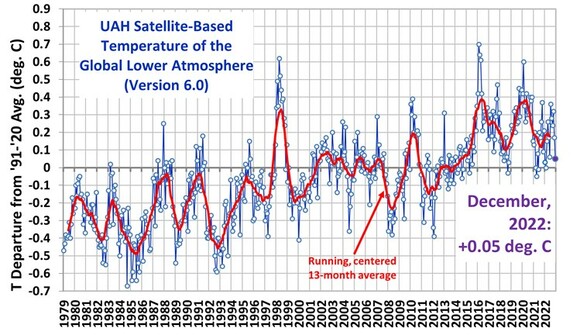
Bildet man den Durchschnitt der letzten Jahre,
so ist die globale Temperatur seit 8 Jahren und 4 Monaten konstant.
Im Dezember ist die Abweichung der globalen Temperatur
vom 30-jährigen Mittel der satellitengestützten Messungen
der University of Alabama (UAH)erneut gesunken und zwar auf 0,05 Grad Celsius. (siehe Grafik oben).
Zwar gibt es bis 2015 eine langjährige Temperatursteigerung.
Aber sie beträgt im Durchschnitt pro Jahrzehnt seit 1979 lediglich 0,13 Grad Celsius.
[also 13 tausendstel Grad pro Jahr, während den letzten 43 Jahren !]
Aber es kommt noch besser:
neueste wissenschaftliche Untersuchungen zeigen für Europa,
dass es erst einmal 15-20 Jahre leicht bergab gehen wird.
Studie in "Nature": Nord-Atlantik kühlt sich ab
Es sind klimawissenschaftliche Schwergewichte, die kürzlich im Nature Journal "climate and atmospheric science" Aufsehen erregten.
Katja Matthes, Direktorin des GEOMAR Helmholtz-Zentrums für Ozeanforschung in Kiel,
Johann Jungclaus vom Max-Planck Institut für Meteorologie in Hamburg
und Nour-Eddine Omrani vom norwegischen Bjerknes centre for climate research
veröffentlichten eine Untersuchung, die zeigt, dass wir
vor einer Abschwächung der Nordatlantischen Oszillation,
einer Abkühlung des Nord- Atlantiks
und damit verbunden einer globalen Temperaturentwicklung wie zwischen 1950 und 1970 stehen
( so die Autoren in ihrer Zusammenfassung).
npj Climate and Atmospheric Science volume
2022-07-13 en Coupled stratosphere-troposphere-Atlantic multidecadal oscillation and its importance for near-future climate projectionThis coupled variability improves the performance of statistical models, which project further weakening of North Atlantic Oscillation, North Atlantic cooling and hiatus in wintertime North Atlantic-Arctic sea-ice and global surface temperature just like the 1950s–1970s.
Die Grafik zeigt den Rückgang der Temperaturen des Nordatlantiks bis 2040.
Wegen des globalen Erwärmungstrends fallen die Temperaturen nicht wieder auf das Niveau der Jahre 1950 bis 1970 zurück, erläutert einer der Autoren, Eddine Omrani.
Die zu erwartende Erwärmungspause gibt uns Zeit - so Omrani-, um technische, politische und ökonomische Lösungen zu erarbeiten
vor der nächsten Erwärmungsphase, die etwa ab 2050 wieder Oberhand gewinnt.
Die Grafik zeigt den Rückgang der Temperaturen des Nordatlantiks
bis 2040.
Die nächste Erwärmungsphase wird erst ab 2050 wieder Oberhand gewinnen.

Die Veröffentlichung der Klimaforscher aus Kiel, Hamburg, Bergen, Venedig und Houston bringt uns eine weitere wichtige Erkenntnis.
Die Erwärmung der Jahre 1980 bis 2015 war massgeblich von der warmen Phase des Atlantiks geprägt.
Wir können abschätzen, dass ein bedeutender Teil der Erwärmung diesem natürlichen Zyklus zuzuschreiben ist.
Dieser Zeitraum wird aber u.a. zugrundegelegt um Temperaturprognosen in die Zukunft vorzunehmen.
Die Modelle schlagen aber den natürlichen Erwärmungsbeitrag dem CO₂-Effekt zu.
Dieser falsch berechnete, höhere CO₂-Effekt wird in die Zukunft fortgeschrieben.
Modelle, die die natürlichen zyklischen Einflüsse nicht berücksichtigen - und das können die Modelle noch nicht - kommen so zu viel zu starken Erwärmungsprognosen.
Es soll nicht unerwähnt bleiben, dass es eine Vielzahl von Veröffentlichungen gibt (etwa diese, an der Matthes und Omrani beteiligt waren, Solar forcing synchronizes decadal North Atlantic climate variability), die eine Kopplung der Stärke der Solarzyklen mit der Nordatlantischen Oszillation für wahrscheinlich halten.
Nature Communications
2015-09-15 en Solar forcing synchronizes decadal North Atlantic climate variabilityDer letzte Solarzyklus von 2008 bis 2019 war der schwächste seit 100 Jahren.
Der augenblickliche Zyklus entwickelt sich bislang genauso schwach.
Die Eindimensionalität der Klima- und Energiedebatte, die darin gipfelt,
dass allein die CO₂-Emissionen unsere Klima bestimmen, ist schon erschreckend.
▶Voraussagen einer neuen Kälteperiode
⇧ 2021
↑ Hochwasser als Ankündigung und Charakteristikum der Kleinen Eiszeit?
-
EIKE Europäisches Institut für Klima und Energie
Axel Robert Göhring
2021-08-30 de Hochwasser als Ankündigung und Charakteristikum der Kleinen Eiszeit?Die aktuellen heftigen Schneestürme in Nord und Süd und das häufiger auftretende Hochwasser könnten ein Zeichen des Klimawandels sein -
des natürlichen, und der bringt Kälte.
Das Mittelalter ging im 14. Jahrhundert zu Ende,
und mit ihm die Warmzeitära mit Bevölkerungsexplosion, Höhenburgenbau und ausgetrocknetem Rhein.
Als zentrales Ereignis wird die Pest von 1348 angesehen, die in einigen Städten und Gegenden bis zu drei Viertel der Bevölkerung auslöschte.
Im Laufe der Flut-Berichterstattung der vergangenen Wochen wurde das Magdalenenhochwasser häufiger erwähnt.
Und das war - 1342, sechs Jahre vor der Pest.
Ob ein direkter Zusammenhang besteht, können wir in einem Artikel nicht evaluieren, aber die zeitliche Nähe läßt den Verdacht aufkommen.
Die "Kleine Eiszeit" nach 1400, eigentlich "nur" eine Abkühlungsphase, ist immerhin von einigen Hochwasser-Ereignissen gekennzeichnet.
Ein Grund dafür könnte sein, daß warme Luft mehr Wasser aufnehmen kann und es sich daher seltener in Oberflächengewässern befindet.
Typisches Beispiel ist die "Thüringer Sintflut" von 1613, die mehrere Flüsse meterhoch ansteigen ließ und in Jena, Weimar, Erfurt, Stadtilm, Gotha und Apolda etliche Häuser zerstörte - und über 2.200 Menschen tötete, bei zehnfach geringerer Bevölkerung gegenüber heute.
Es gab seit 1997 mehrere Hochwasser-Ereignisse,
die zeitweilig die Medien beherrschten und Wahlen entschieden.
1997 - die Oderflut,
2002 - das Hochwasser in Bayern und Österreich,
2013 - die Flut im Osten,
2021 - die Flut im Rhein-Einzugsgebiet.
Es sieht nach Häufung aus, und das könnte ein Anzeichen für eine Abkühlung zumindest auf der Nordhalbkugel sein.
Zusammen mit den gewaltigen Schneefällen von Dezember bis Februar, und den derzeitigen Kälterekorden in Brasilien (Kaffee-Ernte fällt aus), kann sogar eine globale Abkühlung vermutet werden.
Ob die Vermutung stimmt, kann erst in 10, 20 Jahren geklärt werden;
Klima-Statistik ist von langen Datenreihen abhängig.
Eines ist aber jetzt schon sicher:
Waldbrände in Südamerika und Australien, und Hitzerekorde in Südeuropa und den Nordwest-USA sind kein Beweis für die Heißzeittheorie der Klima-Alarmisten, die exzellente Geschäfte machen.
| de | en | fr |
|---|---|---|
|
Wetterphänomene Auswirkungen auf Hochwasser/Überschwemmungen |
Weather phenomena Impacts on floods |
Phénomènes météorologiques Impact sur les inondations |
↑ Wie lang dauert das solare Minimum?
-
2021-11-07 de
Wie lang dauert das solare Minimum?
(K50)
▶Klimaschau Wird demnächst gelöscht, da die Kalte Sonne nicht mehr publiziert wird!


⇧ 2020
↑ Kommt ein Dürresommer? Eine experimentelle Prognose auf Basis der schwankenden Sonnenaktivität
-
Die kalte Sonne (Fritz Vahrenholt & Sebastian Lüning)
Dr. Ludger Laurenz
2020-04-19 de Kommt ein Dürresommer? Eine experimentelle Prognose auf Basis der schwankenden SonnenaktivitätDie schwankende Sonnenaktivität beeinflusst unser Wetter nach neueren Untersuchungen wesentlich stärker als gedacht.
Die Aktivität der Sonne schwankt in einem elfjährigen Zyklus, die Energie der Sonnenstrahlung ändert sich dabei aber nur um etwa 0,1 Prozent.
Dennoch beeinflusst die Variation der Sonnenstrahlung unser Wetter erheblich und für jeden spürbar.
Mögliche Verstärkermechanismen befinden sich noch in der Erforschung.
Laut folgender These wird der solare Einfluss auf unser Wetter erkennbar:
Der solare Einfluss auf unser Wetter wird sichtbar, wenn der Beginn des Sonnenzyklus auf das Jahr des Sonnenflecken-Maximums gelegt wird.
In jenem Jahr erzeugt die Sonne einen Startimpuls.
Ausgelöst durch diesen Impuls werden in jedem Zyklus für etwa 10 Jahre wiederkehrende Wettermuster gebildet.
Das betrifft alle Schichten der Atmosphäre.
Aus den wiederkehrenden Wettermustern lassen sich Trendprognosen erstellen.
Dazu hat der Autor in den letzten Monaten mehrere Beiträge verfasst (hier & hier).
-
Die Kalte Sonne / Dr. Ludger Laurenz
2010-03-06 de Handschrift der Sonne in Daten zahlreicher Wetterstationen fordert Meteorologen und Klimaforscher herausZusammenfassende Hypothesen
Im 11-jährigen Sonnenzyklus (Schwabezyklus) erzeugt die Sonne im Jahr des Sonnenfleckenmaximums einen Startimpuls.
Ausgelöst durch diesen Startimpuls werden in jedem Sonnenfleckenzyklus für etwa 10 Jahre ab dem Sonnenfleckenmaximum wiederkehrende Wettermuster gebildet.
Der Vergleich zwischen Sonnensignalen einzelner Stationen mit dem Sonnensignal im Mittelwert größerer Regionen hat gezeigt, dass der solare Einfluss an einzelnen Wetterstationen deutlicher ausgeprägt ist als in Mittelwerten über größere Regionen wie Bundesländer oder Staaten.
Das solare Wettermuster des Schwabezyklus ist beim Niederschlag ausgeprägter als bei der Sonnenscheindauer oder Temperatur.
Eigentlich dürfte es die gezeigten solaren Wettermuster nicht geben.
Sowohl der IPCC als auch führenden Klimaforschungs- und Klimafolgenforschungseinrichtungen in Deutschland betonen bis heute, dass von der Sonne kein bedeutender Einfluss auf den Wettertrend ausgehen kann.
Dafür sei die Variabilität der Sonnenaktivität innerhalb des Schwabezyklus viel zu gering.
Mit diesem Beitrag werden insbesondere die Klimawissenschaftler angesprochen,
die den aktuellen Klimawandel fast allein auf die Zunahme der CO₂-Konzentration zurückführen
und zur Stellungnahme hinsichtlich des nachgewiesenen solaren Einflusses auf den Wettertrend aufgefordert.
Mit dem aufgezeigten solaren Einfluss wird die Argumentation gestützt, dass die Sonne der Haupttreiber für Klimaveränderungen und die aktuelle Warmzeit ist.
Die im ersten KALTESONNE-Beitrag dargestellte positive Korrelation zwischen der Anzahl der Sonnenflecken im Jahr des Fleckenmaximums und der Temperaturanomalie im äquatorialen Pazifik unterstützt die Annahme, dass die globale Erwärmung der letzten Jahrzehnte solar beeinflusst ist (s. bit.ly/2VIKA7R, Abbildung 7).
Mit Hilfe der These vom Impuls der Sonne im Jahr des Fleckenmaximums sind erstmalig Prognosen des monatlichen Niederschlagstrends bis zu 10 Jahre im Voraus möglich.
Die bisher gefundenen Muster sind aber nur in 10 bis 20 Prozent des Jahres so eindeutig, dass eine Trendprognose Sinn ergibt.
Auch in der restlichen Zeit des Jahres ist ein solarer Einfluss auf die Wettermuster zu vermuten.
Allerdings muss nach dem oder den Schlüsseln gesucht werden, die den solaren Einfluss aufzeigen.
Ein Schlüssel dürfte bei den Phasenverschiebungen und unterschiedlichen Verzögerungen in der Wirkungskette Sonne, Stratosphäre und Troposphäre liegen.
Sollte ein solcher Verzögerungsschlüssel gefunden werden, wären noch wesentlich bessere Wettertrend-Prognosen als in diesem Beitrag skizziert möglich sein.
Klimaforschung sollte die Sonne als zentrale Einflussgröße einbeziehen.
Es ist Aufgabe von Sonnenphysikern und Atmosphärenforschern, die Signale der Sonne zu identifizieren, die eine den Wettertrend beeinflussende Wirkung haben.
Alle EDV-gestützten Klimaprojektionen und Zukunftsszenarien, die bisher die Sonne nicht als wesentlichen Wetter- und Klimagestalter einbezogen haben, dürften wertlos sein.
Erst mit Einbeziehung der Sonne als wichtigen Wetter- und Klimagestalter in die Computerprogramme ist mit belastbaren Zukunftsprojektionen zu rechnen.
-
Die Kalte Sonne / Dr. Ludger Laurenz
2020-01-31 de Handschrift des 11-jährigen Sonnenfleckenzyklus in Atmosphäre und OzeanenINHALT:
Kapitel 1: These vom Impuls der Sonne im Jahr des Sonnenfleckenmaximums
Kapitel 2: Vom Sonnenfleckenzyklus im australischen Buschfeuer zur globalen Erwärmung
Kapitel 3: Handschrift der Sonnenfleckenzyklus in der Atmosphäre (17 km, 10 km)
Kapitel 4: Handschrift der Sonnenfleckenzyklus in den Daten einzelner Wetterstationen
Dr. Ludger Laurenz gelang in Zusammenarbeit mit zwei weiteren Wissenschaftlern der Nachweis, dass die Niederschlagsverteilung in weiten Teilen von Europa vom Sonnenfleckenzyklus beeinflusst wird.
Die Ergebnisse sind 2019 im Journal Atmospheric and Solar-Terrestrial Physics veröffentlicht worden
▶ en Influence of solar activity on European rainfall
Laurenz, L., H.-J. Lüdecke, S. Lüning (2019)
J. Atmospheric and Solar-Terrestrial Physics,
185: 29-42, doi: 10.1016/j.jastp.2019.01.012
Der Einfluss des Startimpulses der Sonne lässt sich im Sommer in den Monaten Juni und Juli nachweisen, wenn die Sonne bei uns am höchsten steht.
Der Deutsche Wetterdienst (DWD) stellt die Wetterdaten von Deutschland, den und vieler Stationen ab 1881 zur Verfügung.
Seitdem hat es 12 vollständige Sonnenzyklen (von Maximum zu Maximum) gegeben, von 1883 bis 2013, und den aktuellen Zyklus, der 2014 mit einem weiteren Maximum begonnen hat.
Wird der Beginn eines jeden Zyklus auf das Impulsjahr gelegt, entsteht der Kurvenschwarm in Abbildung 1.
Das Impulsjahr entspricht meist dem nach SILSO definierten Jahr mit dem Sonnenfleckenmaximum.
SILSO Sunspot Index and Long-term Solar Observations
en Sunspot number series: latest updateSolar Cycle 25
An international panel of experts coordinated by the NOAA and NASA,to which the WDC-SILSO contributed, released a preliminary forecast for Solar Cycle 25 on April 5, 2019.
Based on a compilation of more than 60 forecasts published by various teams using a wide range of methods, the panel reached a consensus indicating that cycle 25 will most likely peak between 2023 and 2026 at a maximum sunspot number between 95 and 130.
This prediction is now given in the scale of sunspot number Version 2.
Therefore, solar cycle 25 will be similar to cycle 24, which peaked at 116 in April 2014.
The next minimum between the current cycle 24 and cycle 25 is predicted to occur between July 2019 and September 2020.
Given the previous minimum in December 2008, this thus corresponds to a duration for cycle 24 between 10.6 and 11.75 years.
Je nach Monat oder Jahreszeit, in denen solare Wettermuster auftreten, können sich die Impulsjahre geringfügig unterscheiden.
Das dürfte nicht an unterschiedlichen Zeitpunkten des Sonnenimpulses liegen, sondern an unterschiedlichen Verzögerungen, bis das Sonnensignal im Wettertrend erscheint.
Die These vom Impuls im Jahr des Sonnenfleckenmaximums ist so jung, dass Fragen zur Definition des Impulsjahres und der Verzögerungszeiten noch näher analysiert werden müssen.
...
Abbildung 1: Trend der Niederschlagssumme Juni/Juli im Deutschlandmittel
Abbildung 1: 11-jähriger Sonnenfleckenzyklus und
Trend der Niederschlagssumme Juni/Juli im Deutschlandmittel
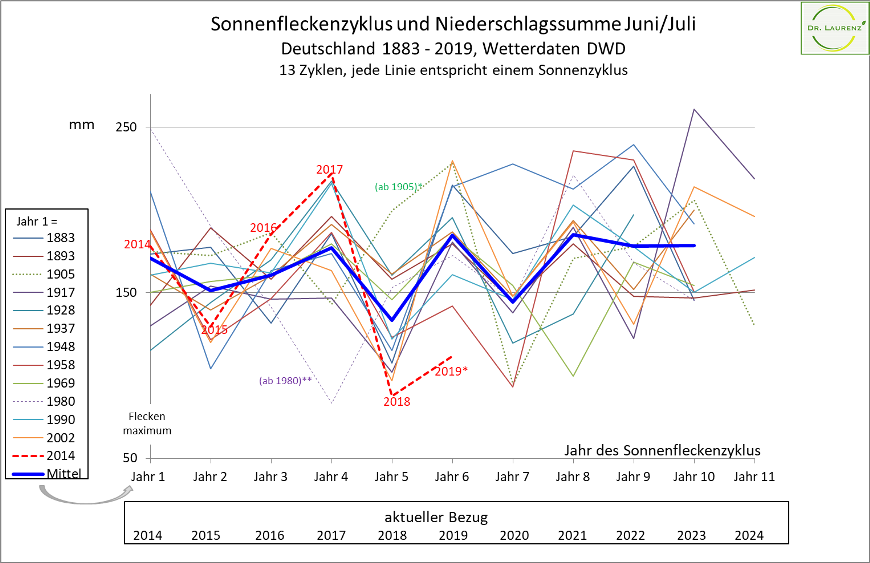
Jede Linie entspricht dem Verlauf der Niederschlagssumme in einem Sonnenzyklus.
Beim erstmaligen Betrachten irritiert der Kurvenverlauf.
Ein ähnliches Muster findet sich weltweit in allen solaren Wettermustern, wenn der Beginn des Sonnenzyklus auf das Jahr des Fleckenmaximums gelegt wird.
Eine Erklärung dafür wird am Ende dieses Beitrages gegeben.
Zeitweise verlaufen alle 13 Kurven gleichsinnig parallel.
Das ist ein Hinweis darauf, dass von der Sonne im Jahr des Fleckenmaximums ein Impuls ausgeht, der für diesen Trend verantwortlich ist.
Mit dieser Parallelität kommt das Signal zum Ausdruck, das die Sonne im Verlauf des Sonnenfleckenzyklus an die Sommerniederschlagsaktivität in Deutschland sendet.
...
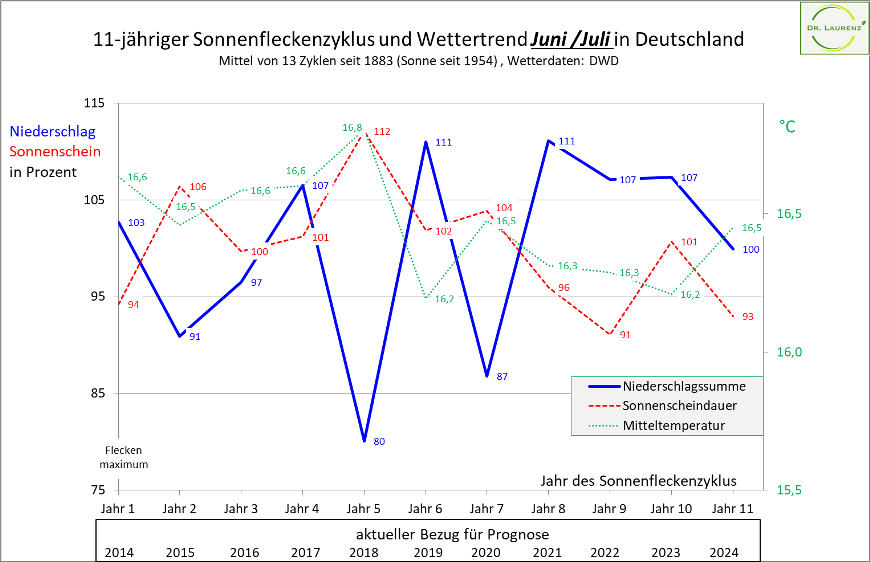
Abbildung 2: Wettertrend im Juni/Juli im Deutschlandmittel
Abbildung 2: 11-jähriger Sonnenfleckenzyklus und
Wettertrend im Juni/Juli im Deutschlandmittel
mit Trendprognose für die nächsten Jahre
▶Niederschläge: Kommt ein Dürresommer?
▶Sonnenscheindauer: Kommt ein Dürresommer?
▶Temperaturen: Kommt ein Dürresommer?
▶Auftreten von Dürre: Kommt ein Dürresommer?In Abbildung 2 ist das Sonnensignal für die Klimagrößen Niederschlagssumme, Sonnenscheindauer und Temperatur für Juni/Juli im Mittel von Deutschland dargestellt.
Für den Niederschlagstrend und die Sonnenscheindauer werden Relativwerte verwendet.
Dadurch sind diese Größen leichter vergleichbar.
Die Sonnenscheindauer ist erwartungsgemäß negativ korreliert zur Niederschlagssumme.
Die Temperatur verläuft weitgehend parallel zur Sonnenscheindauer.
Das Zyklusjahr 5 ist das trockenste, sonnenscheinreichste und wärmste Jahr aller Zyklusjahre.
Das Hitze- und Dürrejahr 2018 ist ein Jahr 5.
Die Sonnenaktivität war offensichtlich verantwortlich für den Wettercharakter im Sommer 2018.
Der Kurvenverlauf in Abbildung 2 lässt sich für Trendprognosen nutzen.
Dazu sind die Jahreszahlen des aktuellen Sonnenzyklus, beginnend mit 2014, am unteren Rand eingefügt.
Für 2020 sind erneut niedrige, eventuell sogar sehr niedrige Niederschlagssummen wahrscheinlicher als durchschnittliche oder sogar überdurchschnittliche Regensummen.
In 11 von 12 Zyklen sinkt die Niederschlagssumme von Jahr 6 zu Jahr 7, s. Abbildung 1.
Der aktuelle Sonnenzyklus mit dem zu Beginn sehr schwachem Impuls verläuft nicht normal.
So ist der in anderen Zyklen regelmäßig auftretende Windrichtungswechsel in der QBO (s.u.) von Jahr 1 zum Jahr 2 ausgeblieben.
Wikipedia
de Quasi-zweijährige SchwingungDie quasi-zweijährige Schwingung (kurz: QBO vom englischen "quasi-biennial oscillation"), auch quasi-biennale Oszillation, ist eine quasi-periodische atmosphärische Welle des zonalen Windes in der äquatorialen Stratosphäre der Erde.
Wenn sich 2020 entsprechend den Kurvenverläufen in Abbildung 1 zu einem historischen Dürrejahr entwickelt,
könnte das allein durch den aktuellen Verlauf der Sonnenaktivität verursacht worden sein.
Für Deutschland lässt sich in Zukunft ein Trend für die Niederschlagssumme Juni und Juli für ca. 10 Jahre im Voraus aufstellen, sobald der Zeitpunkt und die Qualität des Sonnenfleckenmaximums bzw. des Sonnenimpulses bekannt sind.
In wieweit das auch in Zyklen mit zu Beginn sehr niedriger Fleckenzahl und schwachem Impuls möglich sein wird, müssen weitere Untersuchungen zeigen.
...
Abbildung 3: Wettertrend im Juni/Juli in verschiedenen Regionen Deutschlands und den Niederlanden
Abbildung 3: 11-jähriger Sonnenfleckenzyklus und
Wettertrend im Juni/Juli in verschiedenen Regionen Deutschlands
und den Niederlanden

In allen Bundesländern ähnliches Sonnensignal
Zur Berechnung des Sonnensignals in unterschiedlichen Regionen Deutschlands sind die Datensätze aus 12 Bundesländern verwendet, die Niederschlagssummen in Relativwerte umgewandelt worden.
Die Werte eigenständiger Städte sind in umgebenden Bundesländern integriert.
Zur besseren Übersichtlichkeit sind die Bundesländer mit ähnlichem Kurvenverlauf in Gruppen zusammengefasst, s. Abbildung 3.
Zu den Ergebnissen der Bundesländer ist der Niederschlagstrend der Niederlande hinzugefügt, um zu zeigen, dass sich das in Nordwest-Deutschland besonders starke Sonnensignal auf dem Gebiet der Niederlande fortpflanzt.
Der Kurvenverlauf von Schleswig-Holstein und Baden-Württemberg wechselt mehr oder weniger gleichförmig von Jahr zu Jahr zwischen niedriger und hoher Niederschlagssumme, auch in den Zyklusjahren 9 bis 11.
Die Kurven der drei anderen Regionen bleiben ab dem Zyklusjahr 8 auf hohem Niveau.
Die Ausschläge zwischen den Extremen sind im Nord-West-Deutschland mit maximal 40 Prozent (Jahr 5 zu Jahr 6) am größten.
In den benachbarten Niederlanden steigt der Betrag sogar auf beachtliche 45 Prozent.
Ähnlich hoch sind die Ausschläge in Belgien und Luxemburg.
Auch mit Hilfe dieser Abbildung können Juni/Juli-Niederschlagsprognosen für die verschiedenen Regionen erstellt werden.
Das aktuelle Jahr 2020 entspricht dem Zyklusjahr 7, einem Jahr mit deutlichem Trend zu unterdurchschnittlicher Sommer-Niederschlagssumme.
2021, dem Zyklusjahr 8, besteht eine hohe Wahrscheinlichkeit für erstmalig wieder überdurchschnittlich viel Regen im Hochsommer.
...
Abbildung 4: Niederschlagssumme verschiedener Zeiträume
Abbildung 4: 11-jähriger Sonnenfleckenzyklus und
Niederschlagssumme verschiedener Zeiträume
 -
-
...
Mit Abbildung 4 wird die Struktur des Sonnensignals sowohl hinsichtlich des Auftretens in einzelnen Zyklusjahren als auch im Verlauf des Jahres sichtbar.
Das Sonnensignal ist im Juni/Juli wesentlich stärker ausgeprägt als im Zeitraum Mai bis August und dem Gesamtjahr.
Das Signal ist auf die Monate Juni und Juli begrenzt.
Bei der hier nicht dargestellten Betrachtung der Einzelmonate ist das Sonnensignal im Juni stärker ausgeprägt als im Juli.
Schon im vorgelagerten Mai als auch im nachgelagerten August ist es kaum noch erkennbar.
Die jährlichen Ausschläge steigern sich vom Jahr des Sonnenfleckenmaximums bis zur Phase des Fleckenminimums mit den Zyklusjahren 5, 6 und 7.
Ab dem Zyklusjahr 8 verschwindet das Sonnensignal, die Niederschlagssummen bleiben bis zum nächsten Sonnenfleckenmaximum meist auf überdurchschnittlichem Niveau.
Prognosen haben in den Zyklusjahren 3 bis 8 und Monaten Juni/Juli eine hohe Eintrittswahrscheinlichkeit.
Das für Deutschland typische Sonnensignal in der Juni/Juli-Niederschlagssumme erstreckt sich in Europa auf die eher westlich gelegenen Länder von Dänemark über Großbritannien/Irland, Benelux-Länder, Alpenrepubliken, Frankreich und die Iberische Halbinsel.
In den unmittelbar östlich Nachbarschaft ist das Sonnensignal nur etwa halb so stark.
Das Signal ist kaum vorhanden in einem großen Bogen um Deutschland herum von Island über Norwegen, Finnland, Weißrussland, Bulgarien, Rumänien sowie dem zentralen und östlichen Mittelmeerraum.
Übertragungsweg für das Sonnensignal des Schwabezyklus auf unser Wetter
Die hohe Qualität des Sonnensignals in den Juni/Juli-Niederschlagssummen in Abbildung 1 setzt voraus, dass der Impuls der Sonne im Jahr des Fleckenmaximums durch ein festes Zusammenspiel von Planetenstellung, Sonnenaktivität, Vorgängen in der Mesosphäre (50 bis 80 km Höhe), Stratosphäre (12 bis 50 km Höhe) und Troposphäre (bis 12 km Höhe) übertragen wird.
Zu diesem Übertragungsweg gibt es weltweit viele neue Publikationen.
Auch deutsche Forschungseinrichtungen wie das Max-Planck-Institut für Meteorologie in Hamburg [1] oder GEOMAR Helmholtz-Zentrum für Ozeanforschung in Kiel [2] sind an der Forschung beteiligt.
[1] Geophysical Research Letters
2019-11-20 en Realistic Quasi-Biennial Oscillation Variability in Historical and Decadal Hindcast Simulations Using CMIP6 Forcing[2] Atmospheric Chemistry and Physics
2019-11-20 en Quantifying uncertainties of climate signals related to the 11-year solar cycle.
Part I: Annual mean response in heating rates,temperature and ozoneAus dem Studium der Literatur kann abgeleitet werden, dass die Übertragung des Sonnensignals wahrscheinlich über fünf Ebenen erfolgt:
-
Ebene 1 (vorgeschaltet)
Laufbahn der Planeten im Sonnensystem, die je nach ihrer Stellung das Schwerefeld der Sonne verändern
und damit die Sonnenfleckenaktivität im 11-Jahresrythmus und die Variabilität der UV-Strahlung steuert.
-
Ebene 2
Sonne mit Sonnenflecken, "Sonnenwind" und UV-Strahlung, die das Ozon in der Mesosphäre (50 bis 80 km Höhe) und Stratosphäre (12 bis 50 km Höhe) chemisch-physikalisch beeinflusst.
Die UV-Strahlung variiert während des Sonnenzyklus um ca. 10 Prozent.
-
Ebene 3
Mesophäre und Stratosphäre mit der Ozonchemie und -physik:
je stärker die UV-Strahlung, umso mehr Ozon, umso höher die Temperatur.
Die Ozondynamik wird von der UV-Strahlung gesteuert.
Dadurch verändern sich während des Sonnenzyklus die Temperaturgradienten zwischen Äquator und Polen sowie zwischen verschiedenen Höhen der Atmosphäre.
-
Ebene 4
Quasi-Biennale Oszillation (QBO), die von den Temperaturgradienten in 12 bis 80/nbsp;km Höhe beeinflusst wird.
In der QBO, eine Windzone in 20 bis 40 km Höhe über dem Äquator, wechselt die Windrichtung von Jahr zu Jahr mehr oder weniger regelmäßig von West nach Ost und umgekehrt.
Der Sonnenimpuls wird auf die QBO übertragen, indem die Windrichtung in der QBO im Jahr des Fleckenmaximums in jedem Zyklus von Mai bis Dezember auf Ost dreht.
Der jährliche Windrichtungswechsel (in 20 bis 25 km Höhe) bleibt in den Folgejahren nach eigenen Berechnungen für mehrere Jahre exakt im 12‑Monatsrythmus erhalten, bevor sich der Rhythmus im Verlauf eines jeden Zyklus auf mehr als 12 Monate verlängert.
-
Ebene 5
Zirkulationssystem der Troposphäre mit den wetterbildenden Hoch- und Tiefdruckgebieten, das von der QBO beeinflusst wird.
Der fast jährliche Windrichtungswechsel in der QBO dürfte für das Zick-Zack-Muster in den Niederschlagskurven in den obigen Abbildungen verantwortlich sein.
Fazit
Es gibt unzweifelhaft einen starken Einfluss der Variabilität der Sonne im Rahmen des 11-jährigen Sonnenfleckenzyklus auf unser Wetter,
der wesentlich größer ist als bisher vermutet.
Der Einfluss konzentriert sich auf die Sommermonate Juni und Juli, den Zeitraum höchster Sonneneinstrahlung.
Er zeigt sich in den Niederschlagssumme stärker als in der Sonnenscheindauer oder Temperatur.
Die Niederschlagssumme Juni/Juli reagiert in jedem einzelnen Jahr des Sonnenzyklus unterschiedlich auf die Variabilität der Sonnenstrahlung.
Während der Phase des Sonnenfleckenminimums, in der wir uns zurzeit befinden, betragen die solar verursachten jährlichen Schwankungen der Niederschlagsumme im Juni/Juli 30 bis über 40 Prozent.
Diese Schwankungen haben sich mit hoher Zuverlässigkeit in fast allen 13 Zyklen seit 1883 wiederholt.
Auf Basis dieser Zuverlässigkeit lassen sich für Deutschland Prognosen erstellen.
Prognose für Juni/Juli 2020: Die Niederschlagssumme erreicht nur ca. 80 Prozent des langjährigen Mittels, mit dem Trend zu noch niedrigerem Wert.
Prognose für Juni/Juli 2021: Die Niederschlagssumme erreicht ca. 110 Prozent des langjährigen Mittels.
Diese experimentellen Prognosen sind selbstverständlich ohne Gewähr.
Ziel der Übung ist es, mittelfristige Klimavorhersagen zu entwickeln bzw. zu überprüfen, ob dies möglich ist.
-

|
Kommt ein Dürresommer? Sonnenzyklen: Webseiten / Solar cycles / Cycles solaires Wetterphänomene: Niederschläge Wetterphänomene: Sonnenscheindauer |
↑
Die wirkliche Klimakrise ist nicht die globale Erwärmung,
sondern globale Abkühlung - und vermutlich hat sie bereits begonnen
en
The Real Climate Crisis Is Not Global Warming,
It Is Cooling, And It May Have Already Started

-
EIKE Europäisches Institut für Klima und Energie
Allan MacRae and Joseph D'Aleo / Chris Frey
2020-03-05 de Die wirkliche Klimakrise ist nicht die globale Erwärmung, sondern globale Abkühlung - und vermutlich hat sie bereits begonnenBemerkung: Erstveröffentlichung (Übersetzung 2019)
2019-11-04 de Die wirkliche Klima-Krise ist nicht globale Erwärmung, sondern Abkühlung - und sie könnte schon begonnen habenEinführung: Katastrophale anthropogene globale Erwärmung CADW - eine gescheiterte Hypothese
Die Panikmache um CAGW ("globale Erwärmung", "Klimawandel", "Klimakrise", "Klima-Notstand") ist eine gescheiterte Hypothese und der größte wissenschaftliche Betrug aller Zeiten (hier).
Kann globale Abkühlung in aller Stille real werden?
CO₂, GLOBAL WARMING, CLIMATE AND ENERGY
Another 'Little Ice Age' Coming? NASA's Solar Activity Forecast Might Surprise You
Der Globale-Erwärmung-Alarmismus wurde von politischen Extremisten vorangetrieben, und ihre leichtgläubigen Jünger glaubten Jahrzehnte lang daran - und das, obwohl es keinerlei stichhaltige Beweise dafür gibt, dass eine katastrophale Erwärmung in der Realität überhaupt existiert und trotz vielfältiger Belege, welche die CAGW-Hypothese falsifizieren.
Der gescheiterten CAGW-Hypothese zufolge soll ein gestiegener atmosphärischer CO₂-Anteil aufgrund der Verbrennung fossiler Treibstoffe eine gefährliche Runaway-globale Erwärmung auslösen.
Die einzigen vermeintlichen Beweise für diesen Betrug sind Computer-Klimamodelle,
welche die gegenwärtig beobachtete leichte Erwärmung drastisch übertreiben, typischerweise um 300 bis 500 Prozent.
In diese Klimamodelle gehen absichtlich exzessiv hohe geschätzte Werte der Klimasensitivität bzgl. CO₂ ein, und sie sind darauf ausgelegt, falschen Alarm zu schlagen.
Die globale Erwärmung hat sich seit Mitte der 1990er Jahre verlangsamt.
Also ließen die Alarmisten verlauten, dass ein gestiegener CO₂-Gehalt heftigeres, chaotischeres Wetter auslösen wird.
Es gibt vielfache Belege, dass auch das falsch ist (hier).
Tatsächlich ist das Wetter weniger chaotisch geworden (hier).
Weitere Belege für groß angelegten Betrug sind:
Der Mann'sche Hockeyschläger (MBH98 etc.),
die Klimagate-E-Mails,
die Verfälschung historischer Temperaturdaten
und die aggressive Taktik der Klima-Extremisten.
Eindeutige Belege, dass der durch CO₂ getriebene Alarmismus von globaler Erwärmung/Klimawandel eine erfundene Krise ist
Atmosphärische CO₂-Konzentrationen waren in der geologischen Historie schon viel höher als heute,
aber eine Runaway-globale Erwärmung ist über die Milliarden Jahre der Erdgeschichte niemals eingetreten.
In geologischen Zeiten war es schon viel wärmer, und auch viel kälter als heute.
Die Erde befindet sich derzeit in einer glazialen Epoche,
in welcher Kilometer dicke Eisschilde große Teile des Planeten etwa 100.000 Jahre lang überzogen, jeweils unterbrochen von Interglazialen mit einer Dauer von etwa 10.000 Jahren.
Die Erde befindet sich derzeit in einem solchen warmen Interglazial, aber die letzte Vereisung endete schon vor etwa 10.000 Jahren,
so dass eine erneute Vereisung auf der Erde statistisch demnächst fällig ist.
Während der Mittelalterlichen Warmzeit von 900 bis 1300 lag die Temperatur viel höher als heute.
Danach geriet die Menschheit in die Kleine Eiszeit von etwa 1300 bis 1850.
Diese hatte viel Leiden und den Tod von Millionen zur Folge.
Die USA verfügen über einige der weltweit besten Temperaturdaten.
Die höchsten Temperaturen wurden während der 1930er Jahre registriert, also deutlich bevor sich die Verbrennung fossiler Treibstoffe um das Jahr 1940 erheblich verstärkte.
Die Verbrennung fossiler Treibstoffe verstärkte sich zu Beginn des 2. Weltkriegs erheblich.
Aber die globale Temperatur SANK signifikant von 1940 bis 1977.
Diese eine Beobachtung ist bereits ausreichend, um die CAGW-Hypothese zu widerlegen - die globale Temperatur stieg NICHT katastrophal aufgrund eines steigenden CO₂-Gehaltes.
Selbst unter der Annahme, dass die GESAMTE beobachtete globale Erwärmung dem gestiegenen atmosphärischen CO₂-Gehalt zugeordnet werden kann, rechneten die folgenden beiden Studien vor, dass die MAXIMALE Klimasensitivität einer hypothetischen Verdoppelung des CO₂-Gehaltes nur etwa 1°C beträgt, was viel zu gering ist, um eine gefährliche globale Erwärmung auszulösen: hier
und hier.
Jene 1°C pro Verdoppelung ist nicht die mittlere, sondern die MAXIMALE Klimasensitivität,
kann doch der größte Teil der beobachteten Erwärmung natürlichen Ursachen zugeordnet werden.
Noch einmal: Computer-Klimamodelle des IPCC und Globale-Erwärmung-Alarmisten ziehen Werte der Klimasensitivität heran, die 3 bis 5 mal größer sind als bei 1°C pro Verdoppelung, nur um falsche Ängste bzgl. einer gefährlichen globalen Erwärmung zu wecken.
Die Beweislage ist ziemlich eindeutig:
Sonnenaktivität und nicht das atmosphärische CO₂ ist der primäre Treiber der Temperatur auf der Erde (hier).
|
|
Weiterlesen |
-
Watts UP With That? (Anthony Watts) / Allan MacRae and Joseph D'Aleo
2019-10-27 en The Real Climate Crisis Is Not Global Warming, It Is Cooling, And It May Have Already StartedIntroduction - Catastrophic Anthropogenic Global Warming - A Failed Hypothesis
Global warming alarmism has been promoted by political extremists and believed in by their gullible acolytes for decades, even though there is no credible evidence that catastrophic global warming exists in reality, and ample evidence that the CAGW hypothesis has been falsified.
The failed CAGW hypothesis assumes that increasing atmospheric CO₂ from fossil fuel combustion drives dangerous runaway global warming.
The alleged evidence for this fraud is climate computer models that greatly over-predict current observed warming, typically by 300 to 500%.
These climate models deliberately employ excessively high assumed values of climate sensitivity to CO₂, and are designed to create false alarm.
Global warming has slowed since the mid-1990's,
so the climate alarmists alleged that increased atmospheric CO₂ from combustion of fossil fuels will cause wilder, more chaotic weather.
There is ample evidence that this allegation is also false.
Weather has actually become less chaotic.
The Mann hockey stick (MBH98 etc.), the Climategate emails, historical temperature data revisions and the thuggish tactics of the climate extremists provide ample evidence of fraud.
Credible Evidence That CO₂-Driven Global Warming/Climate Change Alarmism Is A False Crisis
Atmospheric CO₂ concentrations have been much higher in geologic time, and runaway global warming has never occurred in the billions of years of Earth history.
Global temperatures have been much warmer and also much colder over geologic time.
Earth is now in a glacial period, when mile-thick ice sheets cover much of the planet for about 100,000 years, interrupted by interglacials that last about 10,000 years.
Earth is now in a warm interglacial, but the last glaciation ended only about 10,000 years ago, so Earth is due for another glaciation.
Temperatures were much higher during the Medieval Warm Period circa 900-1300 AD,
and then humanity experienced the Little Ice Age circa 1300-1850 which caused enormous suffering and the deaths of millions.
The USA has some of the best surface temperature data in the world.
The hottest USA surface temperature records occurred in the 1930's, before fossil fuel combustion accelerated circa 1940.
Fossil fuel combustion accelerated strongly at the start of World War II, and global temperatures COOLED significantly from 1940 to 1977.
That one observation is sufficient to disprove the CAGW hypothesis - global temperatures do NOT rise catastrophically due to increasing atmospheric CO₂.
Even if it is assumed that ALL the observed global warming is ascribed to increasing atmospheric CO₂, the following two studies calculated that the MAXIMUM climate sensitivity to a hypothetical doubling of atmospheric CO₂ is only about 1 degree C, which is too low to cause dangerous global warming.
Christy and McNider (2017) analysed UAH Lower Troposphere data since 1979.
Lewis and Curry (2018) analysed HadCRUT4v5 Surface Temperature data since 1850.
That 1 C/doubling is not an average, it is a MAXIMUM climate sensitivity,
since some or most of the observed warming could be due to natural causes.
Repeating, climate computer models used by the IPCC and other global warming alarmists employ climate sensitivity values 3-to-5-times higher than 1C/doubling, in order to create false fears of dangerous global warming.
It is highly probable,
based on the evidence, that solar activity, not atmospheric CO₂, is the primary driver of Earth's temperature.
|
|
Continue reading |
⇧ 2019
↑
AMO-Zyklus auf dem absteigenden Ast:
Rotes Meer wird sich in den kommenden Jahrzehnten wohl abkühlen
en
Natural Climate Oscillations may Counteract Red Sea Warming Over the
Coming Decades
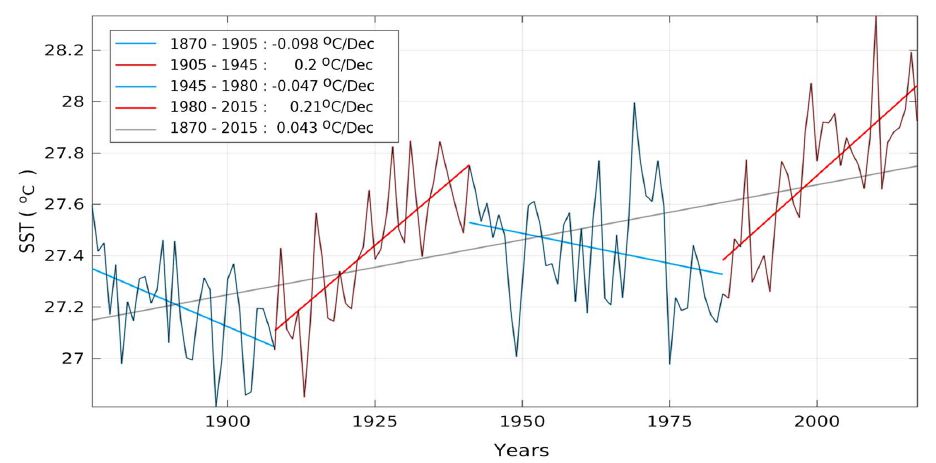 Temperaturentwicklung des Roten Meeres
-
Die kalte Sonne (Fritz Vahrenholt & Sebastian Lüning)
2019-07-07 de AMO-Zyklus auf dem absteigenden Ast: Rotes Meer wird sich in den kommenden Jahrzehnten wohl abkühlenVor sieben Jahren schlugen wir in unserem Buch "Die kalte Sonne" vor, Ozeanzyklen für Mittelfristprognosen einzusetzen.
Das Klimaestablishment war damals strikt dagegen.
Heute haben sich die Zeiten zum Glück geändert.
Ein Team um George Krokos analysierte am 15. März 2019 in den Geophysical Research Letters die Temperaturentwicklung des Roten Meeres, welches sich in den letzten Jahrzehnten spürbar erwärmt hat.
Die Forscher setzten dies in den Langfrist-Kontext und erkannten eine starke Korrelation mit dem 70-jährigen Ozeanzyklus der AMO (Atlantischen Multidekadenoszillation).
Da die AMO nun ihren Scheitelpunkt erreicht hat, erwarten Krokos und Kollegen nun eine Abkühlung des Roten Meeres in den kommenden drei Jahrzehnten.
Hier der Abstract des Papers:
-
Geophysical Research Letters
2019-03-15 en Natural Climate Oscillations may Counteract Red Sea Warming Over the Coming DecadesAbstract
Recent reports of warming trends in the Red Sea raise concerns about the response of the basin's fragile ecosystem under an increasingly warming climate.
Using a variety of available Sea Surface Temperature (SST) data sets, we investigate the evolution of Red Sea SST in relation to natural climate variability.
Analysis of long-term SST data sets reveals a sequence of alternating positive and negative trends, with similar amplitudes and a periodicity of nearly 70 years associated with the Atlantic Multidecadal Oscillation.
High warming rates reported recently appear to be a combined effect of global warming and a positive phase of natural SST oscillations.
Over the next decades, the SST trend in the Red Sea purely related to global warming is expected to be counteracted by the cooling Atlantic Multidecadal Oscillation phase.
Regardless of the current positive trends, projections incorporating long-term natural oscillations suggest a possible decreasing effect on SST in the near future.
|
|
AMO-Zyklus auf dem absteigenden Ast: Rotes Meer wird sich in den kommenden Jahrzehnten wohl abkühlen Ozeanzyklen: AMO-Atlantische Multidekaden-Oszillation, Ozeanzyklen steuern das Klima |
↑ Scientists for Future und der Club of Rome
-
EIKE Europäisches Institut für Klima und Energie
Michael Krüger
2019-05-12 de Scientists for Future und der Club of RomeBei der weiteren Recherche bin ich auf Scientists for Future gestoßen, einen Ableger von Fridays for Future, der ebenfalls vom Club of Rome maßgeblich beeinflusst wird.
Dazu eine Rangliste der Mitglieder von Scientist for Future und den Unterstützern von Fridays for Future und Greta Thunberg, die einen direkten Bezug zum Club of Rome haben.
Mojib Latif ist einer der bekanntesten Klimaforscher in Deutschland
und zugleich Präsident der Deutschen Gesellschaft CLUB OF ROME.
Die Deutsche Bundesstiftung Umwelt (DBU) zeichnet Prof. Dr. Mojib Latif, Klima- und Meeresforscher und DKK-Vorstandsvorsitzender, und den Nachhaltigkeitswissenschaftler Prof. Dr. Johan Rockström (heute Direktor des Potsdam-Institutes für Klimafolgenforschung (PIK)) mit dem Deutschen Umweltpreis 2015 aus.
In seiner Funktion als Präsident des Club of Rome unterstützt Mojib Latif die Schülerproteste von Fridays for Future und trat in Hamburg als Redner auf.
Mojib Latif unterstützt auch die Scientist for Future-Bewegung.
Zusammen mit der Organisatorion Luisa Neubauer (#LangstreckenLuisa) von Fridays for Future und Eckart von Hirschhausen wird von ihn die Scientists for Future-Bewegung unterstützt.
▶Prognosen von Prof. Mojib Latif
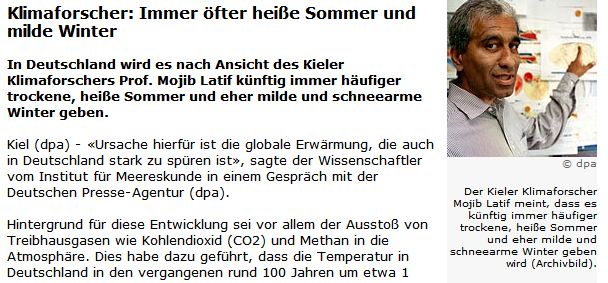
Mojib Latif Dr. rer. nat., Professor für Meteorologie am Leibniz-Institut für Meereswissenschaften (IFM-GEOMAR) an der Universität Kiel.
▶Mojib Latif: Who is who (Aktivisten der anthropogenen Erwärmung)
2. Rang: Hans Joachim Schellnhuber
Hans Joachim Schellnhuber war Direktor am PIK (Potsdam-Institut für Klimafolgenfolgenforschung) und Klimaberater der Kanzlerin und
sitzt heute in der Kohlekomission.
Weiter war er Vorsitzender des Wissenschaftlichen Beirats der Bundesregierung Globale Umweltveränderungen (WBGU) und
brachte dort das Vorhaben der sogenannten "Großen Transformation der Gesellschfat" auf den Weg.
Er ist ebenfalls Mitglied des Club of Rome und Vater des 2°C-Klimaschutzziels.
Schellnhuber hat die "Fridays for Future"-Bewegung als wichtiges Hoffnungszeichen für die Zukunft bezeichnet.
Die von der Schwedin Greta Thunberg initiierten Schülerdemonstrationen für den Klimaschutz seien eine "positive Überraschung" und ein Beweis für den Mut der jungen Generation.
Schellnhuber unterstützt ebenfalls die Scientist for Future-Bewegung.
▶
Rückkehr der Sintflut: Schellnhuber, Latif, Rahmstorff
Hans-Joachim Schellnhuber
*1950-06-07Professor,
Bis September 2018 war er Direktor des 1992 von ihm gegründeten Potsdam-Instituts für Klimafolgenforschung (PIK)
▶Hans-Joachim Schellnhuber: Who is who (Aktivisten der anthropogenen Erwärmung)
Maja Göpel ist Generalsekretärin des Wissenschaftlichen Beirats der Bundesregierung Globale Umweltveränderungen (WBGU)
und stellte gemeinsam mit anderen Wissenschaftlern im März 2019 die zur Unterstützung der Schülerproteste Fridays for Future gegründete Kampagne Scientists for Future in der Bundespressekonferenz vor.
Sie war auch auf der Demo in Berlin mit Greta als Rednerin anwesend. Maja Göpel ist ebenfalls Mitglied des Club of Rome.
▶"Welt im Wandel - Gesellschaftsvertrag für eine Große Transformation"
WBGU Wissenschaftlicher Beirat der Bundesregierung Globale Umweltveränderungen
▶WBGU: Who is who (Institute & Organisationen der Globalen Erwärmung)
Die Energieökonomin Claudia Kemfert ist ebenfalls Mitglied des Club of Rome
und unterstützt auch Fridays for Future und Scientist for Future.
Kemfert sagt, "Fridays for Future" sind berechtigt - und richtig.
Angesichts solcher Arbeitsverweigerung ist es eine ziemlich gute Idee,
dass die Jugendlichen freitags statt in die Schule auf die Straße gehen.
Ihre Botschaft ist so einfach wie berechtigt:
Wir haben keine Zeit für Lektionen der Vergangenheit, wenn ihr uns die Zukunft verbaut!
▶Das fossile Imperium schlägt zurück - oder: Wie eine Wissenschaftlerin ihre Reputation vernichtet
Claudia Kemfert Energieökonomin, Leiterin der Abteilung Energie, Verkehr und Umwelt am Deutschen Institut für Wirtschaftsforschung (DIW).
▶Claudia Kemfert: Who is who (Aktivisten der anthropogenen Globalen Erwärmung)
5 Rang: Ernst Ulrich von Weizsäcker
Ernst von Weizsäcker ist Co-Präsident des Club of Rome.
Er unterstützt ebenfalls Fridays for Future und Scientists for Future.
Ende März war er bei Fridays for Future in Stuttgart zu Gast und gab den streikenden Schülern Tipps und hielt dort eine Rede.
Durch von Weizsäcker kam auch Hirschhausen zu Scientists for Future.
Hirschhausen erzählt: Denn die größte Herausforderung für die globale Gesundheit ist der Klimawandel.
Das ist ein Thema, zu dem sich jeder positionieren muss, aber gerade auch wir Ärzte, durch alle Alters- und Fachgruppen.
Ich bin durch ein Interview für meine Zeitschrift HIRSCHHAUSEN GESUND LEBEN mit der ehemaligen Schimpansenforscherin Jane Goodall und dem Club of Rome Vizepräsidenten Ernst Ulrich v. Weizsäcker selber erst seit einem Jahr so richtig auf den Zusammenhang von Gesundheit und Überhitzung der Atmosphäre gestoßen.
Rang 6: Ingmar Rentzhog
Der schwedische Finanzmarkt-Jongleur Ingmar Rentzhog beschreibt in einem Interview, wie er Greta Thunberg "rein zufällig" entdeckt hat und unter seine Fittiche nahm.
Rentzhog ist kein Unbekannter in der globalen Klima-Propaganda.
2017 gründete der langjährige Finanzunternehmer die dubiose Klimaschutz-Organisation "We don't have Time" als Aktiengesellschaft.
Er nahm Grata im Sommer 2018 unter seine Fittiche und postete im Internet groß ein Foto von Greta mit ihren bekannten Plakat zum Klimastreik.
Rentzhog und seine We Don't Have Time AG sind eng verbandet mit dem Club of Rome.
Im November wurde die globale Live-Übertragung des Klimakrisenplans des Club of Rome von Ingmar Rentzhog, dem Gründer von We Don't Have Time, mit moderiert.
Er begleitete Greta von August 2018 bis Januar 2019 und warb mit ihr für "We don't have Time", in Zusammenarbeit mit dem Club of Rome.
Der neue Direktor des PIK und Nachfolger von Schellnhuber, Johan Rockström ist Autor des Club of Rome.
Er hat an der Aktualisierung der Studie des Club of Rome "Die Grenzen des Wachstums" anlässlich des 50. Jahrestag seines Bestehens mitgearbeitet.
Rockström ist ebenfalls Unterstützer von Scientist for Future. Das Potsdam-Institut für Klimfolgenforschung (PIK) hat anlässlich der Preisverleihung der goldenen Kamera an Greta Thunberg diese in Potsdam auf dem Telegrafenberg empfangen und zusammen mit den beiden Chefs des PIKs und Stefan Rahmstorf eine Rundführung gemacht.
Mit dabei waren auch Luisa Neubauer und Louis Motaal / Plant-for-the-Planet/ Club of Rome.
Diese werden auch weiterhin, wie auch Greta, vom PIK und Stefan Rahmstorf beraten.
Stefan Rahmstorf war gerade zu Besuch zum Freitags-Schulstreik bei Greta in Stockholm.
Frithjof Finkbeiner ist Vizepräsident des deutschen Club of Rome.
Mit Plant-for-the-Planet versuchte er bereist vor etwas über 10 Jahren mit seinem 10jährigen Sohn Felix Finkbeiner und Promis über Aufforstungsaktionen das Klima medienwirksam zu retten.
Damals aber war die mediale Aufmerksamkeit noch bescheiden.
Im Jahr 2015 gab es aber auch schon von Plant-for-the-Planer einen Aufruf Klimastreiks zu organisieren.
Finkbeiner gilt als Vater des Gedankens der Schülerstreikbewegung.
Seine Plant-for-the-Planer-Foundation verwaltet auch die Gelder von Fridays for Future.
Rang 9: Louis Kaspar Abdel Motaal
Louis Kaspar Abdel Motaal ist trotz seines jungen Alters ein "alter Hase" im Klimageschäft.
Der Waldorfschüler ist gerade mit dem Abi fertig und hat schon mit 11 Jahren angefangen Reden zum Klimaschutz zu halten. Seine Eltern waren schon beim WWF aktiv und mit 10 Jahren wollte er schon zu Greenpeace.
Mit 11 Jahren ist er dann Plant for the Planet des Club of Rome beigetreten.
Laut seiner Vita ist er bereits seit sechs Jahren bei der Foundation tätig, war Referent beim Deutschen Handelskongress, beim Jahrestreffen der Deutschen Gesellschaft des Club of Rome und beim Deutschen CSR-Forum.
Er vertrat Plant-for-the-Planet bei der UN-Klimakonferenz und dem Global Landscape Forum und ist zusammen mit Luisa und Jakob Mitorganisator von Fridays for future.
Dieser Louis Motaal hat auch Anfang Februar 2019 beim Deutschen Patent- und Markenamt auch die Wortmarke "Fridays for Future" zur Eintragung angemeldet.
Ehemals Umweltminister der Bundesrepublik Deutschland, der durch den Rhein schwamm.
Töpfer ist ebenfalls Mitglied des Club of Rome und unterstützt Fridays for Future.
Töpfer sagt: "Fridays for future" hat den unschätzbaren Wert, die Notwendigkeit einer überzeugenden Klimapolitik in alle gesellschaftlichen Gruppen hinein getragen zu haben.
Durch diese Bewegung von unten, aus der Gesellschaft heraus wird die Politik massiv herausgefordert.
Manche wollen das noch nicht wahrhaben - sie werden dafür eine teure politische Rechnung bekommen.
|
|
Scientists for Future und der Club of Rome Der Niedergang der seriösen Wissenschaft |
| Greenpeace |
Greenpeace
▶Greenpeace: Who is who (Institute & Organisationen der Globalen Erwärmung) |
| WWF |
de World Wide Fund For Nature en World Wide Fund for Nature fr Fonds mondial pour la nature ▶WWf: Who is who (Institute & Organisationen der Globalen Erwärmung) |
| SFF |
Scientists for Future
▶SFF: Who is who (Institute & Organisationen der Globalen Erwärmung) |
| WBGU |
Wissenschaftlicher Beirat der Bundesregierung Globale
Umweltveränderungen
▶WBGU: Who is who (Institute & Organisationen der Globalen Erwärmung) |
| Mojib Latif |
Dr. rer. nat.,
Professor für Meteorologie am Leibniz-Institut für
Meereswissenschaften (IFM-GEOMAR) an der Universität Kiel.
▶Mojib Latif: Who is who (Aktivisten der anthropogenen Erwärmung) |
|
Hans-Joachim Schellnhuber *1950-06-07 |
Professor, Bis September 2018 war er Direktor des 1992 von ihm gegründeten Potsdam-Instituts für Klimafolgenforschung (PIK) ▶Hans-Joachim Schellnhuber: Who is who (Aktivisten der anthropogenen Erwärmung) |
↑ Krankheiten: Fürchtet die Kälte, nicht die Wärme
-
EIKE Europäisches Institut für Klima und Energie
Dr. Jay Lehr / Chris Frey
2019-05-15 de Krankheiten: Fürchtet die Kälte, nicht die WärmeEs gibt keinerlei nachgewiesene Risiken für die Gesundheit der Öffentlichkeit, falls die Temperatur des Planeten um ein paar Grad steigen würde.
Tatsächlich wird gegenwärtig ja auch keinerlei Erwärmung beobachtet, doch wenn es sie gäbe, würde die Menschheit nur Vorteile davon haben.
Viel wahrscheinlicher ist es, dass sich die Erde während der kommenden Jahrzehnte abkühlt, was die Lebenserwartung beeinträchtigen dürfte.
Es ist an der Zeit, die gesamte Angstmache bzgl. der Gesundheit beiseite zu schieben, welche der Gesellschaft seitens der Alarmisten aufoktroyiert wird, und zwar mittels deren Behauptung, dass ein wenig zusätzliche Wärme eine Katastrophe wäre.
-
The Global Warming Policy Forum (GWPF) / Dr. Jay Lehr
2019-05-10 en Fear cold, not heatThere are no proven risks to public health were the temperature of the planet to warm a couple of degrees.
In fact while no warming is being experienced at present, were it to occur, mankind would likely only experience benefits.
The Earth is far more likely to cool in the coming decades which does carry increased stresses on life expectancy.
It is time to put to rest the many health scares being foisted upon society by the alarmists claiming a little extra warmth is a disaster.
↑ Schnee im Mai 2019 - ein Vorbote der Klima-Abkühlung?
-
EIKE Europäisches Institut für Klima und Energie
Stefan Kämpfe
2019-05-10 de Schnee im Mai 2019 - ein Vorbote der Klima-Abkühlung?Noch 2018 waren die Klima-Alarmisten obenauf, denn anhaltende Hitze und Dürre lieferten ihnen Argumente für ihre Klima-Hysterie.
Doch schon damals gab es mit den sehr kalten Monaten Februar/März Schönheitsfehler, und das laufende Jahr wird deutlich kühler ausfallen.
Im Januar 2019 sorgten massive Schneefälle für Aufsehen, vor Ostern gab es einen markanten Kälterückfall und am 4. Mai starke Schneefälle bis teilweise ins Flachland.
All das ist Wetter und nicht Klima - doch könnte die von den Klimarealisten wegen der schwächelnden Sonne befürchtete Abkühlungsphase nun begonnen haben?
Diese Frage ist nicht eindeutig zu beantworten.
⇧ 2018
↑ Klimasensitivität - Wer rechnet hier falsch ?
-
EIKE Europäisches Institut für Klima und Energie
Dr. D.E. Koelle
2018-12-17 de Klimasensitivität - Wer rechnet hier falsch?Der IPCC basiert seine Hypothese der Klimasensitivität immer noch auf der alten Charney-Studie von 1979:
Eine CO2-Verdoppelung soll demnach einen Temperaturanstieg um 3°C bewirken.
Diese Annahme wird auch bei den Klimamodellen verwendet.
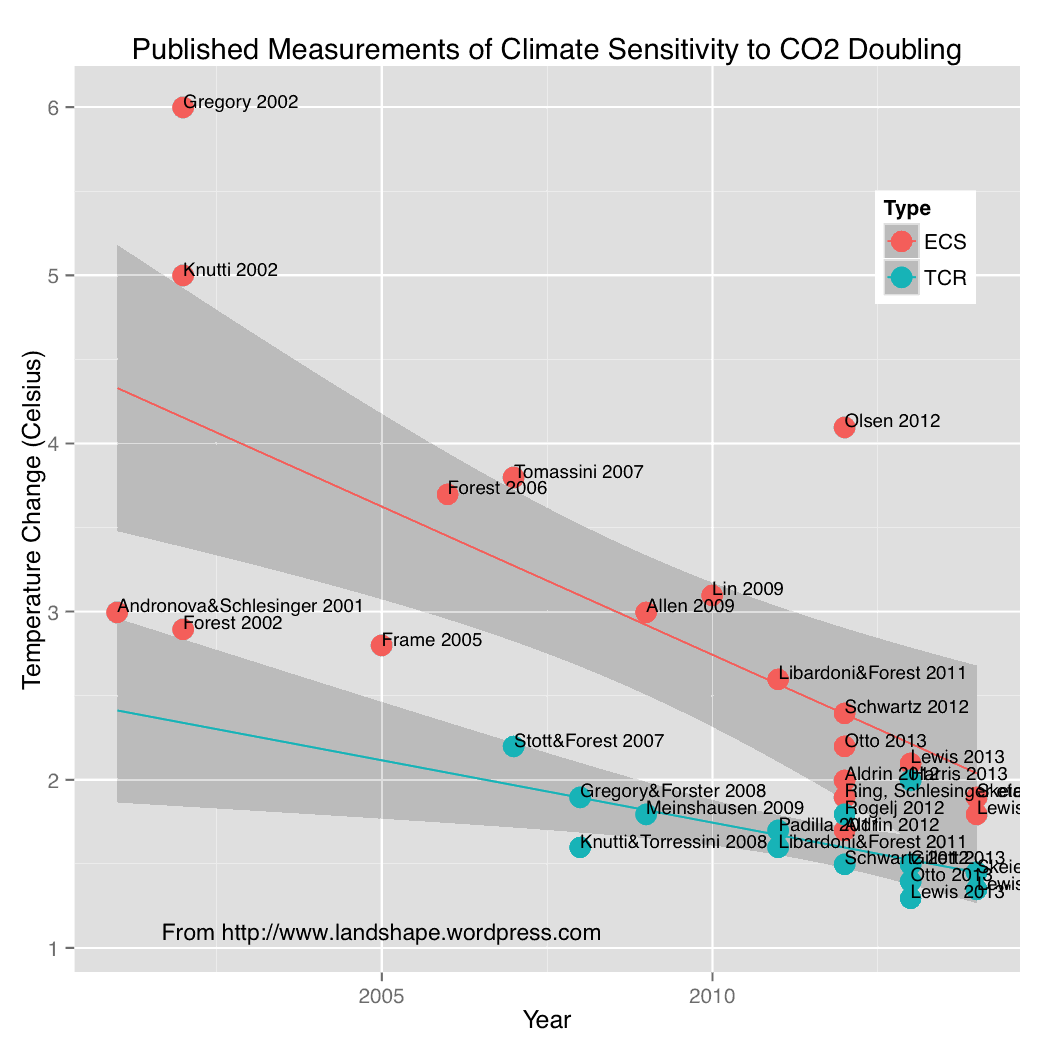
Neuere Studienergebnisse zu diesem Thema mit einem wesentlich geringeren Anstieg
wurden vom IPCC ignoriert.
Wie auch jüngst wieder durch PIK Professor Anders Levermann beim öffentlichen Fachgespräch im Umweltausschuss des Deutschen Bundestages am 28.11.18.
Doch auch Prof. Marotzke (MPI) gab kürzlich zu, dass die bisherige Annahme offenbar zu hoch ist.
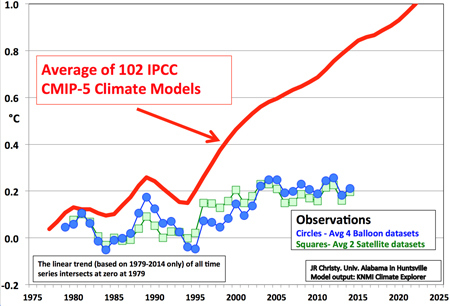
Dies wird durch den Vergleich des berechneten Temperaturanstieges mit der Realität der letzten 20 Jahre bestätigt.
Bis heute konnte der angebliche CO2-Effekt auf die Globaltemperatur nicht durch historische Fakten belegt werden,
sondern ist laut IPCC-Bericht eine Sache von "confidence", d.h. von Glauben oder Vertrauen.
Die Milchmädchen-Rechnung, die Klima-Politiker, Journalisten und etliche Klimatologen nicht machen können oder wollen, lautet wie folgt:
Bis zur Verdoppelung des CO2-Gehaltes von heute 400 auf 800 ppm vergehen bei den aktuellen Emissionen mit einem Anstieg von ca. 2 ppm pro Jahr noch 200 Jahre.
Das bedeutet real in 100 Jahren ca. + 1,5°C - genau das, was sich Politiker bei der Pariser Konferenz so vorgestellt haben, aber ohne kostspielige und risikoreiche CO2-Verminderungsmaßnahmen.
Das international anerkannte Modtran-Programm der Atmosphärenphysik
zeigt zwischen 400 und 800 ppm einen Temperaturanstieg von nur 1,7°C (anstelle von den 3°C des IPCC) mit Berücksichtigung des Sättigungseffektes, der ansonsten oft ignoriert wird.
Das wäre dann in 100 Jahren nur ein Anstieg um ca. +0,85°C.

Tatsächlich ist aber kein weiterer Anstieg der mittleren Globaltemperatur zu erwarten, sondern das Gegenteil:
sie wird in den nächsten 400 Jahren aller Wahrscheinlichkeit nach wieder um ca. 1,5°C absinken
- so, wie dies schon seit 8000 Jahren regelmäßig alle 1000 Jahre der Fall war,
zuletzt in der mittelalterlichen Kaltzeit (auch " Little Ice Age" genannt).
Dieser natürliche Klimazyklus basiert auf solaren und astrophysikalischen Faktoren und kann von Menschen nicht beeinflusst werden - genauso wenig wie andere Natur-Ereignisse wie Erdbeben und Vulkanausbrüche.
|
|
Klimasensitivität - Wer rechnet hier falsch? Der CO2-Treibhauseffekt: Die Klimasensitivität von CO2 Wenn die CO2-Konzentration zunimmt, ist die Erwärmung wegen der Sättigung kleiner Fehler der "Klimamacher", Teil I: Falscher CO2-Verstärkungseffekt des IPCC Neuste Informationen über den Klimawandel: Die Erwärmungspause |
↑ Wir sollten jetzt die realen und nachteiligen Folgen von Abkühlung fürchten

de
Eisbohrkernen zufolge war das letzte Jahrtausend von 1000 bis 2000
das kälteste Millenium des gegenwärtigen Interglazials.
en
According to ice core records, the last millennium 1000AD - 2000AD has
been the coldest millennium of our current Holocene interglacial.
-
EIKE Europäisches Institut für Klima und Energie
Ed Hoskins / Chris Frey
2018-09-09 de Wir sollten jetzt die realen und nachteiligen Folgen von Abkühlung fürchtenUnser gegenwärtiges warmes Interglazial hat es erst möglich gemacht, dass sich die Zivilisation der Menschheit während der letzten 10.000 Jahre entwickeln konnte - von frühesten Ackerbau-Methoden bis zu den jüngsten Technologien.
Eisbohrkernen zufolge war das letzte Jahrtausend von 1000 bis 2000 das kälteste Millenium des gegenwärtigen Interglazials.
Am deutlichsten wird dieser Umstand illustriert, wenn man die Ergebnisse aus den Eisbohrkernen im Zeitmaßstab von Jahrtausenden darstellt, und zwar zurück bis zum Zeitalter des Eemian.
-
Ice Age Now / Ed Hoskins
2018-09-01 de We should now fear the real and detrimental effects of coolingOur current, warm, interglacial has been the enabler of mankind's civilisation for the last 10,000 years, from mankind's earliest farming to the most recent technologies.
According to ice core records, the last millennium 1000AD - 2000AD has been the coldest millennium of our current Holocene interglacial.
This point is more fully illustrated with ice core records on a millennial basis back to the Eemian period here.
↑ Ach wie gut, dass niemand weiß, dass ich PDO heiß'
 Temperaturentwicklung in den USA während der Sommermonate.
Die Ähnlichkeit im Verlauf mit dem PDO-Ozeanzyklus ist frappierend
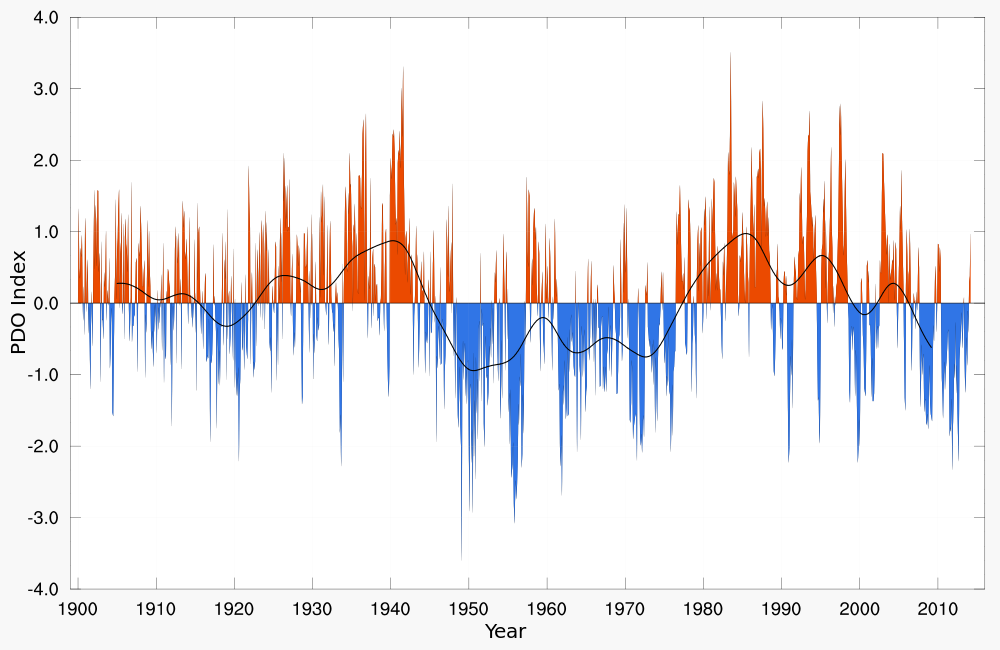 Verlauf des PDO-Ozeanzyklus
-
Die kalte Sonne (Fritz Vahrenholt & Sebastian Lüning)
2018-01-28 de Ach wie gut, dass niemand weiß, dass ich PDO heiß'Die Sommertemperaturen in den USA nahmen einen unerwarteten Verlauf in den letzten 90 Jahren.
In den 1930ern waren die Sommer ziemlich heiß, zum Teil sogar heißer als heute.
Dazwischen sackten die Temperaturen jahrzehntelang ab.
Extrapoliert man den Zyklus in die Zukunft,
kann man schon ahnen, was als nächstes kommt:
Die Sommer in den USA werden wieder kälter werden.
Ein Paper von Alter et al. 2017 kommt zu einem interessanten Schluss:
Die Sommertemperaturen in den USA hatten im letzten Jahrhundert wenig mit dem CO2 zu tun.
⇧ 2017
↑ 7 New (2017) Papers Forecast Global Cooling, Another Little Ice Age Will Begin Soon
-
NoTricksZone (Pierre L. Gosselin)
Kenneth Richard
2017-12-28 en 7 New (2017) Papers Forecast Global Cooling, Another Little Ice Age Will Begin Soon
During 2017, 120 papers linking historical and modern climate change to variations in solar activity and its modulators (clouds, cosmic rays) have been published in scientific journals.
en Skeptic Papers 2017: Part 1. Natural Mechanisms Of Weather, Climate Change
Solar Influence On Climate (120 Papers)
It has been increasingly established that low solar activity (fewer sunspots) and increased cloud cover (as modulated by cosmic rays) are highly associated with a cooling climate.
In recent years, the Earth has unfortunately left a period of very high solar activity, the Modern Grand Maximum. Periods of high solar activity correspond to multi-decadal- to centennial-scale warming.
Solar scientists are now increasingly forecasting a period of very low activity that will commence in the next few years (by around 2020 to 2025).
This will lead to climate cooling, even Little Ice Age conditions.
Thirteen recently-published papers forecasting global cooling are listed below.
The Sun is headed into a grand minimum, that is, a period of unusually low solar activity.
A relatively low number of or nonexistent sunspots are observed during the protracted solar minimum.
Since 1000 AD, there have been six protracted solar minimums, namely, the
- Oort minimum (1040-1080 AD),
- Medieval Minor minimum (1150 1200 AD),
- Wolf minimum (1270-1350 AD),
- Spörer minimum (1430-1520 AD),
- Maunder minimum (1620-1710 AD), and
- Dalton minimum (1787-1843 AD).
All the orbits of the planetary system are in disorder during the six protracted solar minimums.
en Nurtaev and Nurtaev, 2017
Long Term Trends in Climate Variability of Caucasus RegionIn accordance with National Geophysical Data Center (NGDC) forecasting the solar cycles 24 and 25 will be very weak:
averaged sunspot numbers W-35 for the solar cycle 24 and for the solar cycle 25 less than W-35 ,
This actually will lead to a decrease of the temperature on 0.5 - 0.7°C in both averaged solar cycles, in Geneva will decrease to 1.5 °C.
Temperature of air will be lower in the Northern Hemisphere.
Precipitation rate in Caucasus will be more in average on 100-150 mm in dependence from location.
The World Ocean level also will be lower, due to more snow and glacier accumulation on continents.
The Little Ice Age was a period of cooling that occurred after the Medieval Warm Perion.
Global warming has happened repeatedly over time: periodical cooling cycles anternated with warming.
Average near-surface temperatures of the northern hemisphere
during the past 11.000 years

The model computes
a new Dalton-type sunspot minimum from approximately 2025 to 2050
and a new Dalton-type period TSI minimum from approximately 2040 to 2065.
en Lüdecke and Weiss, 2017
Harmonic Analysis of Worldwide Temperature Proxies for 2000 YearsG7 [global temperature over the last 2000 years],
and likewise the sine representations have maxima of comparable size
- at AD 0,
- 1000, and
- 2000.
We note that the temperature increase of the late 19th and 20th century is represented by the harmonic temperature representation, and thus is of pure multiperiodic nature [it is of natural solar origin].
It can be expected that the periodicity of G7, lasting 2000 years so far, will persist also for the foreseeable future.
It predicts a
- temperature drop from present to AD 2050,
- slight rise from 2050 to 2130, and
- further drop from AD 2130 to 2200.
.

The summary curve shows a remarkable resemblance to the past sunspot and terrestrial activity:
grand minima
- Maunder Minimum (1645-1715 AD),
- Wolf minimum (1280-1350 AD),
- Oort minimum (1010-1050 AD) and
- Homer minimum (800 900 BC);
grand maxima
- modern warm period (1990-2015),
- medieval warm period (900-1200 AD),
-Roman warm period (400-10 BC) and others.
We confirm the occurrence
of upcoming Modern grand minimum in 2020-2053,
en Stozhkov et al., 2017
Cosmic rays, solar activity, and changes in the Earth's climate
Cooling (a drop in ΔT values) is expected in the next few decades.
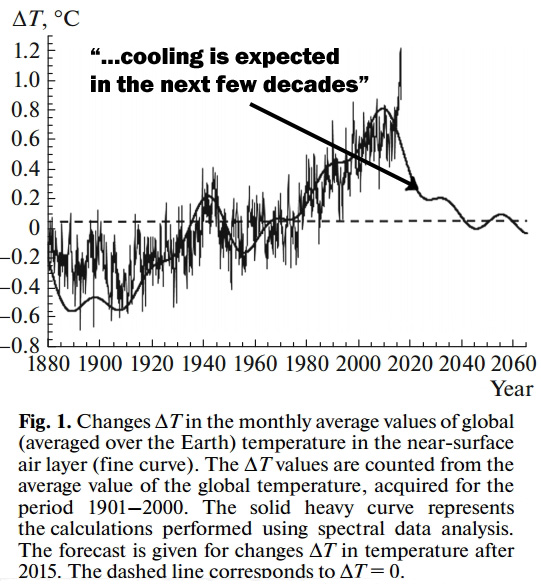
en Norman J Page, 2017 The coming cooling: Usefully accurate climate forecasting for policy makers


Based on the similarities of the Solar Cycles 5 and 24 we can expect a longer period of cold weather for the years 2022 y/o 2034, corresponding to the Solar Cycles 24 and 25.
... suggesting a solar decreasing trend toward grand (super) minimum conditions for the upcoming period, AD 2050-2250.
en Evans, 2016 Chapter 19 - The Notch-Delay Solar Hypothesis
The notch-delay hypothesis predicts sustained and significant global cooling starting sometime in the period 2017 to 2022, of ~0.3°C
The start of the TSI's Grand Minimum is anticipated in the solar cycle 27±1 in 2043±11 and the beginning of the phase of deep cooling of the 19th Little Ice Age for the past 7,500 years around 2060±11.
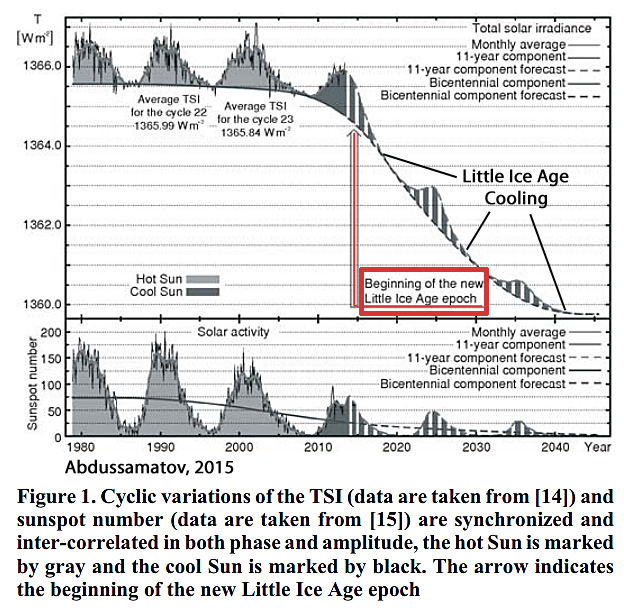
en Mörner, 2015 The Approaching New Grand Solar Minimum and Little Ice Age Climate Conditions
By about 2030-2040, the Sun will experience a new grand solar minimum.
en Lüdecke et al., 2015 Paleoclimate forcing by the solar De Vries/Suess cycle
It gives correctly the 1850-1900 temperature minimum and shows a temperature drop from present to ~ AD 2080, the latter comparable with the minimum of 1870,
as already predicted in the studies (Steinhilber and Beer, 2013; Liu et al., 2011) on the grounds of solar activity data alone.
↑ Die Sonne im Oktober 2017 und das Christ-Mädchen vor der Tür
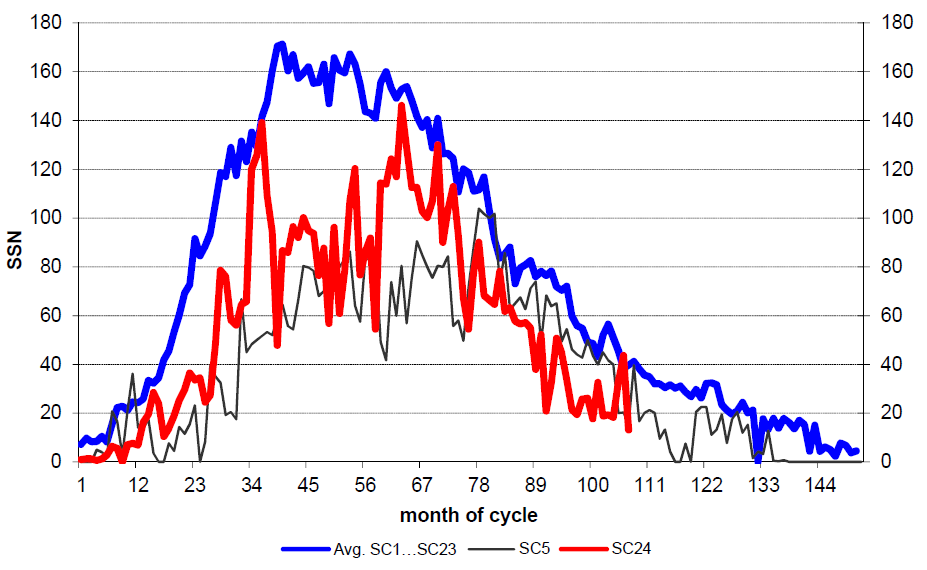 Die SSN- Zahlen des aktuellen Zyklus ( rot)
im Vergleich mit einem mittleren Zyklus ( blau)
und dem seit über 2 Jahren sehr ähnlichen Zyklus 5 (schwarz).
Auch auffällig: seit etwa einem Jahr erkennen wir einen Stillstand
("Hiatus") der Aktivität bei einer mittleren SSN von 25 und leichten
Pendelbewegungen um diesen Wert.
 Die Temperaturverteilung beim letzten großen El Niño unter dem
pazifischen Äquator.
Die Temperaturverteilung beim letzten großen El Niño unter dem
pazifischen Äquator.
Man erkennt die warmen Wässer vor allem bis in nur 100m Tiefe
im östlichen Pazifik
während die tieferen Schichten des Westpazifiks deutlich kühler
als normal sind.
 Die gleiche Darstellung wie Abb.3 nun unter La Niña- Bedingungen.
Der Ostpazifik bis weit westlich der Datumsgrenze bei 180° ist kühler
in den oberen Schichten,
dafür ist der Westpazifik vor allem in Schichten unter 100m viel
wärmer als normal.
-
Die kalte Sonne (Fritz Vahrenholt & Sebastian Lüning)
Frank Bosse und Fritz Vahrenholt
2017-11-20 de Die Sonne im Oktober 2017 und das Christ-Mädchen vor der TürUnser (fast) einziger Energielieferant im Zentrum des Sonnensystems war im Vormonat wieder so unternormal aktiv wie wir es - außer im September - immer vermelden mussten.
Die festgestellte Sonnenfleckenzahl (SunSpotNumber SSN) betrug im Monatsmittel 13,2.
Besonders zur Monatsmitte (vom 9. bis 20. d.M.) war die Sonne häufig - an 11 von 12 Tagen - gänzlich ohne Fleck.
Damit brachte es unser Zentralgestirn nur auf eine Aktivität, die bei 33% des zu diesem Zyklusmonat ( Nr. 107) üblichen lag.
Über den gesamten Zyklus betrachtet sahen wir damit nur 56% der Aktivität des mittleren Zyklus, gebildet aus dem Mittelwert aller bisher vollendeten 23 Zyklen, blau im Bild unten.
↑ Milder Oktober 2017: Eine bloße Laune der Natur?
-
EIKE Europäisches Institut für Klima und Energie
Josef Kowatsch, Stefan Kämpfe
2017-10-29 de Milder Oktober 2017: Eine bloße Laune der Natur?Nach dem rauen September bescherte uns der Oktober wenigstens noch eine Woche mit sehr warmen, oft sonnigen Spätsommertagen;
Am Monatsanfang und zum Ende war es aber spätherbstlich kühl.
Wie die meisten anderen Monate, so hat sich auch der Oktober seit 1881 in Deutschland merklich erwärmt
- allerdings scheint diese Erwärmungsphase mit Beginn der 2000er Jahre beendet zu sein, und extrem zu warm war dieser Oktober sowieso nicht, wie ein Blick in die Vergangenheit zeigt.
Oktobertemperaturen über die letzten 230 Jahre
Die Oktobertemperaturen auf dem HPB verhalten sich wie eine Schwingung mit zwei Wellenbergen und einem Wellental.
Sie waren zu Beginn der Betrachtung auf einem ähnlichen hohen Niveau wie heute.
Die Kältedepression lag im Zeitraum 1860 bis1910.

Die Sonnenaktiviät
Im letzten Drittel des 19. Jahrhunderts kam es vorerst letztmalig zu einer geringeren Sonnenaktivität;
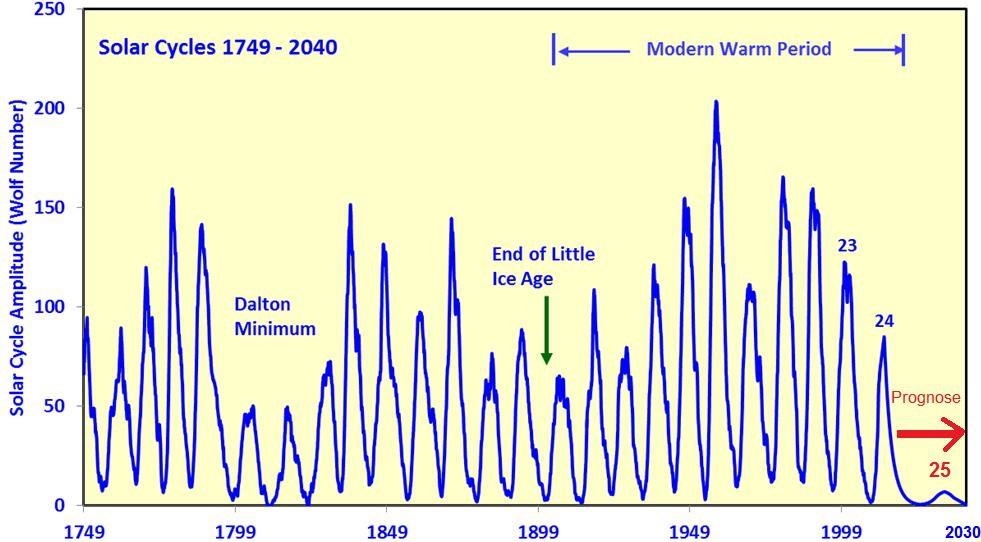
um 1900 endete die Kleine Eiszeit ("End of Little Ice Age").
Mit dem schon merklich schwächeren 24. SCHWABE- Zyklus (Maximum 2014) hat möglicherweise der Übergang in eine neue Kleine Eiszeit bereits begonnen.

Nachtrag der kalten Sonne vom 8. November 2017
Der Oktober 2017 in Deutschland war mild.
Darüber sollte man sich freuen.
Im Kontext der letzten 20 Jahre war die kleine Wärmespitze jedoch nichts Besonderes.
Entwicklung der Oktober-Temperaturen in Deutschland ab 1995

↑ Hat die globale Abkühlung begonnen?
↑ Hartmut Hüne: Haben Sonnenwind und Planetenstellungen Einfluss auf unser Wetter bzw. Klima?
-
EIKE Europäisches Institut für Klima und Energie
Hartmut Hüne
2017-09-26 de Haben Sonnenwind und Planetenstellungen Einfluss auf unser Wetter bzw. Klima?Unser Wetter- und Klimageschehen ist stark beeinflusst von der Wechselwirkung zwischen Sonnenwind und kosmischer Strahlung.
Starke Sonneneruptionen reduzieren die auf der Erde gemessene kosmische Strahlung (Forbush-Effekt).
Treten zusätzlich einseitige Planetenstellungen auf, verstärkt sich dieser Effekt noch.
Dr. Borchert (12. Nov. 2015 verstorben; ehem. EIKE Mitglied) hat dieses Verhalten in der letzten Erwärmungsdekade (bis 1998) in allen Einzelheiten untersucht und seine Arbeit - Using Satellite Measurements to study the Influence of Sun Activity on Terrestrial Weather - zu der Tagung der "Amerikanischen Meteorologie" 2010 eingereicht.
Sein dortiger Vortrag über diese Arbeit stieß auf eine breite positive Resonanz und Anerkennung.
Auszug aus "Die Wirkungsweise von Emissionen der Sonnenflecken auf unsere Erde" (Dr. Borchert, 2013):
Da der Mechanismus der Klimawirkung von CO2 als falsch erkannt worden ist, sollte der Mechanismus der Klimabeeinflussung und auch anderer Störungen auf der Erde durch die Sonnenaktivität genauer bekannt sein.
Aus den Messungen solarer Protonen, Elektronen und Röntgensignalen, die von Satelliten der NOAA gewonnen werden, und aus Messergebnissen des weltweiten Neutronenmessnetzes kann ein Weg der Einwirkung von Partikelemissionen der Sonne auf die Erde gezeigt werden.
Die Periodizitäten der Sonnenflecken werden nach gängiger Meinung verursacht durch stochastisch bedingte Magnetströme im Inneren der Sonne.
In letzter Zeit wird eine systematische Steuerung dieser Periodizitäten durch die Konstellation der Planeten zur Sonne nicht mehr ausgeschlossen.
Der von P. Jose-Havard 1964 berechnete zeitliche Verlauf des Drehimpulses der Sonne, bezogen auf den Schwerpunkt des Sonnensystems in Abhängigkeit von der jeweiligen Stellung der vier großen Gasplaneten Jupiter, Saturn, Neptun und Uranus ist von Jose festgestellt worden
mit einem Zyklus der vier großen Planeten von 178,8 Jahren
(auch von Landscheidt 2004, ETH, Solheim, Scafetta, Frau Präsidentin Prof. Dr. Richards der Internationalen Astronomischen Union 2015).
Mittels einer Planetensoftware wurde nun von mir dieser 178,8 Zyklus über ca. 2.800 Jahre untersucht.
Nach ca. 19,866 Jahren stehen sich Jupiter und Saturn immer wieder in einer Reihe gegenüber.
Die Umlaufzeiten schwanken von 6.912 bis 7.492 Tagen, jeweils bezogen darauf, ob die beiden Planeten näher (Erde = kühler) oder ferner (Erde = wärmer) zur Sonne stehen.
Grundsätzlich gibt es zwei aufsteigende und dann einen absteigenden Knoten - siehe Abb. 11 (Graphik oben).
Nach 23 solcher Umläufe von ca. 460 Jahren erfolgt eine Umkehrung.
Nach ca. 920 Jahren stellt sich der erste Zustand wieder ein.
Interessant ist, dass der 59,6 Jahre-Zyklus (3×19,866 Jahre) mit der atlantischen Oszillation deckungsgleich ist.
Neben den 2-fachen Planetenstellungen gibt es auch 3-fache Stellungen
sowie alle 178,8 Jahre die große 4-fache Stellung, die nach 9 Umläufen von Jupiter und Saturn immer wieder präzise erscheinen.
Grundsätzlich gibt es einen durchgehenden nachweisbaren Zyklus über die 2800 Jahre mit den Planetenstellungen Jupiter + Uranus und Saturn + Neptun.
Zusätzlich wurden zwei weitere parallele Zyklen festgestellt, der zweite 4-fache Zyklus ist nachweisbar bis 1140, macht dann eine Pause und ist ab 629 wieder vorhanden.
Der dritte 4-fache Zyklus ist nur bis 1268 nachweisbar (Abb. 9-2).
Im Bereich von 800 bis um 1350 n.Chr. waren in der mittelalterlichen Warmzeit nur sehr wenige 3-fache und 4-fache Planetenstellungen zu beobachten - die Parallelste um 1306,61.
Ganz anders in der "Kleinen Eiszeit" von ca. 1620 bis 1710; hier wurden nur geringe oder keine Sonnenflecken auf der Sonne beobachtet und wir hatten zusätzlich in diesem Zeitraum sieben 3- und 4-fache Planetenstellungen, die einen nicht unwesentlichen Einfluss auf den beschriebenen Forbush-Effekt ausübten!
Nach Borchert: Ein Vergleich der meteorologischen Zeitreihen mit dem Verlauf der in Moskau gemessenen Neutronenstrahlung der Sekundärstrahlung ergab einen um etwa 7 Tage verzögerten Rückgang der Bewölkung gegenüber der Forbush-Reduktion.
Nach meinen Untersuchungen/Beobachtungen ist die Zeitverschiebung bzgl. der Abnahme der Bedeckungen abhängig von der Intensität des Sonnenwindes, ob es sich um einen CME, einen Flare oder wie in den letzten Monaten um ein Black Hole handelt.
Ich habe schon bei einem CME nur 3 bis 5 Tage an Zeitverzögerung festgestellt, bei Black Hols ergeben sich erheblich größere Zeitverschiebungen!
Der Forbush-Effekt ist dafür verantwortlich, dass die kosmische Strahlung, wenn sie auf den Sonnenwind trifft, einen reduzierten energetischen Schauer über der Erde erzeugt, der durch den Neutronen-Monitor zB. Moskau - Boulder (USA) messtechnisch erfasst wird.
Kosmische Strahlung bei 4-facher Planetenstellung von 1984

Im Jahre 1984,25 hatten wir einen 4-fachen Planetenzyklus von 178,8 Jahren, entsprechend der dritten Planetenstellungen - Jupiter + Neptun - Saturn + Uranus.
DAS führte zu einer Zunahme der kosmischen Strahlung von ca. 18%.
Über mehrere Jahre musste ich große Schneemengen von meinem Grundstück beseitigen (Kältedauer ca. 3-4Jahre)!
Kosmische Strahlung bei 4-facher Planetenstellung von 1996

Im Jahre 1996,91 hatten wir einen weiteren 4-fachen Planetenzyklus von 178,8 Jahren entsprechend der ersten Planetenstellung - Jupiter + Neptun - Saturn + Uranus.
Das führte zu einer Zunahme der kosmischen Strahlung von ca. 14%, in der Warmdekade.
Die Abkühlung war messtechnisch erkennbar, war aber nicht sehr stark (Kältedauer ca. 3 Jahre)!!
Kosmische Strahlung bei einer 3-fachen Planetenstellung von 2009

Im Jahre 2009,7 wurde ein 3-facher Planetenzyklus entsprechend der Planetenstellung - Jupiter + Saturn + Uranus festgestellt.
Das führte zu einer Zunahme der kosmischen Strahlung von ca. 12%, in der ausklingenden Warmdekade.
Diese Abkühlung wurde von mir Anfang 2009 vorhergesagt, mit einer Zeit von ca. 3 Jahren.
Von 2009 auf 2010 hatten wir mehrere Wochen eine Schneehöhe von ca. 25cm und eine Temperatur von bis zu minus 24 C°. (Kältedauer ca. 3 Jahre)!
Kosmische Strahlung von 2000 bis 2017 und die Direktmessung

Seit 2000 gab es eine Zunahme der kosmischen Strahlung um ca. 19%.
Es deckt sich mit der direkt gemessenen kosmischen Strahlung vom 03.2015 bis 06.2017 um ca. 13%!
Messungen der NASA: Kosmische Strahlung von 2015 bis 2017
Eike
Cosmic Rays - Spaceweather.com
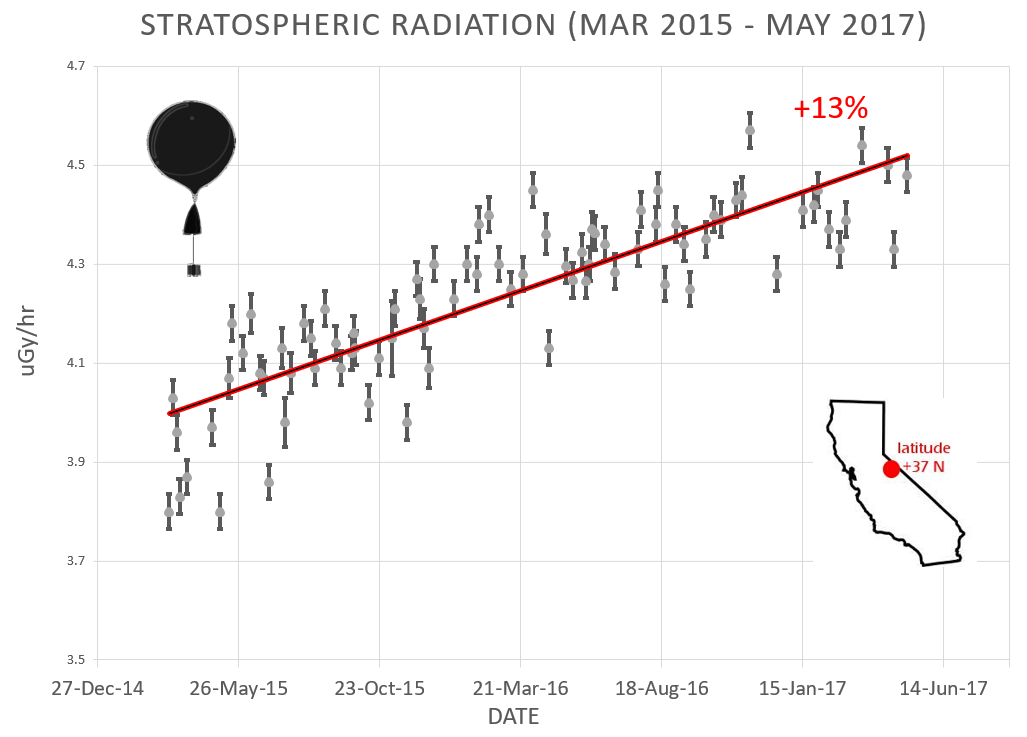
Messungen der NASA zeigen, dass sich die kosmischen Strahlen mit einer Zunahme von mehr als 13% seit 2015 verstärken.
Warum werden kosmische Strahlen intensiviert?
Der Hauptgrund ist die Sonne.
Solare Sturmwolken wie koronale Massenauswürfe (CMEs) fegen die kosmischen Strahlen weg, wenn sie an der Erde vorbeifliegen.
Während eines Solar-Maximums sind CMEs reichlich vorhanden und kosmische Strahlen werden in Schach gehalten.
Nun aber schwingt der Sonnenzyklus auf das Solar-Minimum, so dass kosmische Strahlen zurückkehren können.
Ein weiterer Grund könnte die Schwächung des Magnetfeldes der Erde sein, die uns vor der Tiefenstrahlung schützt.
Voraussage:
Abkühlung bis nach 2040 durch 3- und 4-fache Planetenstellungen.
Zusammenfassung:
Auf Grund der oben festgestellten zusätzlichen Auswirkungen der Sonnenmagnetfelder durch die 3- und 4-fachen Planetenstellungen wird eine Zunahme der kosmischen Strahlung erfolgen und damit verbunden eine Abkühlung auf der Erde.
Für die 4-fachen Planetenstellungen um 2024,33 und um 2035,21 (Kältedauer ca. 3-4 Jahre) können wir mit einer erheblich GRÖSSEREN Abkühlung als von 1984 rechnen!

| de | en | fr |
|---|---|---|
|
Klima: Wandel Ursachen des Klimawandels |
Climate: Change Causes of Climate Change |
Climat: Changement Les causes du changement climatique |
|
Einflüsse auf das Klima Temperatur der Erde Klima-Beobachtungen Neuste Meldungen zum Klimawandel |
Impacts on Climate Change Earth Temperature Climate Observations News on Climate Change |
Impacts sur le climat Température de la terre Observations sur le climat Dernières nouvelles sur le changement climatique |
↑ en Correlation of Accumulated Cyclone Energy and Atlantic Multidecadal Oscillations
Mittelfristig lässt sich die Hurrikanaktivität ganz gut vorhersagen, denn sie ist eng an den AMO-Ozeanzyklus gekoppelt, die Atlantische Multidekadenoszillation, die eine Periodizität von 60 Jahren besitzt.
Michel de Rougemont erinnerte daran in einem Aufsatz in WUWT.
-
Watts UP With That? (Antony Watts) / Michel de Rougemont
2017-09-04 en Correlation of Accumulated Cyclone Energy and Atlantic Multidecadal OscillationsVarious sources, scientists publishing their opinion in the media, claim that Tropical Storm Harvey, recently landed in Texas, is one more signal of the influence of global warming on such catastrophic events.
These claims are based on model calculations.
Let's examine the facts.
In the Atlantic Ocean, sea surface temperature oscillations are
observed as a multidecadal cycle (AMO).
 The total energy accumulated each year by tropical storms and
hurricanes (ACE) is also showing such a cyclic pattern.
The total energy accumulated each year by tropical storms and
hurricanes (ACE) is also showing such a cyclic pattern.
 A correlation between ACE and AMO is confirmed by regression
analysis.
A correlation between ACE and AMO is confirmed by regression
analysis.

↑ Erster Sonnenfleck des neuen Sonnenzyklus Nr. 25 ist da! Schwache Sonne - kühle Erde!
-
WOBLEIBTDIEGLOBALEERWAERMUNG
2017-08-20 de Erster Sonnenfleck des neuen Sonnenzyklus Nr. 25 ist da! Schwache Sonne - kühle Erde!Es tut sich was auf der Sonnenoberfläche:
Im schwächsten Sonnenzyklus (SC 24) seit 200 Jahren ist der erste Sonnenfleck mit umgekehrter Polarität auf der Südhälfte der Sonne aufgetaucht!
Wir gehen für Jahrzehnte global kühleren Zeiten entgegen!
Das Auftauchen eines Sonnenflecks mit "falscher" Polarität ist zuammen mit der relativen Äquatorferne dieses Flecks ein sicheres Zeichen für den Beginn einer mehrjährigen Übergangsphase vom aktuellen SC 24 zum neuen schwachen SC 25.
-
WOBLEIBTDIEGLOBALEERWAERMUNG
2017-09-03 de Kühler Herbst und kalter Winter?Mehr als 60 cm Neuschnee auf der Zugspitze! Der Schneefall dauert an! webcam.
Starke Schneefälle in den Alpen bis 1800 m: Live-Video.
Nach einem durchschnittlich temperierten Sommer 2017 in Deutschland steht das NOAA-Wettermodell CFSv2 für den Herbst und vor allem für den kommenden Winter weiter auf "Kalt".
In Ostsibirien hat es Ende August 2017 ungewöhnlich frühe Schneefälle gegeben, die dort zu großflächigen Stromausfällen und der Ausrufung des Ausnahmezustandes führten, wie das ZDF heute in seinem Videotext meldet.
Eine frühe Einwinterung in Sibirien bereits Ende August könnte auch eine frühe Einwinterung in Nordosteuropa im Oktober 2017 nach sich ziehen: Eine gute Voraussetzung für einen kalten Winter auch bei uns in Mitteleuropa.
Neuer Juli-Kälterekord mit -33°C auf Grönland!
↑
Temperaturschwankungen der letzten 450.000 Jahre
Holozän Interglaziale Epoche: 8000 BC - 2000AC
en
Temperature record for the last 450.000 years
Holocene interglacial epoch: 8000BC - 2000AC
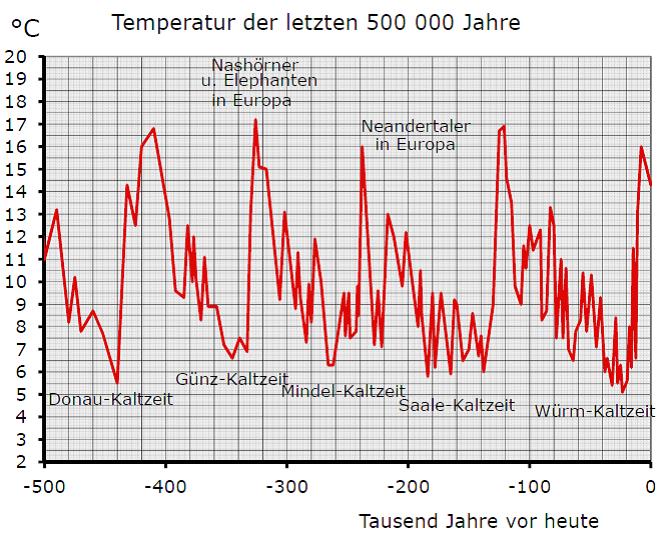 Das zyklische Auftreten von kurzen Warmzeiten während der
aktuellen Eiszeit
Das zyklische Auftreten von kurzen Warmzeiten während der
aktuellen Eiszeit
Wenn sich der Klimazyklus der vergangenen 500'000 Jahre so fortsetzt,
dann könnte das bedeuten, dass in wenigen tausend Jahren
wieder der Rückfall auf das echte Eiszeit-Temperaturniveau
mit Ausbreitung der Gletscher über Kanada und Skandinavien eintreten würde.
 de
en
de
en
Temperaturschwankungen der letzten 450.000 Jahre.
Zum einen sind die Temperaturschwankungen zyklisch und zum anderen
ist das heutige Niveau vergleichsweise niedrig!
 Antarctica EPICA and VOSTOK Ice Cores
-
EIKE Europäisches Institut für Klima und Energie
Ed Hoskins / Chris Frey
2017-07-23 de Die Welt sollte jetzt die realen und schädlichen Auswirkungen von Abkühlung fürchten
 Holozän Interglaziale Epoche: 8000 BC - 2000AC
Das Holozän-Interglazial dauert nunmehr bereits seit 10.000 bis 11.000 Jahren an,
und zieht man die zeitliche Länge früherer Interglaziale als Vergleich heran, müsste die Epoche des Holozäns in diesem Jahrhundert zu ihrem Ende kommen
- vielleicht aber auch erst im nächsten Jahrhundert oder in diesem Millenium.
↑ Mini Ice Age by 2021 not 2024, Every Continent Will be Affected
-
2017-01-06 en
Mini Ice Age by 2021 not 2024, Every Continent Will be Affected
New news headline out as NASA admits Mini Ice Age coming faster than anticipated.
All continents are now showing signs of cooling.
With summer snow in New Zealand, record snow in Athens, Central Asia record cold, North America record snows, Sahara desert snows, Middle East blizzard, and Australia 5X rains and desert floods.
Get ready as there is no where to run
↑
SNF: Einfluss der Sonne auf den Klimawandel erstmals beziffert
en
SNF: Current Weak Solar Cycle Could Reduce Global Temperatures By
Half A Degree
-
Wikipedia
de
Schweizerischer Nationalfonds (SNF)
Schweizerische Nationalfonds zur Förderung der wissenschaftlichen Forschung
en Swiss National Science Foundation (SNSF)
fr Fonds national suisse de la recherche scientifique (FNS)
-
Schweizerischer Nationalfonds (SNF)
2017-03-27 de Einfluss der Sonne auf den Klimawandel erstmals beziffertModellrechnungen zeigen erstmals eine plausible Möglichkeit auf, wie Schwankungen der Sonnenaktivität einen spürbaren Effekt auf das Klima haben.
Gemäss den vom Schweizerischen Nationalfonds geförderten Arbeiten könnte sich die menschgemachte Erderwärmung in den nächsten Jahrzehnten leicht verlangsamen:
Eine schwächere Sonne wird voraussichtlich ein halbes Grad Abkühlung beitragen.
-
EIKE Europäisches Institut fü Klima und Energie
2017-04-03 de Klima : Es ist die Sonne - welche Neuigkeit!Schweizer Studie: Nicht der Mensch, die Sonne erwärmt das Klima.
Weltwoche, Ausgabe 13/2017 vom 31. März 2017 / Markus Schär
Jürg Beer im September 2013
Mit der Leistung von hundert Millionen Kernkraftwerken strahle die Sonne auf die Erde ein, betonte Jürg Beer, als die führenden Schweizer Forscher im September 2013 den neuen Bericht des Weltklimarates IPCC vorstellten.
Der Experte von der Eawag, dem Wasserforschungsinstitut (!) der ETH, sprach über den Einfluss der Sonne auf die Klimaänderungen;
er sah aber darüber hinweg, dass sich auf seinen Grafiken die Schwankungen der Sonnenaktivität und der Temperaturen über die Jahrhunderte auffallend deckten.
Denn der IPCC dekretiert seit je:
Ob die Sonne stärker oder schwächer scheint, beeinflusst das Klima nicht.
Und jetzt das:
«Einfluss der Sonne auf den Klimawandel erstmals beziffert»,
meldete der Schweizerische Nationalfonds am Montag.
Ein Team des Physikalisch-Meteorologischen Observatoriums Davos sowie von Eawag, ETH und Uni Bern schätzte aufgrund von «aufwendigen Modellrechnungen» den Beitrag der Sonne zu den Temperaturänderungen und fand dabei einen «signifikanten Effekt».
Wenn sich die Sonnenaktivität wie erwartet abschwächt, dürfte sich das Erdklima um 0,5 Grad abkühlen - das ist wenig, aber mehr als die Hälfte der 0,8 Grad, um die sich das Erdklima seit dem 19. Jahrhundert angeblich besorgniserregend erwärmt hat.
Und vor allem stellte Projektleiter Werner Schmutz fest, die Schwankungen der Sonnenaktivität seien «der einzige Ansatz, um die natürlichen Klimaschwankungen der letzten paar tausend Jahre zu verstehen».
Wie bitte?
Fritz Vahrenholt, vorher Umweltpolitiker, Windkraft-Unternehmer und Weltklimarat-Experte, gab vor fünf Jahren mit dem Geologen Sebastian Lüning das Buch «Die kalte Sonne» heraus.
«Die Sonne befand sich in den letzten Jahrzehnten in einer ihrer aktivsten Phasen der vergangenen 10'000 Jahre», stellten die beiden Wissenschaftler fest:
Die Erde genoss ein «Grosses Solares Maximum» wie um das Jahr null und das Jahr 1000 - als ein ebenso günstiges Klima herrschte wie heute.
Und das Duo sagte bis 2035 wegen der schwachen Sonnenaktivität eine Abkühlung um ein halbes Grad voraus.
Laut Wikipedia wurden diese Thesen in der Fachwelt aber «einhellig verworfen».
Jetzt kommen Schweizer Forscher «erstmals» zur Erkenntnis, dass sich der Klimawandel nur mit der Sonnenaktivität erklären lässt.
Das ist eine solche Sensation, dass Tages-Anzeiger, NZZ und Blick natürlich nicht darüber berichteten.
Kommentar vom EIKE-Admin
Das ist ja die Ironie. Diese Leute von der ETH tun so als ob sie gerade das Rad erfunden haben.
Graphik: Horst Malberg vom 28.01.2014
Graphik: Horst Malberg vom 28.01.2014

-
Die kalte Sonne (Fritz Vahrenholt & Sebastian Lüning)
2017-03-30 de Einfluss der Sonne auf den Klimawandel erstmals beziffertDringende Leseempfehlung auch für den Beitrag "Es ist die Sonne" von Markus Schär in der Weltwoche vom 29. März 2017:
Klima: Es ist die Sonne
Schweizer Studie: Nicht der Mensch, die Sonne erwärmt das Klima
[...] Und vor allem stellte Projektleiter Werner Schmutz fest, die Schwankungen der Sonnenaktivität seien «der einzige Ansatz, um die natürlichen Klimaschwankungen der letzten paar tausend Jahre zu verstehen».
Wie bitte?
Fritz Vahrenholt, vorher Umweltpolitiker, Windkraft-Unternehmer und Weltklimarat-Experte, gab vor fünf Jahren mit dem Geologen Sebastian Lüning das Buch «Die kalte Sonne» heraus.
«Die Sonne befand sich in den letzten Jahrzehnten in einer ihrer aktivsten Phasen der vergangenen 10 000 Jahre», stellten die beiden Wissenschaftler fest:
Die Erde genoss ein «Grosses Solares Maximum» wie um das Jahr null und das Jahr 1000 - als ein ebenso günstiges Klima herrschte wie heute.
Und das Duo sagte bis 2035 wegen der schwachen Sonnenaktivität eine Abkühlung um ein halbes Grad voraus.
Laut Wikipedia wurden diese Thesen in der Fachwelt aber «einhellig verworfen».
Jetzt kommen Schweizer Forscher «erstmals» zur Erkenntnis, dass sich der Klimawandel nur mit der Sonnenaktivität erklären lässt.
Das ist eine solche Sensation, dass Tages-Anzeiger, NZZ und Blick natürlich nicht darüber berichteten.
-
Watts Up With That? (Antony Watts)
2017-03-31 en Current Weak Solar Cycle Could Reduce Global Temperatures By Half A DegreeFor the first time, model calculations show a plausible way that fluctuations in solar activity could have a tangible impact on the climate.
Studies funded by the Swiss National Science Foundation expect human-induced global warming to tail off slightly over the next few decades.
A weaker sun could reduce temperatures by half a degree.
↑ de Russian scientists predict global cooling in the next few decades
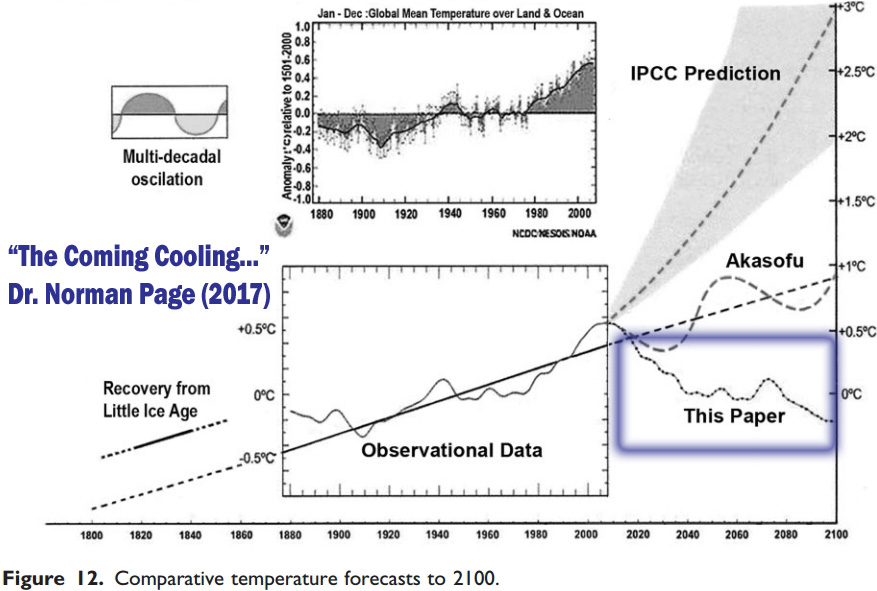 Comparative temperature forecasts to 2100
-
NoTricksZone (Pierre L. Gosselin)
2017-03-23 en Russian Scientists Dismiss CO2 Forcing, Predict Decades Of Cooling, Connect Cosmic Ray Flux To ClimateA new scientific paper authored by seven scientists affiliated with the Russian Academy of Sciences was just published in the scientific journal Bulletin of the Russian Academy of Sciences: Physics.
Scientific Papers Predict Cooling In Coming Decades
-
GWPF The Global Warming Policy Forum
2017-03-15 de Russian scientists predict global cooling in the next few decades
↑ de Unheimliche Korrelation zwischen Sonnenaktivität und Temperatur: Ganz sicher kein Zusammenhang?
-
Die kalte Sonne (Fritz Vahrenholt & Sebastian Lüning)
2017-01-25 de Unheimliche Korrelation zwischen Sonnenaktivität und Temperatur: Ganz sicher kein Zusammenhang?Solare Vorhersagen
Die Forscher sind sich mittlerweile weitgehend einig, dass die Sonne bis mindestens in die 2030er Jahre schwach bleibt.
Bemühungen laufen, um die solaren Vorhersagen noch verlässlicher zu machen.
Dabei wurde nun klar, dass sich das Sonnenmagnetfeld dafür viel besser eignet, als die üblicherweise angeführten Sonnenflecken, wie in Eos im Februar 2016 nachzulesen war:
Das PMOD-Modell
Im Jahr 2015 veröffentlichte eine Gruppe um Velasco-Herrera in New Astronomy Rekonstruktionen der Sonnenaktivität für die vergangenen 1000 Jahre sowie Prognosen bis 2100. Hier das PMOD-Modell:
Rekonstruktion der Sonnenaktivität für die vergangenen 1000 Jahre sowie
Prognose bis 2100 (PMOD-Modell). Y-Achse: Total Solar Irradiance (power anomalies).
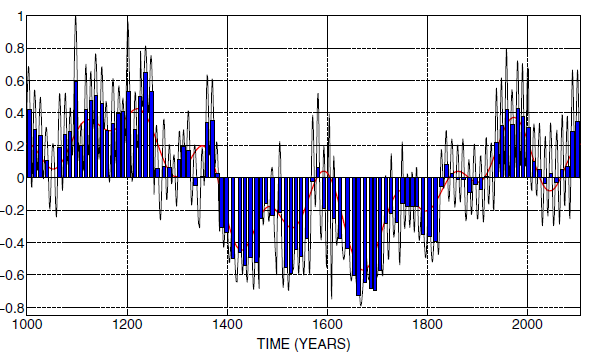
Erinnert Sie die Verlaufsform der Kurve auch an irgendetwas?
Man mag es gar nicht aussprechen:
Mittelalterliche Wärmeperiod, Kleine Eiszeit und Moderne Wärmeperiode (Abb. 2) sind in der Sonnenaktivitätskurve (Abb. 1) deutlich auszumachen.Die Y-Achse der Graphik gibt wohlgemerkt die Sonnenaktivität wieder.
Das Tal in der Kurve rechts vom Jahr 2000 ist das sich gerade entwickelnde solare Tief, das bis Mitte des Jahrhunderts anhalten soll, um danach bis 2100 wieder anzusteigen.
Temperaturentwicklung der letzten 2000 Jahre auf der außertropischen
Nordhemisphäre
RWP = Roman Warm Period
DACP = Dark Ages Cold Period
MWP = Medieval Warm Period
LIA = Little Ice Age
CWP = Modern Warm Period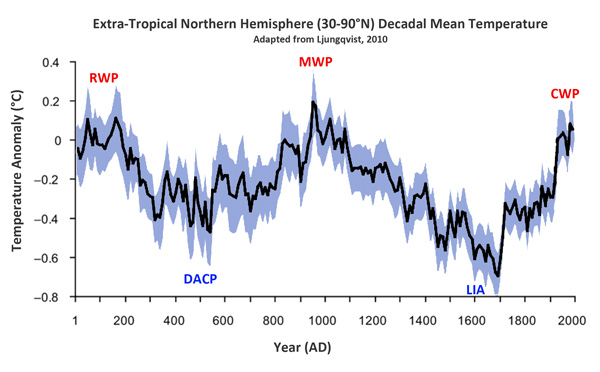 Wassertemperaturen der vergangenen 2000 Jahre

Andere solare Vorhersagen
Andere solare Vorhersagen sind hier weniger optimistisch und prognostizieren eine schwache Sonne gleich für die kommenden 300 Jahre.
So zeigen Matthes et al. 2016 eine Vorhersage der galaktischen Kosmischen Strahlung (GCR), die durch das Sonnenmagnetfeld moduliert wird. Je stärker die Sonne und ihr Magnetfeld, desto geringer die GCR. Die Zeit bis 2300 ist im Modell von Matthes et al. 2016 durch hohe GCR-Werte (also eine schwache Sonne) gekennzeichnet:
⇧ 2016
↑
Beginnt die globale Abkühlung?
Globale Mitteltemperatur stürzt um mehr als 1 °C steil ab.
en
Steepest drop in global temperature on record

-
EIKE Europäisches Institut für Klima und Energie
Michael Limburg
2016-12-01 de Beginnt die globale Abkühlung? Globale Mitteltemperatur stürzt um mehr als 1 °C steil ab.Die globale Mitteltemperatur über Land zeigt eine noch nie so gemessene steile Abkühlung von 1,2 K.
Die Medien übergehen diese dramatische Abkühlung mit Schweigen.
Setzt sie sich fort, stehen wir evtl. am Beginn einer neuen "kleinen Eiszeit".
Nichts würde ich mehr bedauern als das.
-
Watts Up With That? (Antony Watts)
2016-11-28 en Steepest drop in global temperature on record
-
Global average temperatures over land have plummeted by more than 1C
-
Comes amid mounting evidence run of record temperatures about to end
-
The fall, revealed by Nasa satellites, has been caused by the end of El Nino
This means it is possible that by some yardsticks, 2016 will be declared as hot as 2015 or even slightly hotter - because El Nino did not vanish until the middle of the year.
But it is almost certain that next year, large falls will also be measured over the oceans, and by weather station thermometers on the surface of the planet - exactly as happened after the end of the last very strong El Nino in 1998.
If so, some experts will be forced to eat their words.
-
Quelle / Source:
-
THE MAIL ON SUNDAY / DAVID ROSE
2016-11-26 en Stunning new data indicates El Nino drove record highs in global temperatures suggesting rise may not be down to man-made emissions
↑ de Sonne in der Krise. Warm anziehen!
-
Die kalte Sonne (Fritz Vahrenholt & Sebastian Lüning)
2016-07-26 de Sonne in der Krise. Warm anziehen!
↑ en World Government Think Tanks Ready for Global Food Shortages: Timeline and Which Countries
-
2016-06-29 en
World Government Think Tanks Ready for Global Food Shortages:
Timeline and Which Countries
FEMA representatives came out and said that food shortages will abound by 2020 and food prices will rise by 400%.
This summary was from the larger Food Chain Reaction Global Food Security Group Workshop.
The findings were startling.
All governments across the planet know the Grand Solar Minimum is arriving, and they had this exercise to discover the ramifications on our global food yields and delivery systems.
Losses and chaos were the outcomes.
SOLUTION:
South East Asia Water And Power Alliance as envisioned by Thone Siharath, one of his many big project to use abundance of water in Laos for mass food and quality goods production that will feed real physical economy, feeding world population, greening the deserts, creating new international cities across the Equator, connecting Earth to space and explore the universe.
↑ de Forschergruppe um Michael Mann: Es könnte noch bis zu zwanzig Jahre dauern, bis die Erwärmung wieder kräftig anzieht
-
Die kalte Sonne (Fritz Vahrenholt & Sebastian Lüning)
2016-05-19 de Forschergruppe um Michael Mann: Es könnte noch bis zu zwanzig Jahre dauern, bis die Erwärmung wieder kräftig anzieht
↑ en New NOAA forecast suggests current El Niño will fade fast, and be replaced by a strong cooling La Niña this year
-
Watts Up With That? (Antony Watts)
2016-02-19 en New NOAA forecast suggests current El Niño will fade fast, and be replaced by a strong cooling La Niña this year
↑ Neue Eisbrecher, LNG und Ethanol
Eisbrecher
-
NDR
2015-10-04 de
Neue Eisbrecher für den Hamburger Hafen
-
Die kalte Sonne (Fritz Vahrenholt & Sebastian Lüning)
2016-02-21 de Hamburg Port Authority scheint den Klimaprognosen nicht zu trauen und bestellt größere Eisbrecher
| de | en | fr |
|---|---|---|
|
Neue Kälteperiode Forschungsergebnisse und Hypothesen |
New Cold Period Research and Hypotheses |
Nouvelle periode froide Recherches et hypothèses |
Liquefied Natural Gas (LNG)
-
Shell
2012-12-10 en
What is LNG? Turning natural gas into liquid
As global demand for natural gas grows, companies are using advanced technology to transport it from source to customers.
Shipment to faraway markets overseas
Gas can be piped over relatively short distances.
But cooling the gas to -162°C (-260°F) turns it to liquid for easier, safe shipment to faraway markets overseas.
| de | en | fr |
|---|---|---|
|
Fossile Brennstoffe Schiefer-Gas/Öl (Fracking) |
Fossil Fuels Shale gas & Oil (Hydraulic fracturing) |
Combustibles fossiles Gaz de schiste (Fracturation hydraulique) |
Ethanol
de
Im Namen des vom Menschen verursachten Klimawandels
en
In the Name of Human Caused Climate Change
fr
Au nom du changement climatique anthropique
de Panik-Küche en Panic laboratory fr Marmite alarmiste
-
2012-08-21 en
Earth 2050 - full length video
By the year 2050, the world's population will reach nine billion.
The demand on the world's resources - energy, first and foremost - will be severe.
| de | en | fr |
|---|---|---|
|
Energie: Erneuerbar Agro Nahrung zum Heizen und als Treibstoff: Hungersnot |
Energy: Renewable Agro Food for Heating and as Fuel: Famine |
Énergie: Renouvelable Aliments agro pour chauffer et comme carburant: famine |
↑
Britischer Wetterdienst prognostiziert klimatische Abkühlung des
Südpolarmeeres und des östlichen tropischen Pazifik
en
What global warming? Large parts of Earth expected to COOL over next five
years
-
Die kalte Sonne (Fritz Vahrenholt & Sebastian Lüning)
2016-02-20 de Britischer Wetterdienst prognostiziert klimatische Abkühlung des Südpolarmeeres und des östlichen tropischen PazifikDie Erderwärmung stockt. Die britische Tageszeitung Express wertete am 3. Februar 2016 die kürzliche Mittelfristprognose des Britischen Wetterdienstes aus
-
Watts Up With That? (Antony Watts)
2016-02-02 en Latest MET Prediction: Large Scale Cooling, Warming at High LatitudesThe British MET have forecast that large areas of the world will cool over the next 5 years, though they still expect global average temperatures to remain high.
Of course, they also still claim that CO2 is in the driving seat.
Quellen / Souces:
-
EXPRESS
2016-02-03 en What global warming? Large parts of Earth expected to COOL over next five yearsLARGE areas of the globe are set to cool over the next five years, according to weather forecasters.
-
Met Office
2016-01-29 en Decadal forecast
↑ en Mini Ice Age 2015-2035
- a en Agricultural Losses in 2014 due to Cold Temperatures
- b en China's Food Production Strategy for the New Grand Solar Minimum
- c en Grand Solar Minimum - Global Cooling
↑ a en Agricultural Losses in 2014 due to Cold Temperatures
-
Watts Up With That? (Antony Watts)
2014-10-11 en Agricultural Losses in 2014 due to Cold TemperaturesEarly frost events, below normal temperatures and snows across the globe are starting to reduce agricultural yields.
Cooling temperatures and reduced sunspot counts are easy data points to find, so to match results,
I have recorded early frost events, below normal temperatures and snows across the globe are starting to reduce agricultural yields.
2014-10-09 en
Agricultural Losses 2014 from Cold Temperatures
Early frost events, below normal temperatures and snows across the globe are starting to reduce agricultural yields. Here are some events from Sept-Oct 2014. Australia, Algeria, USA, Canada, China, South Africa.
↑ b en China's Food Production Strategy for the New Grand Solar Minimu
Das neue solare Minimum hat begonnen. Kommt jetzt eine neue Kleine Eiszeit? Das folgende Video diskutiert, wie Chinas Landwirtschaftsstrategie aussehen könnte:
2015-03-23 en
China's Food Production Strategy for the New Grand Solar Minimum
China's Food Production Strategy for the New Grand Solar Minimum.
What is their Knowledge of Solar Minimums and Climate Change since trading for 2000+ years to faraway destinations?
Do they know what the climate in Africa will change to this solar minimum and is why they are investing so heavily in N.Africa for future food production areas?
Land Grabbing
-
Wikipedia
de
Land Grabbing
en Land grabbing
fr Accaparement des terres
-
Basler Zeitung
2016-03-10 de Hier machte es bei Markus Ritter klickWissen Sie, was «Land Grabbing» bedeutet?
Für den obersten Schweizer Bauern war dies der Start für die Ernährungs-Initiative - wegen eines hohen Besuchs aus China.
Für den Bauernverbandspräsidenten ist klar, dass für die Versorgung der Schweizer Bevölkerung mit einheimischen Produkten viel Land gebraucht wird.
Die Schweiz sei jetzt nur noch zu 50 Prozent selbstversorgend, und es werde immer weniger.
Das chinesische Land Grabbing als Inspiration für die Initiative
Ritter vergleicht die Reduzierung von Kulturland in der Schweiz in seiner Argumentation mit dem Land Grabbing: dem grossflächigen Aufkaufen von Land in Schwellen- und Drittweltländern durch finanziell starke Staaten, vor allem in Afrika und in Asien.
«Das Land Grabbing zeigt, dass sich viele Staaten auf der ganzen Welt bewusst sind, dass die Versorgung ihrer Bevölkerung mittel- und langfristig mit dem eigenen Kulturland nicht gesichert ist», sagt Ritter.
In den kommenden 20 Jahren würde es in weiten Teilen der Erde zu einem «Engpass in der Ernährungssicherheit» kommen.
Es sei wichtig, dass die Versorgung der Schweizer Bevölkerung für die Zukunft gesichert werde: «Das geht nur, wenn der Verlust von Kulturland deutlich reduziert wird.
Andernfalls ist in 200 Jahren die ganze Schweiz vom Bodensee bis zum Genfersee verbaut.»
Besonders bekannt für das Land Grabbing sind die Chinesen. Schon seit mehreren Jahren kauft sich das Land systematisch in afrikanische Farmen, beispielsweise in Moçambique, ein und bringt zur Bewirtschaftung nicht selten gleich noch chinesische Bauern mit.
Es sind denn auch die Chinesen, die Ritter und die anderen Initianten für diese Initiative inspiriert haben.
Während eines Besuchs des chinesischen Ministerpräsidenten Li Keqiang, unter anderem auf einem Hof eines Mitglieds des Bauernverbands, sei die Idee entstanden, sagt Ritter.
Über 220 Millionen Hektaren wurden in Drittweltländern gekauft
Land Grabbing wird mittlerweile von vielen Staaten oder auch privaten Investoren getätigt. Japan, Südkorea und China bezwecken damit vor allem, sicherstellen zu können, ihre Bevölkerung ausreichend zu ernähren.
Golfstaaten wie Katar oder Saudiarabien haben das gleiche Ziel vor Augen, doch verschiedene Bedingungen.
Wegen der Wüstenlandschaften ist der landwirtschaftliche Anbau in ihren Ländern schwierig.
Durch den Ankauf von Land in fruchtbareren Regionen wollen sie vor allem unabhängiger werden.
↑ c en Grand Solar Minimum - Global Cooling
-
2016-01-24 en
Taipei, Taiwan Snow for the First Time in 80 Years at 23 N Latitude
Mini Ice Age 2015-2035
Taipei Snow for the First Time in 80 Years at 23 North Latitude For the first time in 80 years it has snowed in Taipei City, Taiwan.
Highways across the country are shut and temperatures dipped below freezing.
Hong Kong is also at 36F this is at 23N. Massive cold surge sweeps Asia in January up to 50F below normal temperatures.
-
2016-02-01 en
First Ever Recorded Snow 300km south of Hanoi Vietnam 18°N Latitude
Snows blanketed Vietnam and Laos the last week of January 2016 breaking hundreds of cold and snow records.
SaPa farmers at total crop losses, 9000+ cattle froze to death and Nghe An recorded its first snowfall ever with records stretching back to 1650.
Quellen / Sources
-
Oil Seed Crops (David DuByne)
en HomeMini Ice Age 2015-2035
2016-01-01 en
2016-2019 Grand Solar Minimum Global Cooling Forecast
Using an overlapping set of data points including Pacific Decadal Oscillation (PDO), Atlantic Multi Decadal Oscillation (AMO) Southern Oscillation Index (SOI), and Solar Cycles
I show the Earths climate will cool significantly beginning 2017.
2015-12-15 en
Changes in Clouds Worldwide Now Affecting Earth's
Temperatures - Mini Ice Age 2015-2035
Svensmark's "The Cloud Mystery" demonstrates that when a grand solar minimum starts the weakened magnetosphere on our Earth allows more galactic cosmic rays in which create more low clouds, which in turn lead to more floods, snows, winds and other weather effects.
We are beginning to see that now, so I synthesized all of the cloud data I could find to show this effect of low cloud formation is indeed happening.
2015-06-12 en
A New Grand Solar Minimum Has Begun Are You Ready to Thrive
With the new solar minimum upon our planet, think about prosperity and thriving with your communities during this next 30 years.
Life will change for billions of people on our planet.
Adapt 2030 brings you barely reported cold weather events across ur planet so you can prepare for this new cold era and keep abreast of food prices and solutions for our new era of existence.
2015-07-14 en
60% Reduction in Solar Activity Means a 5C Drop by 2030 | Mini Ice Age 2015-2035 (85)
60% Reduction in Solar Activity by 2030, What to Expect The Sun is Going to Sleep (Suspicious Observers)
2015-07-27 en
Solar Wind Decrease, 2nd Confirmation of 2030 Mini Ice Age
Second Confirmation the Sun is Reducing Output and where the cold spots will be upon Earth.
2015-04-28 en
Nova Scotia Agriculture Decimated, Insurers Reel From Cold Claims
Nova Scotia Agriculture Decimated Insurers Reel From Cold Claims
2015-04-24 en
Delayed Crop Planting, Volcanic Cycles & -20F in Maine
Smoke and ash rise from the Calbuco volcano as seen from the city of Puerto Montt
2015-03-20 en
Nova Scotia Salmon Aquaculture Kill Off
Salmon die from super chilled waters in aquaculture facilities, another break in the foods supply chain due to cold temperatures in 2014-2015.
2015-01-08 en
Saudia Arabia Freezes & Panic Grain Buying in Russia
Cold Wave to Lash Kingdom of Saudi Arabia with Snow & Wind: Saudi Arabia warning to wear clothes Bitterly cold weather accompanied by wind, sub-zero temperatures and snow is expected to hit the KSA (Kingdom of Saudi Arabia) on Wednesday and last until Sunday, the Presidency of Meteorology and Environmental Protection (PME) said on Monday.
-
Middle East Eye
2016-01-28 en Snow falls in Kuwait for 'first time ever'

Temperatures in Kuwait soar up to 50C in the summer months and even in winter 20C is the norm. However, on Thursday the temperature was as low as 3C.
There is no record of snow having fallen in Kuwait before, although the emirate has experienced hail and frost in the past when temperatures have fallen in the winter.
A Kuwaiti told MEE that Thursday's snow was a first for the country.
"I asked my grandfather, he said there has never been snow before," they said, preferring to remain anonymous. "Everyone is surprised."
While snow is unheard of in Kuwait, in neighbouring Saudi Arabia the north of the country regularly sees snowfall.
In the city of Rafha on Thursday temperatures fell to -2C. Photos and footage sent to MEE showed the ground covered in snow.
-
ANYARENA
2016-01-25 en PARTS OF VIETNAM SEE SNOW FOR FIRST TIME EVERIt's officially Snow Day in Northern Vietnam right now, with a massive cold blast hitting that part of the country and giving some regions their first ever taste of snow.
Ever.Confused locals and tourists alike have been getting out into the winter wonderland and enjoying the cold, wet, white substance known as snow.
-
Life of Guangzhou
2016-01-25 en Snow in Guangzhou - for the First Time in 88 YearsGuangzhou residents were excited Sunday to observe snow falling in their subtropical city for the first time in 88 years.
Even if the flakes were small and the snow didn't really stick, people were out in force taking photos of this rare phenomenon.
-
Nippon Television Network
2016-01-24 en
COLD SNAP BRINGS OKINAWA FIRST-EVER SNOW
Okinawa's main island in southwestern Japan gets its first snowfall on record.
-
AccuWeather
2016-01-21 en Top 10 snowiest major cities around the world
-
TUOI TRE NEWS
2016-01-25 en Hanoi shivering with coldest spell in nearly four decadesThe capital city of Vietnam has experienced the most frigid weather after almost 40 years, with temperatures way lower than expected, local meteorologists said.
According to the National Center for Hydro-Meteorological Forecasting, the lowest temperature in Hanoi had been estimated at 8-9 degrees Celsius but a huge cold snap currently hitting the northern region caused it to plunge to 5.4 degrees Celsius on Sunday at 9:00 am.
This is the lowest point since January 31, 1977.
-
Free Republic
2016-01-26 en The snowfall total in Moscow beats 50 years recordA record amount of snow has fallen this January in Moscow.
"An analysis of our last 50 years' records allows us to say that this January is the most snowy since the January of 1970
with its 100 cm of snow (39 3/8 inches).
This January's total snowfall has already risen to 104 cm (41 inch) and the month isn't over yet, so the total can grow more.
The 50 years average is 40-45 cm (15 3/4-17 5/7 inches)".
-
Global Times
2016-01-24 en China copes with worst cold in decadesChina has geared up to cope with the winter's coldest weekend as the worst cold front in decades sweeps across the country.
The national observatory raised the weather warning level from yellow to orange on Saturday morning.
According to the National Meteorological Center (NMC), temperatures dropped 6 to 10 degrees Celsius on Saturday morning in parts of northwest China, north China and the Huanghuai area.
China has a four-tier warning system for severe weather, with red being the most serious, followed by orange, yellow and blue.
In Beijing, temperatures dropped to under minus 10 degrees Celsius on Friday and will hit a 30-year low of minus 16 degrees Celsius from Saturday through Sunday, the Beijing meteorological station said.
The maximum load of Beijing's power grid system reached about 16.96 million kilowatts at 5:54 pm on Friday, setting a record for the capital's winter power supply in recent years.
A total of 465 emergency repair vehicles and 15 emergency generator wagons allocated by Beijing Electric Power Corporation are ready to help with any power supply problems.
The downtown of southwest China's Chongqing Municipality braced for its first snow since 1996 from Friday night to Saturday morning.
The "super cold wave" brought sleet and heavy snow to southwest China's Sichuan Province from Friday night to Saturday morning, disrupting parts of the province's power supply system.
The power supply of more than 300,000 households in Sichuan has been affected, and local power companies are racing to repair the paralyzed grid system.
The NMC also expects temperatures in South and Southeast China to drop by 6 to 10 degrees Celsius from Saturday to Monday. Temperatures in central and eastern regions of China were 6 to 8 degrees Celsius lower than the average historical level.
Temperatures in parts of Anhui, Zhejiang, Fujian and Guangdong are forecast to approach or even drop below the lowest levels on record, it said.
As of Saturday noon, a total of 493,600 people in Zhejiang Province had been affected by the cold weather, while 31,852 people had been relocated.
About 5,500 hectares of farmland in Zhejiang have been damaged and seven homes had collapsed, resulting in direct economic losses of about 40.13 million yuan (6.1 million US dollars), the provincial civil affairs department said.
The department so far has provided assistance to 3,565 people and ordered personnel to visit more than 2,280 nursing homes across the province. The department also sent personnel to patrol the streets to help the homeless
In east China's Anhui Province, traffic was disrupted by the snow. Several highways saw different sections closed as of Saturday morning, while long-distance coach service from Wuhu City was suspended.
In neighboring Jiangxi Province, the provincial fishery department ordered local authorities to help the endangered finless porpoise survive the harsh weather. According to weather forecasts, the province will experience the coldest weather since 1992 from Saturday to Tuesday, which could threaten the porpoise.
Special personnel were sent to feed the animals and patrol the Yangtze River to quickly identify porpoises that need help.
The cold air has also brought trouble to China's coastal areas.
Due to freezing weather, sea ice coverage in the north of Liaodong Gulf almost doubled within 10 days to 12,415 square kilometers. The size is 7,650 square kilometers larger than last year.
Liaoning maritime authorities issued a warning on Friday urging those involved in fishing, drilling and shipping in the sea to pay attention to changes in weather and ice and take precautionary measures.
The southernmost island province of Hainan did not escape the weather. Severe cold air caused strong winds to howl across the Qiongzhou Strait. Ferry services across the strait between Hainan and the mainland were suspended on Saturday, according to the Haikou Maritime Safety Administration.
Geothermal
-
As the world has seen over the last 15 years, solar panels and wind turbines for grid scale power have limits due to the lack of continuous wind or sunlight.
These renewable energy sources are great for developed economies with 24/7 electricity availability as an-add in electrical source, but what about Myanmar which is beginning to establish a power grid from 1960's infrastructure to develop into our modern 21st century world? Editors Personal Article.
2013-06-06 en Geothermal Resources of Myanmar Overview
Myanmar is one of the countries with numerous geothermal resources that could be represented as an additional source of energy to fulfill its future energy requirements.
Hot springs are found in Kachin State, Shan State, Kayah State, the Southern Part of Rakhine State in Kyaukphyu, Central Myanmar Area, Shwebo Monywa Area and especially in Mon State and Taninthayi Division.
A total of 93 hot springs have so far been recorded and identified.
China's Shale Gas
-
2014-10-25 en China's Shale Gas Development 2014-2034
China's first tier (good) shale gas acreages overlap with existing conventional gas blocks owned by China National Petroleum Corporation (CNPC) and Sinopec.
The recent announcement of Sinopec's "big find" in its Fuling shale gas Block 3 is potentially the beginning of a new phase.
To date, PetroChina has formed a joint venture with (Yibin City Holding and Beijing Guolian Energy Investment Fund) in Sichuan to explore a ChangNing shale gas block.
| de | en | fr |
|---|---|---|
|
Neue Kälteperiode Meldungen |
New Cold Period News |
Nouvelle periode froide Actualités |
↑
Einfluss des El Nino
en Impact of the El Nino
-
Die kalte Sonne (Fritz Vahrenholt & Sebastian Lüning)
Frank Bosse und Fritz Vahrenholt
2016-02-09 de Die Sonne im Januar 2016, Rekorde und Ozeanströmungen: Der Golfstrom bleibt stabil!Das Rekordjahr 2015 und was dazu beitrug
Das Jahr 2015 endete mit einem Rekordwert: Die Temperaturreihe GISS verzeichnete +0,87 °C Anomalie gegenüber dem Referenzzeitraum 1951-1981.
Dies waren nochmals 0,13°C mehr als im Vorjahr 2014 global festgestellt wurde. Besonders stark stiegen die Ozeantemperaturen an.
Ein Blick zurück auf einen nur wenige Monate älteren Datensatz GISS vom Mai 2015 zeigt, dass die globalen Mitteltemperaturen 2014 damals noch um 0,06°C geringer angezeigt wurden als im Januar 2016.
Wie kann das sein? Im Sommer 2015 wurde eine Korrektur der Meerestemperaturen eingeführt, wir hatten u.a. hier darüber berichtet.
Der Auslöser:
Die Messmethoden zur Erfassung der Oberflächentemperaturen der Meere (SST- Sea Surface Temperature) änderten sich ab 1998.Wurden früher die SST von Schiffen aus bestimmt, oft indem die Wassertemperatur in Eimern oder über das angesaugte Kühlwasser gemessen wurde, ging man später zu präziseren Bojenmessungen über.
Dieser Übergang trug, so die Wissenschaftler um T. Karl von der NOAA, eine negative Verfälschung ein, die man mit Korrekturen (für die offensichtlich zu warmen Messungen der Vergangenheit nach unten, für die präzisen Messungen der Gegenwart nach oben) minimierte.
Diese Maßnahme wurde sehr schnell für die globalen Bodentemperatur-Reihen übernommen.
Es gibt hierfür nicht nur Beifall in der Fachwelt, wie unser Artikel "IPCC-Autor Gerald Meehl verurteilt fragwürdige Rettungsaktionen von Klimaaktivisten zur Erwärmungspause: Der Hiatus ist real und ist erklärungsbedürftig" zeigte.
Es erscheint recht fragwürdig, gute neuere Bojenmessungen nach oben zu verändern, um sie an die schlechten alten Eimermessungen anzupassen.
...
 NOAA in Not: Erwärmungspause der letzten 15 Jahre lässt sich nicht so
einfach wegtricksen
NOAA in Not: Erwärmungspause der letzten 15 Jahre lässt sich nicht so
einfach wegtricksen
Update: University of Alabama in Huntsville (UAH) lehnt fragwürdige Veränderungen am RSS-Satelliten-Temperaturdatensatz abEinfluss des El Nino
Einen deutlich höheren Einfluss auf die weltweiten Temperaturen sehen Sie in Abb. 4 im äquatorialen Pazifik: den bereits im November 2015 voll entwickelten ElNino.
Über die Entstehung und den Verlauf dieser internen Variabilität unseres Klimas hatten wir hier berichtet.
Bereits im Jahre 2014 kündigte er sich an, zumindest bis zum Mai.
Ab Anfang August 2014 war er abgesagt, wie wir hier meldeten.
Nun also kam er mit einiger Wucht in 2015 und bescherte den globalen Temperaturen im Jahr 2015 im Mittel einen Anstieg von ca. 0,09 °C.
Das viele rot in Abb. 4 hinterließ seine Spuren in den Troposphären-und Bodentemperaturen.
Alle genannten Beiträge zum Rekord in Summe belaufen sich auf ca. 0,16°C. Nach GISS hätten wir dann etwa die globalen Temperaturen des Vorjahres.
Der Rekord in 2015 ist also zu ganz großen Teilen auf natürliche Variabilität
und eine umstrittene Korrektur von Messdaten größtenteils der Vergangenheit zurückzuführen,
die die Trends ansteigen ließ, gewissermaßen "on top" auf die klimatische Entwicklung.
Im Übrigen zeigen die Satellitenmessungen der Troposphäre keinen Rekordanstieg : beide Messreihen, sowohl UAH als auch RSS, geben 2015 nur als drittwärmstes Jahr seit 1979 an.
Dass die Troposphärentemperaturen langsamer steigen als die Bodentemperaturen ist ein Sachverhalt, den die Klimamodelle nicht reproduzieren. Sie erwarten es genau anders herum.
...
Was erwarten wir von 2016?
Zunächst werden die Temperaturen weiter hoch bleiben.
Die Wärme des ElNino ist noch vorhanden: Sie schlägt sich in verstärkter Wolkenbildung im Ostpazifik nieder. Diese latente Wärme wird erst später in den Weltraum abgestrahlt.
Der ganze Vorgang sollte noch etwa 4-5 Monate dauern,
dann werden die globalen Temperaturen sinken.
Es kündigt sich dann nämlich eine LaNina an. Dies ist nicht etwa das Gegenteil eines ElNino mit seiner Strömungsumkehr.
Vielmehr sind es "verstärkte Normalbedingungen".
Die Passatwinde wehen heftiger als normal und fördern sehr viel kühles Tiefenwasser vor Südamerika an die Oberfläche.
Dadurch wird ein Teil des erwärmten Wassers eines ElNino wieder in die Tiefe vor Indonesien verfrachtet und in die Oberflächentemperaturen geht eine große Kaltwasserfläche im äquatorialen Teil des Pazifiks ein.
In die globalen Temperaturen wird dieser doch recht heftige Umschwung sehr wahrscheinlich erst in 2017 voll durchschlagen.
Für klimatische Einschätzungen wird es so auch in 2017 noch zu früh sein, denn erst nach der zu erwartenden LaNina wird sich ein "neutrales Niveau" einstellen.
Wo das liegt ist noch unbestimmt.
Entwarnung im Atlantik
Erinnern Sie sich noch an die medial so "ausführlich" ausgeschlachteten Meldungen vom Frühjahr 2015, dass sich der Golfstrom dramatisch abgeschwächt hat durch das Schmelzen des Grönlandeises?
Wir hatten uns hier sehr kritisch mit einer Arbeit (Rahmstorf 2015) von Stefan Rahmstorf vom PIK und Kollegen auseinandergesetzt, die den neuerlichen Hype auslöste.
Die Süddeutsche Zeitung beispielsweise vermied das Wort "Katastrophe", zitierte jedoch die Autoren, die ihrer Besorgnis Ausdruck verliehen, dass stark reduzierte Atlantikströme "massive Folgen" für Mensch und Umwelt haben, ergänzten die Forscher.
Die Ökosysteme in den Meeren könnten gestört werden, was die Fischerei und die Lebensgrundlage vieler Menschen entlang der Küsten treffe.
Auch trügen Veränderungen zu einem regionalen Meeresspiegelanstieg etwa in den US-Städten New York und Boston bei.
Zudem seien auch Wetterveränderungen sowohl in Nordamerika als auch in Europa denkbar."
Im Januar 2015 erschien nun eine Arbeit von Parker & Ollier, die die Schlüsse von Rahmstorf2015 entschieden zurückweist.
Wie wir in unserem Artikel damals schon zeigten hatte Rahmstorf 2015 einen Stellvertreter ("Proxy") für die Stärke der AMOC (Atlantic Meridional Overturning Circulation, der Wärmetransport nach Norden) verwendet, der bei näherer Betrachtung offensichtlich Schwierigkeiten mit der Kausalität hatte: er reagierte auf AMOC- Veränderungen bevor diese eintraten.
Die Autoren der widerlegenden Arbeit um Albert Parker von der James Cook- Universität in Townsville, Australien verwendeten einen vertrauenserweckenden Parameter, der auch kürzere Schwankungen der AMOC gut abbildet.
-
EIKE Europäisches Institut für Klima und Energie
Klaus-Eckart Puls
2016-02-17 de Klima-Fakten 2015/16Das Jahr 2015 wurde von den Klima-Alarmisten in bewährtem engen Schulterschluß mit den deutschen(!) Medien zum "wärmsten Jahr aller Zeiten" und zum "endgültigen Klimasignal" hoch gejubelt. Jedoch - die Nachprüfung zeigt:
Es war ein so genannter "Super-El-Nino",
der die Temperatur trieb - wie zuletzt 1998. Eine nahezu verzweifelte Aktion, um nach 18 Jahren der Temperatur-Stagnation eine angeblich anthropogen verursachte Klima-Katastrophen-Hypothese zu retten, anhand eines einzigen Jahres.
Alle anderen Parameter machen auch nicht mit:
Weder die Stürme, noch die Sturmfluten, noch der Meeres-Anstieg!
EIKE Europäisches Institut für Klima und Energie
Quang M. Nguyen, P.E.
2016-02-16 de Wärmer, noch wärmer, am wärmsten - NOAA und NASA erwischt mit der Manipulation der AufzeichnungenFAZIT
Wie so häufig von den Mainstream-Medien seit April 2015 wiederholt, erklärten NOAA und NASA offiziell, dass 2015 heißer als 2014 war, das alte wärmste Jahr der Aufzeichnungen und "versprechen", dass 2016 heißer als 2015 sein könnte!
Jedoch, unleugbare Beweise zeigen, dass die von NOAA und der NASA berechneten durchschnittlichen globalen Temperaturen ungenau, unzuverlässig und nicht mit den Satellitendaten konsistent erscheinen.
1997 war das heißeste Jahr
Laut Daten der NOAA Website, war 1997 wirklich das heißeste Jahr der Aufzeichnung mit 16,9°C (62.45°F).
Die globale Durchschnittstemperatur im Jahr 2015 betrug 14,8°C (58.62°F) oder 2,12K (3.83F) von unter der Temperatur 1997. [... und unter der "Normal" Temperatur von 15°C gemäß PIK u.ä., der Übersetzer]
Nach den Daten der NOAA Website, haben die Parameter wie beispielsweise die Durchschnittstemperatur des 20. Jahrhunderts und der jährlichen Temperaturanomalien, die konstant sein müssten, unterschiedliche Werte in den jährlichen globalen Analysen.
Korrigierte historische Temperaturdaten
NOAA und NASA korrigierten historische Temperaturdaten und stellten Temperaturdaten in Gebieten ohne Temperaturaufzeichnung systematisch her, weit verbreitet und unidirektional zum "kühlen" der Vergangenheit, in dem Versuch, einen steigenden Temperaturtrend zu beweisen.
NOAA und NASAm diskreditieren ihre eigenen Satellitendaten.
NOAA und der NASA haben Anstrengungen unternommen, um ihre eigenen Satellitendaten zu diskreditieren - die im Einklang mit dem Ballon Daten sind - weil eine globale Erwärmung Pause seit 1998 im Widerspruch mit der von NOAA und der NASA bevorzugten Behauptung steht.
NOAA und NASA weigern sich die angeforderten Daten heraus zugeben
NOAA und NASA haben sich geweigert, die durch das US-Repräsentantenhaus für Wissenschaft, Weltraum und Technologie angeforderten Daten und Informationen heraus zugeben.
Es gibt keinen Grund für sie die Daten und Informationen, die öffentlich zugänglich sind, zurückzuhalten, es sei denn, sie haben etwas zu verbergen.
⇧ 2015
↑
"Kleine Eiszeit" schon 2030
en Mini ice age in 2030
-
wobleibtdieglobaleerwaermung
2015-07-13 de Neues Sonnenmodell: "Kleine Eiszeit" schon in 15 Jahren - Eisige Winter in Europa und NordamerikaSchon ab dem Jahr 2030 erwarten Wissenschaftler der University of Northumbria/Wales wegen des starken Rückgangs der Sonnenaktivität eine neue "Kleine Eiszeit" mit eisigen Wintern in Europa.
Die Themse werde im Winter wieder zufrieren, wie dies vor etwa 300 Jahren im Maunderminimum der Fall gewesen war, als auch in Nordamerika von etwa 1645 bis 1715 wegen der sehr schwachen Sonnenaktivität besonders eisige Winter auftraten.
Quelle / Source:
-
Science Daily
2015-07-09 en Solar activity predicted to fall 60% in 2030s, to "mini ice age" levels:
Sun driven by double dynamo
Solar activity predicted to fall 60% in 2030s, to "mini ice age" levels:
Sun driven by double dynamo
↑ Joe Bastardi Sees Possible "Nasty Winter Shaping Up" In Europe As North Atlantic Cold Expands!
-
NoTricksZone (Pierre L. Gosselin)
2015-09-21 en Joe Bastardi Sees Possible "Nasty Winter Shaping Up" In Europe As North Atlantic Cold Expands!The model shows a cold winter in store for Northern Europe, especially Great Britain and a large part of Scandinavia.
It's still early and these seasonal forecasts are fraught with uncertainty.
But Joe seems to be leaning toward a cool winter, and so already that is not a good sign.
-
wobleibtdieglobaleerwaermung
2015-09-21 de Schockierende Wetterwarnung: Kältester Winter seit 50 Jahren soll monatelange heftige Schneefälle und Kälte nach Großbritannien bringen!Die in natürlichen Zyklen von 50 bis 80 Jahren schwingende Atlantische Multidekaden-Oszillation (AMO) im Nordatlantik befindet sich seit Mitte der 1990er Jahre in einer natürlichen warmen positiven Phase und geht nun ganz offensichtlich in eine ebenso natürliche kälterere Phase über.
Der aus natürlichen zyklischen Gründen kalte Nordatlantik kann also durchaus eine mögliche Ursache eines besonders kalten Winters 2015/16 - nicht nur - in UK sein, da er zu einer negativen NAO führen kann.
Als weiterer möglicher Grund wird in dem EXPRESS-Artikel vom 12.9.2015 die stark abgeschwächte Sonnenaktivität genannt:
Die seit vielen Jahren deutlich abnehmende komplexe zyklische Sonnenaktivität ist in der Tat eine natürliche Ursache der seit 18 Jahren und 8 Monaten ausbleibenden globalen Erwärmung bei den unverfälschten Satellitendaten von RSS.
-
Express
2015-09-17 en SHOCK WEATHER WARNING: Coldest winter for 50 YEARS set to bring MONTHS of heavy snow to UKBRITAIN is facing the most savage winter in more than 50 years with months of heavy snowfall and bitter Arctic winds set to bring the country to a total standstill.
Sub-zero temperatures and violent snow storms could hit as soon as late October as a freak ocean cooling in the Atlantic threatens to trigger a historic, nationwide whiteout.
Emergency services have been warned to prepare for a repeat of the devastating 1962/63 winter which saw rivers and lakes freeze over across Britain.
↑ David Dilley: We Are Now Starting To See A Dramatic Cooling In The Arctic" - "Extremely Cold" From 2025 To 2050!
David Dilley: We Are Now Starting To See A Dramatic Cooling In The Arctic" - "Extremely Cold" From 2025 To 2050!
-
David Dilley, President and Founder of Global Weather Oscillations, Inc.
en
Is Climate Change Dangerous
-
Quelle / Source NoTricksZone (Pierre L. Gosselin)
2015-08-12 en "We Are Now Starting To See A Dramatic Cooling In The Arctic", Says Former NOAA Meteorologist "Extremely Cold" From 2025 To 2050!Trillions are being spent on the completely wrong scenario, an independent veteran meteorologist implies.
Instead of warming, we need to worry about the coming 125-year cool period, which has already begun.
Here are the points he makes in the video
-
The 18+ years temperature pause is real. (4.09)
-
Natural cycles are behind the current pause.
-
Ice cores show CO2 lags temperature. (5.00)
-
7000 years ago there was 50% less Arctic ice. (8.20)
-
The 1000-year cycle is real. (9.20)
-
Planet has been cooling over past 10,000 years. (9.34)
-
Natural cycles are driving our climate. (10.04)
-
Shows cooling from 2023 to 2150.
-
Current warming is perfectly natural.
-
Milankovitch cycles driving large-scale cycles. (13.00)
-
Gravitational forces can bulge Earth's core by 1.4 km (15.35)
-
Gravitational forces impact global temperature (17.20)
-
Warming and cooling both begin at the poles (17.48)
-
Arctic warming/melt was caused by warm ocean pulses (19.50)
-
"Now starting to see a dramatic cooling in the Arctic". (22.50)
-
"Arctic is cooling rapidly now. Rapidly!" (24.06)
-
Both poles are cooling rapidly now. (25.05)
-
Poles don't show signs of warming. (26.30)
-
Western drought and Eastern cold due to 26-year cycle. (27.55)
-
Polar vortices due to Arctic/global cooling. (29.25)
-
Lunar cycles correlated with warming/cooling cycles. (31.30)
-
Rapid global cooling by 2019. (32.00)
-
"Temperature fiddling" are "more political than anything". (32.56)
-
"Could be the biggest scientific scandal ever". (33.20)
-
IPCC using "estimated temperatures". (34.00)
-
How the government manipulated, rewrote data. (36.00)
-
"This is temperature fiddling." Not the truth. (36.45)
-
NASA, NOAA's "politically driven press releases". (37.00)
-
Met Office calls NOAA's 2014 claim untrue. (38.00)
-
Major data fiddling, cheating by NOAA. (39.50)
-
"The 97% consensus is bogus". (41.00)
-
John Cook cooked the consensus data. (41.30)
-
85% meteorologists say climate change is natural. (42.20)
-
Global cooling is the real danger. (43.20)
-
Volcanoes and cooling often correlated. (44.00)
-
Crop failures from cooling "very likely". (45.45)
-
"Extremely cold" from 2025 to 2050. (46.36)
-
Global cooling next 125 years. (47.00)
-
"The cooling is coming".
-
↑
Neue Geomar-Studie: Nordatlantik wird sich im kommenden Jahrzehnt
leicht abkühlen
en IPCC Scientist Mojib Latif Sees North Atlantic
Cooling Over Next Decade... Confirms Oceans Play Crucial Role
Update 2015-06-08
-
Die kalte Sonne (Fritz Vahrenholt & Sebastian Lüning)
2015-06-08 de University of Southampton: Kühlender Ozeanzyklus lässt Atlantik in den kommenden Jahrzehnten um ein halbes Grad abkühlen, globaler Erwärmungshiatus setzt sich fort und Hurrikane werden seltenerKonkret geht es in der Studie um die Atlantische Multidekadenoszillation (AMO), die im 60-Jahrestakt die Temperaturen im Atlantik beeinflusst.
Lange wollten die Klimamodellierer es nicht wahr haben und bauten die AMO nur als undefiniertes Rauschen in ihre Modelle.
Ein fataler Fehler, wie sich ab 1998 herausstellte.
Hätte man die AMO berücksichtigt, wäre man in der Lage gewesen, die bis heute andauernde Erwärmungspause vorherzusehen.
Einer der Wenigen, die diesen Zusammenhang bereits früh verstanden hatten, war Mojib Latif. Chapeau.
Er sah den Hiatus kommen - wurde dafür aber von Stefan Rahmstorf scharf kritisiert.
Die Erwärmungspause wird wohl weiter andauern
In der Kurzfassung findet sich eine Prognose: Die Erwärmungspause wird wohl weiter andauern, da die AMO jetzt in ihre negative (kühlende) Phase eintritt.
Das konnte man übrigens auch schon Anfang 2012 in unserem Buch "Die kalte Sonne" nachlesen.
Damals hagelte es Kritik aus der offiziellen Wissenschaft, heute steht es schwarz auf weiß in Nature. Kurios.
Eine negative AMO beschleunigt für eine Weile den Meeresspiegelanstieg
McCarthy und seine Kollegen fanden jedoch noch eine weitere systematische Auswirkung des AMO-Zyklus: Eine negative AMO beschleunigt für eine Weile den Meeresspiegelanstieg an der nördlichen Ostküste der USA:
Die AMO-Beeinflussung des US-Ostküsten-Meeresspiegels ist für Kalte-Sonne-Blogleser nichts Neues.
Wir hatten dieses Thema bereits hier im Blog vorgestellt (siehe "Beschleunigter Meeresspiegelanstieg an Teilen der US-Ostküste liegt noch vollständig im Bereich der natürlichen Variabilität").Rahmstorf hingegen hatte weniger Erfolg mit seinen Studien aus der Region.
Er stieß bei seinen Fachkollegen auf heftigen Widerstand (siehe "Fachzeitschrift 'Climate of the Past' lehnt Meeresspiegel-Manuskript von Rahmstorf-Gruppe ab:
Gutachter finden fundamentale Fehler in der Methodik").Nun rächt sich die jahrelange Unterschätzung der Ozeanzyklik.
Der Atlantik könnte sich in den kommenden Jahrzehnten um ein halbes Grad abkühlen
In einer Pressemitteilung erläuterte die University of Southampton die neue Nature-Studie.
Sie erklärte, der Atlantik könnte sich in den kommenden Jahrzehnten um ein halbes Grad abkühlen,was im globalen Maßstab die bereits bestehende Erwärmungspause auf viele Jahre hin verlängern könnte.
Zudem rechnen die Forscher mit einem Rückgang der Hurrikane in den USA.
Update 2015-03-28
-
Die kalte Sonne (Fritz Vahrenholt & Sebastian Lüning)
2015-03-28 de Mojib Latif: Keine weitere Erwärmung bis 2020Mojib Latif: Die Erderwärmung steigt rasant an
Achso. Die eigentlich wirklich interessante Nachricht ist also, dass es auch bis 2020 keine weitere Erwärmung geben wird.
Das sind immerhin 5 Jahre.
Der darauf folgende Temperaturanstieg ist nur eine Idee, kein gesichertes Wissen.
Andere Forscher wie Judith Curry sagen, dass es bis Mitte der 2030er Jahre dauern kann, bis es mit der Erwärmung weiter geht.
All diese Weisheiten basieren aber auf Computermodellierungen, die schon die aktuelle Erwärmungspause nicht haben kommen sehen.
Nicht gerade sehr vertrauenserweckend.
Die Behautptung der Forscher ist schon mutig:
Schon bald soll sich das Klima schneller erwärmen als in den letzten 1000 Jahren.
Nun ja.
Heute ist es genauso warm wie vor 1000 Jahren, zur Zeit der Mittelalterlichen Wärmeperiode.
Die Netto-Erwärmung über diesen langen Zeitraum ist also genau - Null!
Und in den letzten anderthab Jahrzehnten ist die Erwärmung ebenfalls Null.
Woher nehmen die Forscher bloß ihren Mut zu ihrer steilen These?
Ist dies vielleicht die Voraussetzung für neue Forschungsgelder?
Quelle / Source:
de Panik-Küche en Panic laboratory fr Marmite alarmiste
-
Wetter.de
2015-03-05 de Mojib Latif: Die Erderwärmung steigt rasant anDer Klimaforscher Mojib Latif vom Kieler Helmholtz-Zentrum für Ozeanforschung rechnet damit, dass sich die Erderwärmung in den kommenden Jahren beschleunigen wird.
"Spätestens nach 2020 werden die Temperaturen wieder stark ansteigen", sagte Latif dem Nachrichtenmagazin 'Der Spiegel'.
"Dann wird es noch schneller wärmer werden auf dem Planeten, als wir es selbst in den Achtziger- und Neunzigerjahren erlebt haben."
-
Die kalte Sonne (Fritz Vahrenholt & Sebastian Lüning)
2014-10-27 de Neue Geomar-Studie: Nordatlantik wird sich im kommenden Jahrzehnt leicht abkühlenDas Kieler Geomar gab am 15. Oktober 2014 eine Pressemitteilung zu einem neuen Paper unter Beteiligung von Mojib Latif heraus.
Wortreich und etwas trocken werden zunächst die klimatischen Grundlagen geschildert, bis ganz am Ende des Textes das eigentliche Highlight verkündet wird:
Der Nordatlantik wird sich im kommenden Jahrzehnt wohl abkühlen!
Ein überraschendes Resultat, wenn man bedenkt, dass wir uns angeblich mitten in einer CO2-getriebenen Hitzespirale befinden sollen.
Aus diesem Grund verschlüsselt Latif die Botschaft so gut er kann.
"Unser Modell sagt uns, dass die Phase mit eher hohen Oberflächentemperaturen im Nordatlantik auch im kommenden Jahrzehnt anhalten wird, allerdings mit einem leicht negativen Trend", sagt Professor Latif.
Offenbar hatte das Geomar nicht den Mumm, die bevorstehende Abkühlung in der Überschrift zu erwähnen.
Doch eine zuverlässige Vorhersage galt bisher als schwierig, da zu wenige Messdaten vorhanden sind.
Klimaforscher des GEOMAR Helmholtz-Zentrums für Ozeanforschung Kiel beschreiben jetzt in der internationalen Fachzeitschrift "Earth and Planetary Science Letters" den Mechanismus dieser dekadischen Schwankungen der nordatlantischen Oberflächentemperaturen und zeigen, dass diese ein hohes Vorhersagepotential besitzen.
Die Studie zeige insgesamt, dass dekadische Klimavorhersagen im nordatlantischen Raum prinzipiell möglich seien, führt der Kieler Klimaforscher aus.
"Die Fähigkeit, Klimaprognosen für die nächsten Jahrzehnte zu erstellen, kann so weiter ausgebaut werden", sagt Latif.
-
NoTricksZone Not (Pierre L. Gosselin)
2014-10-27 en IPCC Scientist Mojib Latif Sees North Atlantic Cooling Over Next Decade... Confirms Oceans Play Crucial RoleMojib Latif Sees North Atlantic Cooling Over Next Decade
Step by step warmist scientists are no longer able to deny the fact that powerful natural oscillations do play a far greater role in climate than what they were allowed in climate models.
Latif admits models have been wrong
"That's new. Particular about simulation is that the existing climate models have deviated strongly from the surface temperatures."
In a nutshell: The other models so far have been worthless.
Quelle/Source:
-
ScienceDirec
M. Klöwera, M. Latif, H. Dinga, R.J. Greatbatcha, W. Parka
en Atlantic meridional overturning circulation and the prediction of North Atlantic sea surface temperatureThe present warm phase of the AMO is predicted to continue until the end of the next decade, but with a negative tendency.
⇧ 2014
↑
Sonnenflecken und steigende Weizenpreise
en Sunspots and Rising Grain Prices
-
Watts Up With That? (Antony Watts)
David DuByne
2014-11-03 en
100 Year Snow Records broken across the South Eastern US on October
31st and November 01st
2014-10-02 en
2015-2035 Mini Ice Age
(
Source)
1 Sunspots and Rising Grain Prices
2 Snow and Record Cold 2014
3 Nine Arctic Seas Gain Ice 2014
4 Agricultural Losses 2014 from Cold Temperatures
↑
Solarzyklenlänge und deren Konsequenzen
en Solar Cycle Length and Its Consequences
|
|
|
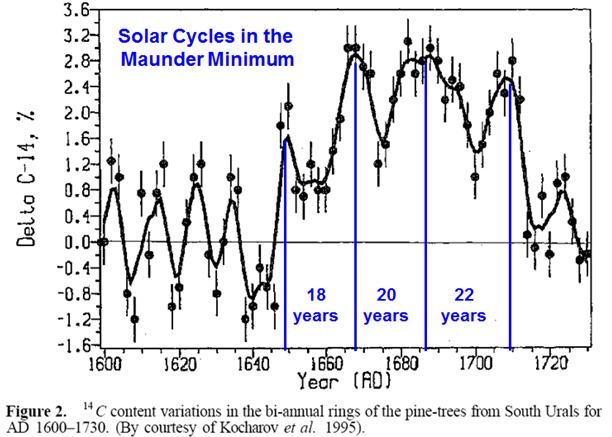

-
Die kalte Sonne (Fritz Vahrenholt & Sebastian Lüning)
Frank Bosse und Fritz Vahrenholt
2014-10-08 de Die Sonne im September 2014: Achtung, X-Flares!Der Zyklus ähnelt immer mehr dem SC 1, mit einem schnellen Abflauen der Sonnenaktivität wäre danach nicht zu rechnen.
Allerdings würde dies auch bedeuten, das wir es nun mit einem überdurchschnittlich langem Zyklus zu tun haben.
Damit haben sich die japanischen Forscher um Hiroko Miyahara in 2013 beschäftigt (Influence of the Schwabe/Hale solar cycles on climate change during the Maunder Minimum).
Sie konnten zeigen, dass die Länge des 11 jährigen Zyklus mit der Sonnenaktivität korreliert.
Die mittlere Länge des Schwabe-Zyklus betrug während des Maunder Minimums ca. 14 Jahre, wohingegen es während der mittelalterlichen Warmzeit etwa nur 9 Jahre waren.
-
Watts Up With That? (Antony Watts)
David Archibald
2012-01-08 en Solar Cycle 24 Length and Its ConsequencesFor those of us who wish to predict climate, the most important solar cycle attribute is solar cycle length.
-
2011-07-13 en Archibald: Solar Based Climate Forecast to 2050
We now have the tools to predict climate out to the mid-21st Century with a fair degree of confidence, and a repeat of the Maunder Minimum is unlikely.
A de Vries Cycle repeat of the Dalton Minimum is what is in prospect up to the early 2030s and then a return to normal conditions of solar activity, and normal climate.
|
|
|
↑ Es gibt keine CO2-Erwärmung - Seit 1998 bewegen uns wieder auf eine kleine Eiszeit zu
-
EIKE Europäisches Institut fü Klima und Energie
2014-05-04 de Es gibt keine CO2-Erwärmung - Seit 1998 bewegen uns wieder auf eine kleine Eiszeit zu
↑
Erwartung: Der 'Big Chill' dauert noch bis 2040
en
'Big chill' expected to stay until 2040 -
Major cooling cycle could match 'Little Ice Age'
-
EIKE Europäisches Institut fü Klima und Energie
Dr. Timothy Ball
2014-02-06 de Erwartung: Der 'Big Chill' dauert noch bis 2040
-
WND RADIO
Dr. Timothy Ball
2014-01-21 en 'Big chill' expected to stay until 2040 - Major cooling cycle could match 'Little Ice Age'
⇧ 2013
↑ Neue Arbeit in den Geophysical Research Letters: Ozeanzyklen führen in den kommenden 15 Jahren auf der Nordhalbkugel zu leichter Abkühlung
-
Die kalte Sonne (Fritz Vahrenholt & Sebastian Lüning)
2013-12-06 de Neue Arbeit in den Geophysical Research Letters: Ozeanzyklen führen in den kommenden 15 Jahren auf der Nordhalbkugel zu leichter Abkühlung
↑
Einhundert Jahre Vorhersage basiert auf Daten bis 2013
en One Hundred Year Forecast using data up to 2013
|
|
|


-
Die kalte Sonne (Fritz Vahrenholt & Sebastian Lüning)
Frank Bosse & Fritz Vahrenholt
2013-12-06 de Die Sonne im November 2013: Sie werden noch etwas Gefrierschutzmittel nachfüllen müssen
-
R. J. Salvador, Vancouver, Canada
2013-11-15 en A mathematical model of the sunspot cycle for the past 1000 yr
The model
This model is simply four interacting waves, but they are modulated to create an infinite possibility for sunspot for-mation. The basic frequencies in years are:
- a VEJ frequency of 22.14 (varying),
- a VEJ frequency of 19.528 (varying and forming a beat frequency of 165.5 with 22.14),
- Jupiter-Saturn synodic frequency of 19.858,
- one-quarter Uranus orbital frequency equal to 21.005,
- two modulating frequencies of 178.8 and 1253 (forming a beat frequency of 208 yr).
Forecasting
To test if the model has forecasting ability, we can redo the correlation with data only up to the years 1950 and 1900 and determine the forecast for the next 50 and 100 yr to see if the model can predict the sunspot data we have already experi-enced.
Figure 5 gives a forecast for the period 1950 to 2050 made from the correlation of the model with data up to 1950.
The model forecasts a peaking sunspot cycle and a significant de-cline in sunspots around the turn of the century, and an ongo-ing solar minimum.
The model is a little early, but direction-ally correct 50 yr out.
↑
Vorhersage der Sonnenaktivität für die kommenden 500 Jahre.
en Prediction of the solar activity for the
coming 500 years
 de
en
de
en
Vorhersage der Sonnenaktivität für die kommenden 500 Jahre.
Prediction of the solar activity for the coming 500 years
Abbildung 4 aus Steinhilber und Beer 2013.
Die zwei verschiedenen Grauschattierungen entsprechen zwei
unterschiedlichen Modellen.
-
EIKE Europäisches Institut für Klima und Energie
Prof. H. Luedecke & C.O. Weiss
2013-11-29 de Lassen sich zukünftige Erdtemperaturen berechnen?In einer jüngsten Veröffentlichung vom 23.5.2013 [1] unternehmen es die Sonnenforscher Friedhelm Steinhilber und Jürg Beer die Erdtemperaturen für die nächsten 500 Jahre zu berechnen.
Dies erscheint nicht unmöglich, weil die Sonnenaktivität der vergangenen 10.000 Jahre Periodizitäten zeigt, die hohe Korrelationswerte mit den zeitlich zugehörigen Vergangenheitstemperaturen der Erde aufweisen.
Zusammenfassend kann festgestellt werden, dass die Analyse der Sonnenaktivität von Steinhilber & Beer die von uns aus Temperaturaufzeichnungen und Stalagmitendaten ermittelten Periodizitäten bestens bestätigt.
Der solare *de Vries Zyklus" zusammen mit der AMO/PDO bestimmen praktisch vollständig die Klimaverläufe der letzten Jahrhunderte und der kommenden Jahrhunderte.
Insbesondere ist die starke Erwärmung am Ende des 20. Jahrhunderts dem Zusammentreffen des de Vries und des AMO/PDO Maximums zuzuschreiben.
Ein wesentlicher Einfluss von CO2 auf die Erdtemperatur muss daher ausgeschlossen werden-
Die Berechnung von Steinhilber & Beer sagt überdies ein Temperaturminimum um das Jahr 2100 voraus, das durchaus dem der kleinen Eiszeit Ende des 17. Jahrhundert gleichkommen könnte.
Kommentar von M. Hofmann:
Eine sehr schöne Darstellung!
Wir werden kalten Jahreszeiten entgegengehen und wenn wir von "Kalt" sprechen, dann bedeutet dies extrem viel Energieeinsatz um in diesen Zeiten über die Runden zukommen.Und jetzt kommt das fatale der merklischen diktierten Energiewende zum Tragen!
Die nächsten hundert Jahre wird es immer kälter und wir vernichten in Deutschland unsere zuverlässigen und kostengünstigen Energieträger-Erzeuger (Kohle,Gas und Kernkraft) durch dieses EEG/Energiewende.Vor allen die Kernkraftenergie geben wir in Deutschland auf! Die Kernkraft die uns sicher, zuverlässig und mit ausreichender kostengünstiger Energie durch diese kalten Jahrzehnte bringen kann!
Es hatte schon seinen Sinn (von der Evolution aus), warum der moderne und fortschrittsgewandte Mensch das Atom bzw. die Kernkraft erforscht/entdeckt hat und weiter daran forscht!
-
NoTricksZone (Pierre L. Gosselin)
Prof. H. Luedecke & C.O. Weiss
2013-12-03 en German Scientists Show Climate Driven By Natural Cycles - Global Temperature To Drop To 1870 Levels By 2100!This prediction is possible due to the multi-periodic character of the activity.
The solar activity agrees well with the terrestrial climate.
It clearly shows in particular all historic temperature minima.
Thus the future temperatures can be predicted from the activities - as far as they are determined by the sun.
The present "stagnation" of global temperature) is essentially due to the AMO/PDO: the solar de Vries cycle is presently at its maximum.
Around this maximum it changes negligibly.
The AMO/PDO is presently beyond its maximum, corresponding to the small decrease of global temperature.
Its next minimum will be 2035.
The temperature can expected to be then similar to the last AMO/PDO minimum of 1940.
Due to the de Vries cycle, the global temperature will drop until 2100 to a value corresponding to the "little ice age" of 1870.
-
Watts Up With That? (Antony Watts)
2013-12-17 en Claim: Solar, AMO, & PDO cycles combined reproduce the global climate of the past
-
Die kalte Sonne (Fritz Vahrenholt & Sebastian Lüning)
Frank Bosse
2013-04-07 de Wer ist Schuld am Kältewinter? MPI-Studie weist eher auf die schwache Sonne anstatt des arktischen Meereises hin. Die Sonne im März 2013
Vorhersage der Sonnenaktivität für die kommenden 500 Jahre.Bis zum März war die Sonne nur zu 44% aktiv wie im Mittel.
In jedem Unternehmen würde sie als "Underperformer" unter Beobachtung stehen!
↑ en Grand minimum of the Total Solar Irradiance leads to the Little Ice Age
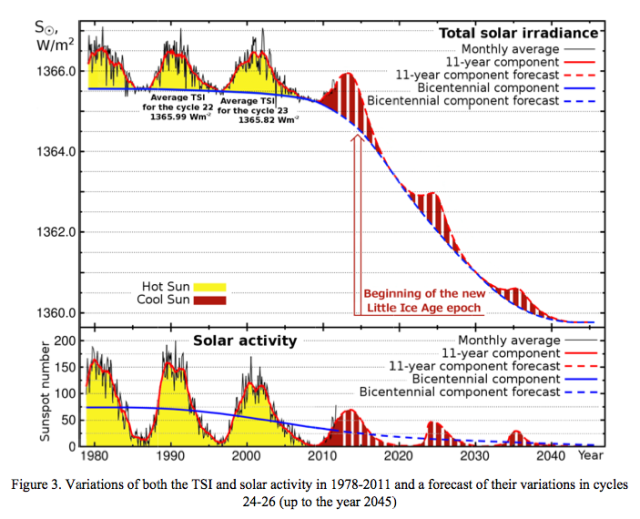 Variations of both the TSI and solar activity in 1978-2013 and prognoses
of these variations to cycles 24-27 until 2045.
The arrow indicates the beginning of the new Little Ice Age epoch after
the maximum of cycle 24.
Variations of both the TSI and solar activity in 1978-2013 and prognoses
of these variations to cycles 24-27 until 2045.
The arrow indicates the beginning of the new Little Ice Age epoch after
the maximum of cycle 24.
|
 The prognosis of natural climate changes for the next hundred years
|
-
SPPI Science & Public Policy Institute
Habibullo Abdussamatov
2013-11-25 en
Grand minimum of the Total Solar Irradiance leads to the Little Ice Age
Significant climate variations during the past 7.5 millennia indicate that bicentennial quasi-periodic TSI variations define a corresponding cyclic mechanism of climatic changes from global warmings to Little Ice Ages and set the timescales of practically all physical processes taking place in the Sun-Earth system.
The start of Grand Maunder-type Minimum of the TSI of the quasibicentennial cycle is anticipated in solar cycle 27±1 about the year 2043±11 and the beginning of the phase of deep cooling of the 19th Little Ice Age in the past 7,500 years in the year 2060±11
Now we witness the transitional period from warming to deep cooling characterized by unstable climate changes when the global temperature will oscillate (approximately until 2014) around the maximum achieved in 1998-2005. These prognoses are confirmed by the Sun itself and the course of global temperature changes and the level of the World Ocean for the past 16 years.
↑
Der 'Stillstand' der globalen Erwärmung könnte 20 weitere Jahre andauern,
und das Arktische Meereis hat schon angefangen, sich zu regenerieren.
en
Global warming 'pause' may last for 20 more years and Arctic sea ice has
already started to recover
-
EIKE Europäisches Institut für Klima und Energie
2013-11-09 de Der 'Stillstand' der globalen Erwärmung könnte 20 weitere Jahre andauern, und das Arktische Meereis hat schon angefangen, sich zu regenerieren.
-
Mail Online
2013-11-03 en Global warming 'pause' may last for 20 more years and Arctic sea ice has already started to recover
↑ Forscher befürchten neue Kleine Eiszeit
-
Focus Online
2013-11-02 de Forscher befürchten neue Kleine Eiszeit
↑ Zukünftige Temperaturenentwicklung in Deutschland - Wärmer oder Kälter? (Teil 1)
-
EIKE Europäisches Institut für Klima und Energie
2013-04-11 de Zukünftige Temperaturenentwicklung in Deutschland - Wärmer oder Kälter? (Teil 1)In unserer Untersuchung "Die Winter werden in Deutschland seit einem Vierteljahrhundert deutlich kälter", die wir am 02.03.2013 auf EIKE veröffentlichten, konnten wir anhand des Datenmaterials des Deutschen Wetterdienstes (DWD) zeigen, dass bereits seit über 25 Jahren die Wintertemperaturen in Deutschland fallen.
Wobei der Rückgang in den vergangenen Jahren an Geschwindigkeit zunahm, was bedeutet, dass die Winter zunehmend kälter werden.
Wir ersparen es uns, auf den diesjährigen Winter hinzuweisen, der viele Negativrekorde (geringe Sonnenscheindauer, Länge, Schneefall, ...) gebrochen hat.
Der März 2013 ist mit +0,2 Grad im Schnitt zu einem weiteren Wintermonat geworden.
↑ Leiter des russischen WWF-Klimaprogramms: 60-Jahres-Ozeanzyklus wird in den kommenden zwei Jahrzehnten voraussichtlich für Abkühlung sorgen
-
Die kalte Sonne (Fritz Vahrenholt & Sebastian Lüning)
2013-03-14 de Leiter des russischen WWF-Klimaprogramms: 60-Jahres-Ozeanzyklus wird in den kommenden zwei Jahrzehnten voraussichtlich für Abkühlung sorgenAls eine der ersten großen Nichtregierungsorganisationen in der Klimawandeldiskussion scheint der WWF nun nämlich das Konzept einer bevorstehenden globalen Abkühlung zu unterstützen.
"Das Klima folgt ozeanischen Zyklen mit einer Periode von 60 bis 70 Jahren.
Die nun folgenden zwei Jahrzehnte werden nicht unbedingt wärmer werden - sie könnten eher kälter werden.
Die hierauf folgenden Jahrzehnte könnten dann aber wieder deutlich wärmer werden.
Die Veränderungen der Temperatur laufen in einem wellenförmigen Prozess ab."
↑
Es ist die Sonne, Dummkopf - die geringe Bedeutung des
CO2
en It's the Sun stupid - The minor significance of
CO2"
-
EIKE Europäisches Institut für Klima und Energie
2013-02-24 de Es ist die Sonne, Dummkopf- die geringe Bedeutung des CO2Die Wassertemperaturen der NOAA zeigen, dass es trotz eines Anstiegs des CO2-Gehaltes um 8% seit 1997 keine Gesamterwärmung mehr gegeben hat, der Erwärmungstrend im Jahr 2003 seinen Höhepunkt erreicht und seitdem ein Abkühlungstrend eingesetzt hat.
Gegenwärtig legt die PDO nahe, dass wir in unmittelbarer Zukunft 20 bis 30 Jahre lang Abkühlung erwarten können.
-
Watts Up With That? (Antony Watts)
2013-02-20 en It's the Sun stupid - The minor significance of CO2The NOAA SSTs show that with CO2 up 8% there has been no net warming since 1997, that ,the warming trend peaked in 2003 and that there has been a cooling trend since that time.
Currently the PDO suggests we may expect 20 - 30 years of cooling in the immediate future.
↑
Die NASA warnt: Die Erde könnte in eine Periode "globaler Abkühlung" eintreten
en NASA Warns Earth May Be Entering a Period of "Global Cooling"t
-
EIKE Europäisches Institut für Klima und Energie
update:
2013-01-22 de Die NASA warnt: Die Erde könnte in eine Periode "globaler Abkühlung" eintretenNASA: Wir könnten am Rand eines neuen "Mini-Maunder"-Ereignisses stehen.
Alle Klimawissenschaftler stimmen darin überein, dass die Sonne das Erdklima bis zu einem gewissen Grad beeinflusst. Sie sind sich nur uneinig, wie stark der Sonneneffekt verglichen mit den anthropogenen Einflüssen ist.
-
ICECAP
2013-01-22 de NASA Warns Earth May Be Entering a Period of "Global Cooling"This week, scientists from the US Solar Observatory and the US Air Force Research Laboratory have discovered - to their great surprise - that the sun's activity is declining, and that we might experience the lowest solar output we've seen since 1645-1715.
The Register describes it in dramatic tones.
↑ en 2013-01-07 Joe Bastardi: "Models Portraying Severe Winter" For Europe. North America Forecast For Brutal Cold
-
NoTricksZone (P Gosselin)
2013-01-07 en Joe Bastardi: "Models Portraying Severe Winter" For Europe. North America Forecast For Brutal Cold
↑
en
Met Office: Bis 2018 wird's nicht mehr wärmer!
Britisches Klimainstitut passt seine Modelle der Realität an.
en Major change in UK Met Office global
warming forecast
 Met Office Global annual temperature, decadal forecast
Old: 1950-2020 / New: 1950-2018
-
EIKE Europäisches Institut für Klima und Energie
update:
2013-01-09 de Bis 2018 wird´s nicht mehr wärmer!
Britisches Klimainstitut passt seine Modelle der Realität an.Nur vier Wochen nach Doha ließ sich die Wahrheit wohl nicht länger verbergen. Das britische Metoffice - eines der drei Institute, die offiziell für die Bestimmung der Globaltemperatur verantwortlich sind - senkt seine Prognose für die kommenden 6 Jahre kurzerhand um sage und schreibe 0,4 °C!
Das heißt auch: Die ganze schöne Erwärmung ist kaputt!
Bei genauem Hinsehen erkennt man sogar noch mehr.
Met-Office getraut sich mit seiner neuen Prognose nicht wie vorher bis an 2020 ran, sondern "wagt sich" nur bis 2018.
Das ist auch kein Wunder bei dem starken Abwärtstrend, den sie ab 2015 vorhersehen.
Denn wenn man die blaue Prognosekurve bis 2020 extrapoliert, so wie es viele Klimaforscher vorhersagen, so landete man unweigerlich bei einer Prognosekorrektur von sogar -0,6 Grad.
-
Die kalte Sonne (Fritz Vahrenholt & Sebastian Lüning)
Frank Bosse und Fritz Vahrenholt
2013-01-07 de Die Lawine kommt ins Rollen: Britischer Wetterdienst reduziert Erwärmungsprognose bis 2020 drastischDer britische Wetterdienst hat nun als eine der ersten wichtigen Organisationen die Reißleine gezogen und seine Erwärmungsprognose drastisch reduziert.
Nach anderthalb Jahrzehnten Erwärmungsstopp wurden nun beim UK Met Office offensichtlich die Modelle überprüft und die Idee eines unmittelbar bevorstehenden globalen Hitzschubes aufgegeben.
-
Climate Observations (Bob Tisdale)
2010-01-04 en Major change in UK Met Office global warming forecast
-
Met Office
2012-02-06 en Global annual temperature, decadal forecast
2012-12-24 en Global annual temperature, decadal forecast
↑ Eine Vorschau auf die globalen Mitteltemperaturen in 2013: Abkühlung in Sicht!
-
Die kalte Sonne (Fritz Vahrenholt & Sebastian Lüning)
Frank Bosse und Fritz Vahrenholt
2013-01-07 de Eine Vorschau auf die globalen Mitteltemperaturen in 2013: Abkühlung in Sicht!Die nächsten Monate werden auf jeden Fall spannend. Wollen wir dochmal sehen, ob sich unserere kleine Temperaturprognose bewährt, erstellt ohne "geheimnisvolle" Wärmetransporte in Antarktisnähe!
Es lohnt sich also in den kommenden Monaten öfter einmal im kalte Sonne Blog vorbeizuschauen. Wir halten Sie auf dem Laufenden.
↑
Stimme Russlands: Die Welt vor einer Eiszeit
en
Russian Scientists say period of global cooling ahead due to changes
in the sun
-
Stimme Russlands
2013-03-03 de Die Welt vor einer Eiszeit
-
Watts Up With That? (Antony Watts)
2013-04-29 en Russian Scientists say period of global cooling ahead due to changes in the sun
-
NoTricksZone (Pierre L. Gosselin)
2013-04-11 en German Scientists Show Climate Driven By Natural Cycles - Global Temperature To Drop To 1870 Levels By 2100!
↑ Zukünftige Temperaturenentwicklung in Deutschland - Wärmer oder Kälter?
-
EIKE Europäisches Institut fü Klima und Energie
2013-04-11 de Zukünftige Temperaturenentwicklung in Deutschland - Wärmer oder Kälter? (Teil 1)
⇧ 2012
↑
Voraussagen für Winter 2012/13
en Predictions for Winter 2012/13
-
Die kalte Sonne (Fritz Vahrenholt & Sebastian Lüning)
2012-10-17 de Klimawissenschaftlerin der Rutgers University: Europa steht möglicherweise erneut ein harter Winter ins HausVerwundert reibt man sich die Augen.
Zu dieser seltsamen Geschichte gehört irgendwie auch die Serie besonders kalter Winter in den letzten 5 Jahren.Hatte uns nicht Mojib Latif um die Jahrtausendwende gewarnt, dass unsere Kinder wohl kaum noch in den Genuss von Schneemannbauen und Winterrodeln kommen werden?
2012-09-29 de Und plötzlich wurde es kalt in Deutschland
2012-11-12 de Die Zeichen stehen auf Frost
Nun legte auch der Britische Wetterdienst nach und kündigte einen britischen Winter an, der kälter als der Durchschnitt ausfallen soll.
Auch für die Ostküste der USA ist für diesen Winter 2012/2013 mehr Schnee als üblich vorhergesagt.
-
Metro
2012-10-16 en Winter to be colder as chances of white Christmas increase"We're forecasting a colder than average period from mid-November to late January, with significant snow at times, particularly in the north and east, but with London also seeing snow," said British Weather Services' senior meteorologist Jim Dale.
Minimum temperatures are expected to fall to about -10C in southern England and -18C in parts of Scotland.
'Cold is the main feature of this winter,' said forecaster WeatherWeb.
-
TerraDaily
2012-08-15 en Forecast: Big snow in Eastern U.S. citiesAbove-normal snowfall during winter 2012-2013 is forecast for the major I-95 cities including New York, Philadelphia, Baltimore and Washington, AccuWeather.com reported Wednesday.
↑
Nationales Astronomisches Observatorium von Japan sagt Abkühlung voraus
en National Astronomical Observatory Of Japan:
World May Be Entering Period Of Global Cooling
|
|
|

de
Die Wissenschaftler fanden zudem ungewöhnliche magnetische Veränderungen auf der Sonne.
Normalerweise wechselt das solare Magnetfeld alle 11 Jahre seine Polarität.
So wurde im Jahr 2001 der magnetische Nordpol der Sonne zum magnetischen Südpol.
Zuvor hatten Forscher angenommen, dass der nächste Polwechsel im Mai 2013 stattfinden sollte.
Jedoch fand nun der Satellit Hinode dass der Nordpol der Sonne bereits jetzt, ein Jahr zu früh, den Wechsel eingeleitet hat, sagen die japanischen Wissenschaftler.
Der Südpol hingegen blieb noch stabil.
Falls sich dieser Trend fortsetzt, könnte der Nordpol bereits im Mai 2012 seine Umpolung vollendet haben, was dann eine magnetische Vierpol-Struktur in der Sonne erzeugen würde, mit zwei neuen Polen in der Nähe des Sonnenäquators.
-
Die kalte Sonne (Fritz Vahrenholt & Sebastian Lüning)
2012-04-30 de Nationales Astronomisches Observatorium von Japan sagt Abkühlung vorausJapanische Wissenschaftler des Nationalen Astronomischen Observatoriums und der Riken Forschungsverinigung sagen eine Phase reduzierter Sonnenaktivität voraus, die mit einem Temperaturabfall verbunden sein könnte.
Die Forscher erklärten am 19. April 2012 dass die aktuelle Sonnenflecken-Aktivität einer 70-Jahre-andauernden Phase im 17. Jahrhundert ähnele, als die Themse zufror und die Kirschblüte in Kyoto später als üblich auftrat.
Während dieser Zeit, die auch als Maunder Minimum bekannt ist, waren die Temperaturen etwa 2,5°C tiefer als in der zweiten Hälfte des 20. Jahrhunderts.
en
-
GWPF The Global Warming Policy Foundation
2012-04-21 de National Astronomical Observatory Of Japan: World May Be Entering Period Of Global CoolingThe sun may be entering a period of reduced activity that could result in lower temperatures on Earth, according to Japanese researchers.
Officials of the National Astronomical Observatory of Japan and the Riken research foundation said on April 19 that the activity of sunspots appeared to resemble a 70-year period in the 17th century in which London's Thames froze over and cherry blossoms bloomed later than usual in Kyoto.
-
Watts Up With That? (Antony Watts)
2012-04-21 en Astronomers: World may be entering period of global coolingComments by Leif Svalgaard
There are curious differences between the Japanese and English versions of the press release.
The Japanese versions abounds with incorrect claims of priority and the usual 'never seen before' stuff.
The fact is that it is quite normal that the polar fields reverse at different times.
This was noted in the very first observations of a polar field reversal The Sun's Polar Magnetic Field
We have seen the North pole reversal coming for some time, e.g. AGU Fall Meeting, San Francisco, 5-9 December, 2011, Early Reversal of the Sun's Polar Field - Is Solar Cycle 24 Already Peaking?, J T. Hoeksema, SH33A-2044.
The Japanese data is just confirmation of what has been known for a long time and does not call for any revisions of current theories.
Currently, the two poles have the same polarity and there are two equatorial patches with the opposite polarity - but this is nothing new. Science by press release is bad style.
↑
Einschätzung der Abkühlung im Sonnenzyklus 24
en Quantifying the Solar Cycle 24 Temperature Decline
-
Klimaskeptiker Info (Andreas Kreuzmann)
2012-02-11 de Einschätzung der Abkühlung im Sonnenzyklus 24Die drei Norweger Jan-Erik Solheim, Kjell Stordahl und Ole Humlum haben eine Studie veröffentlicht, die den Titel trägt:
"The long sunspot cycle 23 predicts a significant temperature decrease in cycle 24" -
Der lange Sonnenfleckenzyklus 23 sagt einen Temperaturrückgang im Zyklus 24 voraus.Die Autoren haben harausgearbeitet, daß die Temperatur der Nordhemisphäre sich um 0,21 °C pro Jahr zusätzlicher Zykluslänge verändert.
Die größte Reaktion haben sie in Svalbard mit 1,09 °C pro Jahr Zykluslänge.
Die grünen Korona-Emissionen deuten darauf hin, daß der Zyklus 24 eine Länge von 17 Jahren haben und damit 4,5 Jahre länger als Zyklus 23 sein wird.
Mit der von Solheim und seinen Co-Autoren gefundenen Relation ergibt sich daraus, daß auf den Temperaturrückgang von 0,63 °C auf der Nordhalbkugel über den Zyklus 24 hinweg eine weitere Abkühlung von 0,95 °C während des Zyklus 25 folgen wird.
Das letzte Mal, daß die Menschheit solche Temperaturen erlebte, war im Jahrzehnt zwischen 1690 und 1700.
Ernteausfälle durch die Kälte ließen 10% der Bevölkerung in Frankreich, Norwegen und Schweden verhungern, 20% in Estland und ein Drittel in Finnland.
-
Watts Up With That? (Antony Watts)
2011-02-11 en Quantifying the Solar Cycle 24 Temperature DeclineThree wise Norwegians - Jan-Erik Solheim, Kjell Stordahl and Ole Humlum - have just published a paper entitled
"The long sunspot cycle 23 predicts a significant temperature decrease in cycle 24".The authors have found that Northern Hemisphere temperature changes by 0.21°C per year of solar cycle length.
The biggest response found in the temperature series they examined was Svalbard at 1.09°C per year of solar cycle length.
The authors also credit me with the discovery of a new branch of science.
I have decided to name this new branch of science "solarclimatology".
It is similar to Svensmark's cosmoclimatology but much more readily quantifiable.
The green corona emissions point to Solar Cycle 24 being 17 years long, and thus 4.5 years longer than Solar Cycle 23.
Using the relationship found by Solheim and his co-authors, that means that the 0.63°C decline for the Northern Hemisphere over Solar Cycle 24 will be followed by a further 0.95°C over Solar Cycle 25.
The last time we witnessed temperatures anything like that was in the decade 1690 - 1700.
Crop failures caused by cold killed off 10% of the populations of France, Norway and Sweden, 20% of the population of Estonia and one third of the population of Finland.
⇧ 2011
↑
Norwegische Wissenschaftler sagen starke Abkühlung in der Arktis voraus
en Solar activity and Svalbard temperatures
Spitzbergen ist eine von Norwegen verwaltete Inselgruppe im Nordatlantik und Arktischen Ozean.
Im norwegischen Sprachgebrauch heißt die Inselgruppe seit dem Spitzbergenvertrag von 1920 Svalbard ("Kühle Küste").
Im deutschen Sprachgebrauch ist dieser Name nicht verbreitet, es wird der Name Spitzbergen verwendet, der eigentlich die Hauptinsel Spitzbergen des Archipels bezeichnet.
-
Klimaskeptiker Info (Andreas Kreuzmann)
2011-12-17 de Norwegische Wissenschaftler sagen starke Abkühlung in der Arktis voraus
-
Cornell University
2011-12-14 en Solar activity and Svalbard temperatures
↑ en Archibald: Solar Based Climate Forecast to 2050
-
Watts Up With That? (Antony Watts)
2011-07-13 en Archibald: Solar Based Climate Forecast to 2050We now have the tools to predict climate out to the mid-21st Century with a fair degree of confidence, and a repeat of the Maunder Minimum is unlikely.
A de Vries Cycle repeat of the Dalton Minimum is what is in prospect up to the early 2030s and then a return to normal conditions of solar activity, and normal climate.
↑ en Lockwood et al: New paper suggests sun may be headed for a Maunder minimum
-
Watts Up With That? (Antony Watts)
2011-12-02 en New paper suggests sun may be headed for a Maunder minimumThe recent low and prolonged minimum of the solar cycle, along with the slow growth in activity of the new cycle, has led
to suggestions that the Sun is entering a Grand Solar Minimum (GSMi), potentially as deep as the Maunder Minimum (MM).
↑ en Chinese 2,485 year tree ring study shows natural cycles control climate, temps may cool til 2068
-
Watts Up With That? (Antony Watts)
2011-12-07 en In China, there are no hockey sticks
Quelle / Source:
-
JoNova
2011-12-07 en Chinese 2,485 year tree ring study shows natural cycles control climate, temps may cool til 2068A blockbuster Chinese study of Tibetan tree rings by Liu et al 2011 shows, with detail, that the modern era is a dog-standard normal climate when compared to the last 2,500 years.
The temperature, the rate of change - it's all been seen before.
Nothing about the current period is "abnormal", indeed the current warming period in Tibet can be produced through calculation of cycles.
Liu et al do a Fourier analysis on the underlying cycles and do brave predictions as well.
In Tibet, it was about the same temperature on at least four occasions:
- back in late Roman times (those chariots!),
- then again in the dark ages (blame the collapse of industry),
- then in the middle ages (the Vikings?),
- then in modern times (blame the rise of industry).Clearly, these climate cycles have nothing to with human civilization.
Their team finds natural cycles of many different lengths are at work: 2-3 years, 100 years, 199 years, 800 years, and 1,324 years.
The cold periods are associated with sunspot cycles.
What we are not used to seeing are brave scientists willing to publish exact predictions of future temperatures for 100 years that include rises and falls.
Apparently, it will cool til 2068,
then warm again, though not to the same warmth as 2006 levels.
⇧ 2010
↑
Easterbrook: Der Niedergang der Sonnenflecken -
Steht eine starke Abkühlung bevor?
en Easterbrook on the potential demise of sunspots
The demise of sunspots - Deep Cooling Ahead?
|
|
|


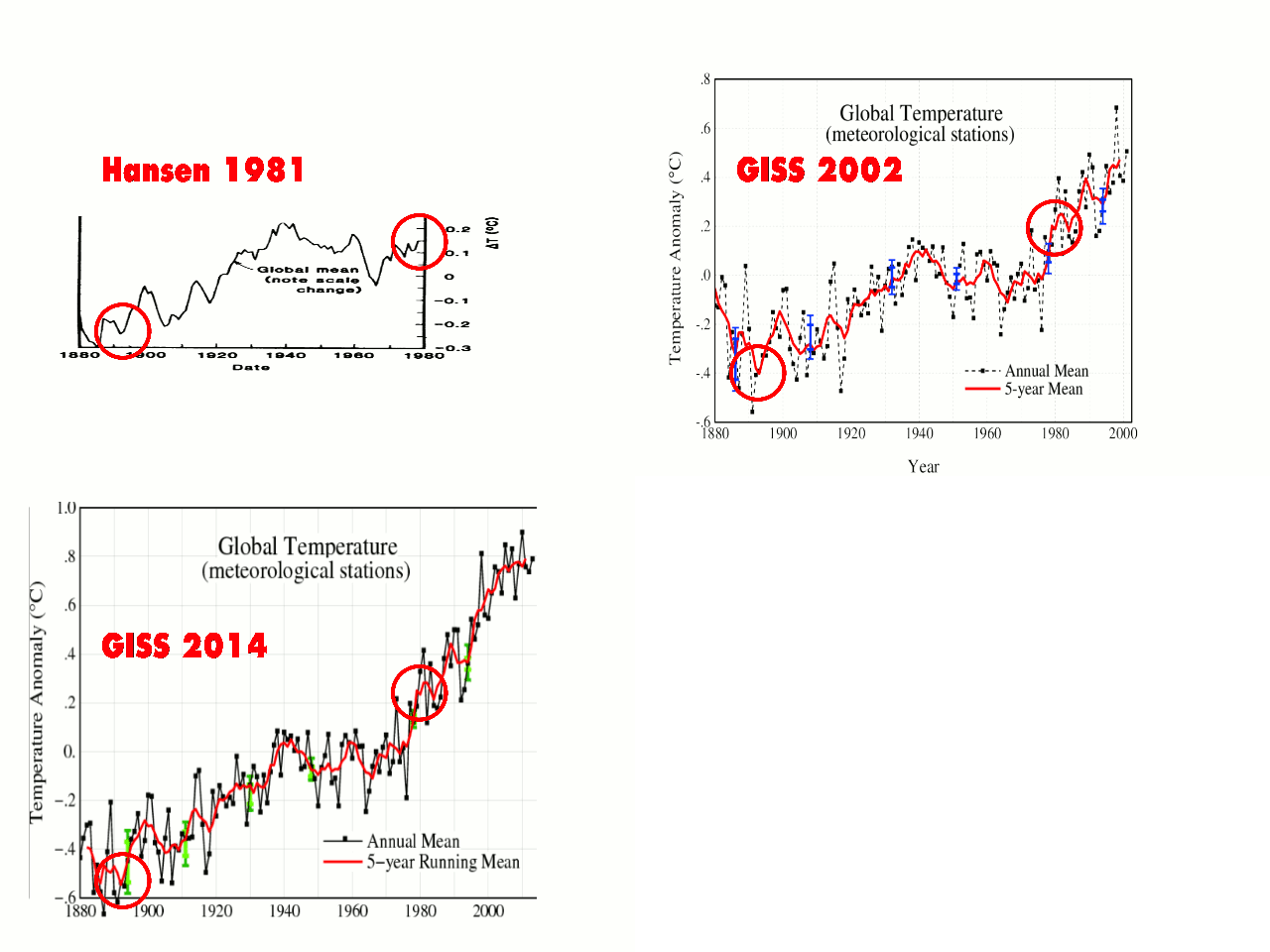


 IPCC projected warming
 Solar Irradiance

-
Klimaskeptiker Info
2010-06-17 de Der Niedergang der Sonnenflecken - Steht eine starke Abkühlung bevor?
-
Watts Up With That? (Antony Watts)
2011-06-17 en Easterbrook on the potential demise of sunspots
| de | en | fr |
|---|---|---|
|
Klima Geschichte Klima in der Zukunft |
Climate History Climate in the future |
Histoire du climat Climat dans le futur |
↑
David Archibald
Formt sich eine Wiederholung des Dalton-Minimums aus?
en A Dalton Minimum Repeat is Shaping Up
-
Klimaskeptiker Info
2010-06-16 de Weiterer IPCC-Patzer aufgedeckt
-
Watts Up With That? (Antony Watts)
2011-06-16 en A blunder of staggering proportions by the IPCCSteve McIntyre has uncovered a blunder on the part of Pachauri and the IPCC that is causing waves of doubt and calls for retooling on both sides of the debate.
In a nutshell, the IPCC made yet another inflated claim that:
...80 percent of the world's energy supply could be met by renewables by mid-century...
Unfortunately, it has been revealed that this claim is similar to the Himalayan glacier melt by 2035 fiasco, with nothing independent to back it up.
Worse, it isn't the opinion of the IPCC per se, but rather that of Greenpeace. It gets worse.
Steve McIntyre discovered the issue and writes this conclusion:
It is totally unacceptable that IPCC should have had a Greenpeace employee as a Lead Author of the critical Chapter 10, that the Greenpeace employee, as an IPCC Lead Author, should (like Michael Mann and Keith Briffa in comparable situations) have been responsible for assessing his own work and that, with such inadequate and non-independent 'due diligence', IPCC should have featured the Greenpeace scenario in its press release on renewables.
Everyone in IPCC WG3 should be terminated and, if the institution is to continue, it should be re-structured from scratch.
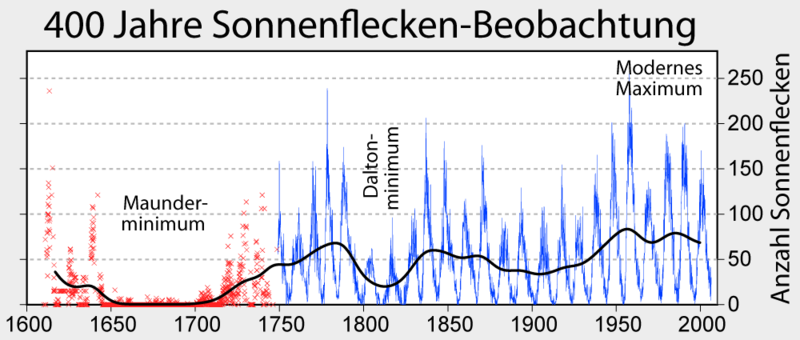 de
de
 en
en

400 Jahre Sonnenflecken-Beobachtung
400 Years of Sunspot Observations
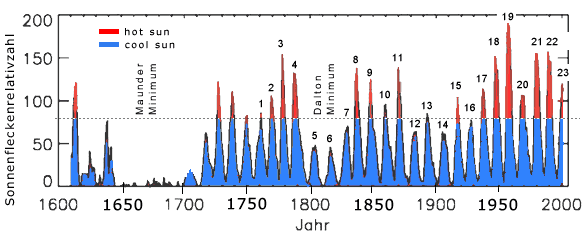 Die Zahl der Sonnenflecken schwankt in einem regelmässigen Zyklus
von etwa 11 Jahren welche in Gruppen auftreten
(Gleissberg-Zyklen: 80-90 Jahre).
Die Zahl der Sonnenflecken schwankt in einem regelmässigen Zyklus
von etwa 11 Jahren welche in Gruppen auftreten
(Gleissberg-Zyklen: 80-90 Jahre).
For those not familiar with the Dalton Minimum, here's some background info from Wiki:
-
The Dalton Minimum was a period of low solar activity, named after the English meteorologist John Dalton, lasting from about 1790 to 1830.
-
Like the Maunder Minimum and Spörer Minimum, the Dalton Minimum coincided with a period of lower-than-average global temperatures.
-
The Oberlach Station in Germany, for example, experienced a 2.0°C decline over 20 years.
-
The Year Without a Summer, in 1816, also occurred during the Dalton Minimum. Solar cycles 5 and 6.
 Solar Cycle 24 compared to Solar Cycle 5
de
-
Klimaskeptiker Info
2010-12-20 de Formt sich eine Wiederholung des Dalton-Minimums aus?Seit etwa 1600 wird die Sonne mit optischen Instrumenten beobachtet und dabei auch die Menge der Sonnenflecken erfaßt.
Zwei bedeutsame Phasen mit geringer Sonnenfleckenaktivität (von etwa 1650 bis 1720 [Maunder-Minimum] und von etwa 1790 bis 1830 [Dalton-Minimum]) waren von unterdurchschnittlichen Temperaturen begleitet.
Die geringe Aktivität der Sonne in den letzten Jahren könnte eine Wiederholung des Dalton-Minimums bedeuten.
Während des Dalton-Minimums wurde beispielsweise an der Station Oberlach ein Temperaturrückgang um 2°C innerhalb von 20 Jahren beobachtet.
Die Sonnenfleckenzyklen 5 und 6 waren erheblich schwächer ausgeprägt.
David Archibald hat eine Anzahl von Graphiken aktualisiert, die die Aktivität der Sonne zeigen.
David Archibald hat in einem Papier vom März 2006 borhergesagt, daß die Sonnenzyklen 24 und 25 das Dalton-Minimum wiederholen würden.
Nachdem jetzt 24 Monate an Daten aus dem Zyklus 24 vorliegen, zeigt der Verlauf der Aktivität eine Wiederholung des Zyklus 5, der die erste Hälfte des Dalton-Minimums ausmachte.
Die Vorhersage ist bestätigt. So wie die Zyklen 5 und 6 werden die Zyklen 24 und 25 mit einer Länge von 12 Jahren erwartet.
Das Aktivitätsmaximum wird demnach Ende 2014/Anfang 2015 erreicht.
Auch Meteorologen erwarten eine neue Kleine Eiszeit.
Der Zusammenhang zwischen Kosmischer Strahlung und Klimaentwicklung wird beim CERN im CLOUD-Experiment erforscht und scheint sich zu bestätigen.
Die empirischen Daten sprechen ebenfalls für diesen Zusammenhang.
Es gibt massive Hinweise darauf, daß die Aktivität der Sonne das Erdklima steuert.
Wenn die Prognosen eintreffen, werden die nächsten 25 Jahre eine meßbare Abühlung bringen.
CO2 spielt in diesen Betrachtungen genausowenig eine Rolle wie für die Entwicklung der globalen Temperaturen.
en
-
Watts Up With That? (Antoy Watts)
2010-12-20 en A Dalton Minimum Repeat is Shaping UpSnow Cover
The northern hemisphere is experiencing its fourth consecutive cold winter.
The current winter is one of the coldest for a hundred years or more.
For cold winters to provide positive feedback, snow cover has to survive from one winter to the next so that snow's higher albedo relative to bare rock will reflect sunlight into space, causing cooler summers.
The month of snow cover minimum is most often August, sometimes July.
We have to wait another eight months to find out how this winter went in terms of retained snow cover.
The 1970s cooling period had much higher snow cover minima than the last thirty years.
Despite the last few cold winters, there was no increase in the snow cover minima.
The snow cover minimum may have to get to over two million square kilometres before it starts having a significant effect.
Papers and Presentations
-
David Archibald Info
en
Papers and Presentations
2007-10 en
Failure to Warm
An entertaining narrative - highly recommended
2008-03 en
Solar Cycle 24: Implications for the United States
Climate prediction from a US data set
2006-03 en
Solar Cycles 24 and 25 and Predicted Climate Response
The paper that started the solar-climate connection
2008-09 en
Warming or Cooling?
The whole story in 800 words
2009-03 en
Solar Cycle 24: implications and expectations
A Dalton Minimum-like outcome is now inevitable
2009-07 en
The Future of Energy in Australia
Global warming as an issue is masking the real problem - declining oil self-sufficiency
2009-04 en
Quantifying the US Agricultural Productivity Response to Solar Cycle 24
-
2008-01-11 en
Global Warming & Sunspots explained
Scientist David Archibald explains in detail the phenomonen that sunspots have more to do with the earths climate than other factors.
-
en
Past & Future Climate change
Part 1 Part 2 Part 3 Part 4
2007-06 The first of a 4 part presentation where Scientist David Archibald has researched the data that effects Climate change and has worked out the most likely future climate predictions.
Part 2 - Scientist David Archibald continues his analysis of the data concerning climate change & it's causes to then predict what the future climate is likely to be. Inconvenient Truth author Al Gore would find histheories contradcted by the evidence presented.
Part 3 - Scientist David Archibald continues giving the data that shows global climate is more influenced by factors other than CO2 including a correlation with sunspot cycle length. The conclusions are a contradiction for Al Gore and Greens who believe Global Warming and climate change are an issue to worry about.
Part 4 - Scientist David Archibald continues to examine the effect of sunspot cycles that correlate with global temperatures. The conclusion is contradictory to Al Gore and environmentalists believ...
| David Archibald |
Scientist operating in the fields of cancer
research, climate science, and oil exploration. He has published a number of papers on the solar influence on climate, and is a director of the Lavoisier Society (Lavoisier Group), a group of Australians promoting rational science in public policy. ▶David Archibald: Who is who (Skeptiker) ▶David Archibald: Video (Präsentationen) |
↑ en Lockwood demonstrates link between low sun and low temps
-
Watts Up With That? (Antony Watts)
2010-04-14 en Lockwood demonstrates link between low sun and low temps
⇧ 2009
↑
Schwacher Sonnenzyklus 24 erwartet - Abkühlung um 2°C möglich
en
NASA now saying that a Dalton Minimum repeat is possible"
de
400 Jahre Sonnenflecken-Beobachtung
en
400 Years of Sunspot Observations
-
Klimaskeptiker Info
2009-07-28 en Schwacher Sonnenzyklus 24 erwartet - Abkühlung um 2°C möglich
David Archibald stimmt mit David Hathaway vom Marshall Space Flight Center der NASA darin überein, daß der kommende Sonnenfleckenzyklus 24 schwach ausfallen und den Beginn eines Minimums vom Dalton-Typ (Anfang 19. Jahrhundert) markieren könnte.
Er ist sicher, daß bereits der aktuelle Wissensstand auf eine durch die schwache Sonnenaktivität drohende Abkühlung von 2°C schließen läßt.
-
Watts UP With That? (Antony Watts)
2009-07-28 en NASA now saying that a Dalton Minimum repeat is possible
NASA's David Hathaway has adjusted his expectations of Solar Cycle 24 downwards.
He is quoted in the New York Times here Specifically, he said:
"Still, something like the Dalton Minimum - two solar cycles in the early 1800s that peaked at about an average of 50 sunspots - lies in the realm of the possible."
-
The New York Times
2009-07-20 en Is the Sun Missing Its Spots?
↑
Space and Science Research Center (SSRC, NASA)
"Global Warming ist vorbei - eine neue Kaltzeit hat begonnen!
en
"Global warming is over - a new cold climate has arrived"
de
Brief der SSRC (NASA) an die Obama Administration
en
Letter of SSRC (NASA) to the Obama Administration
de In diesem Brief ruft der SSRC-Direktor John Casey den wissenschaftlichen Berater von Obama, Dr. John Holdren, dazu auf, bei Amtsantritt Obamas unverzüglich die "Global-Warming-Programme" zu beenden und das Land USA auf eine schon in einigen Jahren beginnende bitter kalte Ära vorzubereiten.
-
EIKE Europäisches Institut für Klima und Energie
update:
2009-07-31 de NASA: Solar cycle may cause dangerous global cooling in an few years time
Brief der NASA (SSRC) an die Obama-Administration mit der Schlagzeile : "Global Warming ist vorbei, eine neue Kaltzeit hat begonnen!"
en In this letter, SSRC Director John Casey calls on Dr. Holdren to immediately reverse course on global warming programs and start preparing the country for the next climate change.
Since the early 2007 discovery of the solar cycles that according to Casey drive our climate over a period of about 200 years, he and later the SSRC have been on a mission to get the word out to government leaders and media representatives in order to prepare the US for the coming bitter cold era.
-
The Cosmic Heart
2009-02-18 en NASA: Solar cycle may cause "dangerous" global cooling in a few years time
The Space and Science Research Center (SSRC)
A letter mailed on January 1, 2009 to President-elect Barrack Obama's nominated science adviser Dr. John Holdren and nominated NOAA administrator Dr. Jane Lubchenco clearly stating that
"... global warming is over; a new cold climate has arrived."
en
Warning of SSRC (NASA) to the American people and their leadership
in Washington:
"Coldest Weather in 100 Years to Strike by 2012"
-
SSRC - Space & Science Research Center, Orlando, Florida
en
Home
2009-06-17 en
Coldest Weather in 100 Years to Strike by 2012
America Unprepared for New Cold Climate Because of President Obama's Climate Change Policies
In one of its most important releases since its founding, the SSRC announced its predictions for the detailed schedule and extent of the rapidly advancing new cold climate.
-
According to Center Director John Casey, "The climate change predictions which I started to pass out to our government and media in early 2007 based upon the 'RC Theory' have now come to pass, exactly as forecast.
Global warming has ended, conclusively, as predicted.
The Earth's average temperature has begun its steep decline within the time frame I said it would. And last but not least, the Sun has entered a state of 'hibernation' when I said it would.
This new solar period is one of the most amazing events in the history of science.
During solar hibernations, the Sun makes significant reductions in output which always, always, brings long cold climates to the Earth.
Unbelievably, this historic phenomena is still largely and intentionally unreported by the media and our leaders and therefore unknown by the American people. The new cold climate will usher in global travail that will be amplified specifically because of the catastrophic climate change policies of the administration of President Barack Obama that will leave most citizens unprepared."
-
My most recent calculations, just completed, indicate that global temperatures approaching 100 year cold weather records will begin to set in any year now but certainly between 2012 and 2017.
The lower troposphere temperature anomaly range during this time frame will be between -0.2C and -0.75C.
-
Further, between 2020 and 2025, if not before, we will begin to see 200 year cold temperature records routinely being broken with a temperature anomaly range between -0.75C and -1.20C.
-
The coldest and most destructive years will be during the decade of the 2030's with temperature ranges between -1.0C and -1.5C.
These global temperature changes are keyed to the mean global temperature for the past one hundred years and while they may not seem like much, they translate to potentially massive agricultural losses world wide especially in the decades of the 2020's and 2030s.
-
... This implies some of the worst cold could arrive well before the predicted coldest years (i.e., the 2020's and later).
... These early cold shocks will cause significant crop damage and then rebound to relative warmth within a year or two before diving once again even deeper into the cold era.
We will of course continue to see hot, possibly record setting summer temperatures over the years.
The noticeable change will be in winters that start sooner, are much colder and last longer, with the power to cause post-planting spring crop damage and early fall pre-harvest crop losses.
Release of this detailed sequence of climate activity still includes the previous assertion that the pronounced cold of the next climate change will have devastating consequences for our primary wheat, corn, and other grain crops in Canada, and the United States.
-
The last solar hibernation the Earth experienced was the so-called Dalton Minimum. Canada and the United States were at that time (1793-1830) still largely unsurveyed, undeveloped, and uncultivated and the great wheat and corn growing states and horizon-to-horizon agricultural regions we take for granted today that feed the world, simply did not exist. However, even crops back then were wiped out in New England, many people died, and thousands moved out to get away from the bitter cold that settled in along the Great Lakes and in the northeastern states. Pennsylvania, for example had ice on lakes and rivers in July.
Historian John D. Post said of this period that it was " ... the last great subsistence crisis."
Of course, this new forecast does not include any major volcanic activity as happened during the Dalton Minimum which would accentuate the solar hibernation cold weather effects already in place."
-
Unfortunately, while the cold climate advances quickly and the Sun cuts back on output, the Obama administration continues its political campaign to stop global warming, a climate period that has already ended.
Our government has willfully not told the American people about the now unstoppable solar hibernation which continues to deepen with each passing month.
This is without a doubt one of the darkest periods in US history for freedom of speech and integrity in the scientific community.
In addition, this administration is planning to add $646 billion in new taxes to combat CO2 and other industrial greenhouse gas effects that have at most only a minor role in climate change.
All the while, the US government is not devoting one penny in preparing our country for the rapidly approaching cold weather and attendant crop failures.
There is now little doubt that this new cold climate era, in conjunction with the disastrous climate change policies of President Obama, has set the stage for what has the potential to be the worst subsistence crisis in recorded human history."
-
As to why the general public should take such unusual and dramatic forecasts seriously, Casey responded, "First of all, the SSRC and I have been sending out this vital message of a coming cold climate era consistently for over two years. In addition, a former Chairman of the House of Representatives Science Committee says I should be taken seriously as have other top scientists around the world who have come to the same conclusion about the next cold climate period. World leaders are growing more skeptical of what they have been force fed about climate change. The President of the European Union Vaclav Klaus has said the CO2 induced man made climate concept is a "bad ... valueless theory." Also, the Space and Science Research Center is now the most quoted reference on the web regarding climate change to the next cold era. But even if we did not have this support, what I and the SSRC have already accomplished should say something about the credibility of the SSRC. We have been the only independent science research organization in America to correctly and publicly predict in advance, three of the most important climate change events in history; the end of global warming, the Sun going into 'hibernation' and the long term decline in the Earth's temperatures. This contrasts with our government's science agencies and the United Nations all of whom have completely missed or otherwise keep quiet about these events.
-
The bottom line is this: I believe these new predictions will be just as accurate as our previous announcements and given their nature, I urge everyone to give them genuine and immediate consideration. The SSRC and I, along with other scientists world wide have been doing our best using every venue to spread the word about getting prepared for the next climate change. What is different about this press release is that the schedule for the rough times ahead is now clearer, the first crop damaging cold will arrive earlier than thought, and thanks to the UN and the Obama administration, it will catch most people on this planet totally off guard. Therefore, the people deserve repeated updates and when possible, long range climate warnings such as this."
-
CFP Canada Free Press / SSRC Space & Science Research, Orlando, Florida
2009-06-17 en Coldest Weather in 100 Years to Strike by 2012
(Space and Science Research Center (SSRC) is the leading science and engineering research company internationally, that specializes in the analysis of and planning for climate changes based upon the "Theory of Relational Cycles of Solar Activity," also called the RC Theory.)
↑ en Are Sunspots Disappearing?

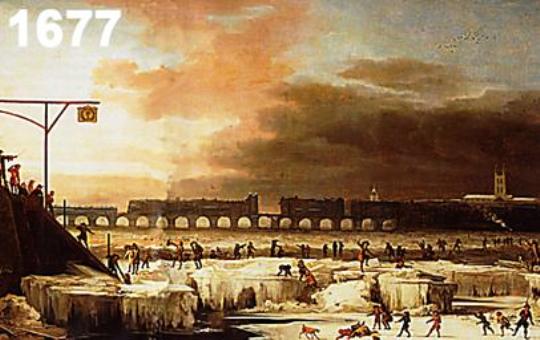 The frozen Thames, A. Hondius 1677 London Museum
If sunspots do go away, it wouldn't be the first time. In the 17th century, the sun plunged into a 70-year period of spotlessness known as the Maunder Minimum that still baffles scientists.
The sunspot drought began in 1645 and lasted until 1715; during that time, some of the best astronomers in history (e.g., Cassini) monitored the sun and failed to count more than a few dozen sunspots per year, compared to the usual thousands.
-
NASA
2009-09-03 de Are Sunspots Disappearing?The sun is in the pits of the deepest solar minimum in nearly a century.
Weeks and sometimes whole months go by without even a single tiny sunspot.
The quiet has dragged out for more than two years, prompting some observers to wonder, are sunspots disappearing?
↑
Henrik Svensmark: Während die Sonne schläft
en
Henrik Svensmark: "global warming stopped and a cooling is beginning" -
"enjoy global warming while it lasts"
MWP = The Medieval Warm Period = Die Mittelalterliche Warmzeit (ca. 900 - 1350)
de Henrik Svensmark: Während die Sonne schläft
-
EIKE Europäisches Institut für Klima und Energie
2009-10-02 de Während die Sonne schläft!Prof. Henryk Svensmark zum Thema Solareinfluss: Der Stern, der uns Leben gibt, zeigt über die letzten Jahre keine Sonnenflecken, die sichtbaren Zeichen der solaren magnetischen Aktivität.
Vergangene Woche berichtete das Wissenschaftlerteam des Sohosatellitten (Solar und Heliospherisches Observatorium), dass die Anzahl der fleckenfreien Tage auf die niedrigste Aktivität der vergangenen 100 Jahre hin deutet.
Alles deutet darauf hin, dass die Sonne in einen Tiefschlaf-ähnlichen Zustand gleitet, und es stellt sich die Frage, welche Bedeutung das für uns auf der Erde hat.
-
Ökologismus
2009-09-15 de Henrik Svensmark: Während die Sonne schläft -
Der Stern, der uns Leben gibt, zeigt über die letzten Jahre keine Sonnenflecken, die sichtbaren Zeichen der solaren magnetischen Aktivität.
Vergangene Woche berichtete das Wissenschaftlerteam des Sohosatellitten (Solar und Heliospherisches Observatorium), dass die Anzahl der fleckenfreien Tage auf die niedrigste Aktivität der vergangenen 100 Jahre hin deutet.
Alles deutet darauf hin, dass die Sonne in einen Tiefschlaf-ähnlichen Zustand gleitet, und es stellt sich die Frage, welche Bedeutung das für uns auf der Erde hat.
Wenn sie das IPCC (International Panel on Climate Change) fragen, welches die derzeitige Konsensmeinung zum Klimawandel repräsentiert, so lautet die Antwort "nichts".
Aber Geschichte und neuere Forschungen zeigen, dass dies möglicherweise absolut falsch ist.
Lassen sie uns näher anschauen, warum.
-
Die Sonnenaktivität hat sich schon immer verändert.
Um das Jahr 1000 war eine Periode hoher solarer Aktivität, was einher ging mit der MWP (The Medieval Warm Period = Die Mittelalterliche Warmzeit).
In dieser Zeit war Frost im Mai ein weitaus unbekanntes Phänomen und wichtig für eine gute Ernte.
Die Wikinger siedelten in Grönland und entdeckten die Küste Nordamerikas. Und die Chinesische Bevölkerung zum Beispiel verdoppelte sich in dieser Zeit.
Aber um das Jahr 1300 begann die Erde kälter zu werden und das war der Beginn der Zeit, die wir die Kleine Eiszeit nennen. Damals verschwanden alle Siedlungen der Wikinger in Grönland.
Die Schweden wunderten sich über den Frost in Dänemark und die Themse in London fror wiederholt zu.
Immer häufiger gab es Missernten, was zur Unterernährung der armen Bevölkerung führte, Krankheit und Hunger ließen die europäische Bevölkerung um 30% schrumpfen.
-
Es ist wichtig festzustellen, dass die Kleine Eiszeit ein globales Ereignis darstellte. Sie dauerte bis in das späte 19. Jahrhundert, wo die solare Aktivität sich verstärkte.
In den letzten 50 Jahren war die Sonne am höchsten in 100 Jahren seit der MWP.
Und nun scheint es das die Sonne sich in Richtung eines "tiefen Minimums" bewegt, wie wir es aus der kleinen Eiszeit kennen.
-
Der Zusammenhang von Solaraktivität und Klima durch die Jahrhunderte wurde versucht als zufällig zu erklären.
Aber es stellte sich heraus, dass es fast egal war, welchen Zeitraum man betrachtete, nicht nur die letzten 1000 Jahre passen zusammen.
Die Aktivität der Sonne wechselt über die vergangenen 10000 Jahre wiederholt zwischen hoch und niedrig.
Bis jetzt befand sich die Sonne dabei 17% der Zeit im Tiefschlaf, gefolgt von einer Abkühlung der Erde.
-
Man wird sich vielleicht wundern, dass das IPCC glaubt, die wechselnde Sonnenaktivität hat keinen Einfluss auf das Klima - der Grund ist einfach, dass sie lediglich die Veränderung der Solarstrahlung berücksichtigen.
-
Satellitenmessungen der Solarstrahlung haben gezeigt, dass die Variationen zu gering sind für eine Klimaänderung, aber man hielt die Augen verschlossen vor einem zweiten, viel kräftigeren Weg, auf dem die Sonne in der Laage ist das Klima zu beeinflussen.
-
1996 entdeckten wir einen überraschenden Einfluss der Sonne - ihre Auswirkungen auf die Wolkenbedeckung der Erde.
Ausgestossene energiereiche Teilchen explodierender Sterne, die kosmische Strahlung, unterstützen die Wolkenbildung.
-
Ist die Sonne aktiv, schirmt ihr Magnetfeld die kosmische Strahlung aus dem All ab, bevor sie die Erde erreicht.
Mit der Änderung der Wolkenbedeckung kann die Sonne die Temperaturen der Erde erhöhen oder senken.
Höhere Aktivität bewirkt weniger Wolken und es wird wärmer.
Niedrige Aktivität hingegen verringert den Schutz gegen die kosmische Strahlung , mit dem Ergebnis zunehmender Wolkenbedeckung und deshalb wird es kühler.
-
Da das Magnetfeld der Sonne sich im 20.Jahrhundert in der Stärke verdoppelt hat, kann dies für einen Großteil der globalen Erwärmung in dieser Zeit verantwortlich sein.
-
Das erklärt auch, warum die meisten Klimawissenschaftler bestrebt sind diese Möglichkeit zu ignorieren.
Es ist in der Tat zugunsten der Idee, dass der Anstieg der Temperatur im 20. Jahrhundert hauptsächlich auf die menschlichen CO2-Emissionen zurückzuführen ist.Wenn die Sonne einen signifikanten Beitrag zur Erwärmung geleistet hätte, wäre der Anteil des CO2 notwendiger Weise geringer.
-
Seit unsere Theorie 1996 herausgebracht wurde, war sie scharfer Kritik ausgesetzt, was normal in der Wissenschaft ist.
-
Zuerst wurde behauptet dass eine Verbindung zwischen Wolkenbildung und Solaraktivität auf Grund des unbekannten physikalischen Mechanismus nicht möglich sei.
Aber im Jahr 2006 konnten wir nach vielen Jahren Arbeit Experimente am DTU Space durchführen, wo wir die Existenz des physikalischen Mechanismus demonstrieren konnten. Die kosmische Strahlung unterstützt die Bildung von Aerosolen, die die Grundlage für die Wolkenbildung sind.
-
Darauf folgte die Kritik, dass der von uns im Labor gefundene Mechanismus in der realen Atmosphäre keinen Bestand haben kann und deshalb praktisch wirkungslos sei.
Aber diese Kritik haben wir ausdrücklich zurückgegeben.
Es stellte sich heraus, dass die Sonne selbst tat, was wir natürliche Experimente nennen würden. Gigantische solare Flares können die kosmische Strahlung auf der Erde für einige Tage zurückdrängen.
In den Tagen nach der Eruption verringerte sich die Wolkenbedeckung um 7%. Man kann sagen, die Wolken werden im All gemacht.
-
Deswegen beobachteten wir die solare magnetische Aktivität mit steigender Aufmerksamkeit, als sie Mitte der 90er Jahre begann zu schwinden.
-
Das die Sonne in ein tiefes Minimum (Tiefschlaf) fallen könnte wurde vor 2 Jahren auf einem Meeting in Kiruna (Schweden) bekannt gegeben. Als Nigel Calder und ich deshalb unser Buch "The Chilling Stars" überarbeiteten, Schrieben wir ein wenig provokativ:
"Wir empfehlen unseren Freunden sich an der globalen Erwärmung zu erfreuen, so lange sie noch anhält."
-
Tatsächlich endete die globale Erwärmung und eine Abkühlung beginnt. Letzte Woche erklärte Mojib Latif von der Uni Kiel auf der Weltklimakonverenz in Geneva, dass die Abkühlung 10-20 Jahre anhalten könnte.
-
Er erklärte es mit Veränderung der Nordatlantischen Oszillation, nicht mit der solaren Aktivität. Aber egal wie man es interpretiert, die natürlichen Variationen des Klimas werden immer deutlicher.
-
In der Konsequenz kann die Sonne selber ihre besondere Rolle für das Klima zeigen, um die Theorien der globalen Erwärmung zu prüfen. Im Gegensatz dazu hat kein Klimamodell eine Abkühlung der Erde vorhergesagt.
-
Das bedeutet, dass Projektionen des zukünftigen Klimas unberechenbar sind. Eine Vorhersage, dass es für die nächsten 50 Jahre wärmer oder kälter werden könnte, ist nicht besonders brauchbar, denn es ist nicht möglich, die solare Aktivität vorherzusagen.
-
In vielerei Hinsicht stehen wir am Scheideweg. Die nächste Zukunft wird extrem interessant werden und ich denke, es ist wichtig zu verstehen, dass die Natur völlig unabhängig davon ist, was wir über sie denken. Wird die Treibhaustheorie eine signifikante Abkühlung der Erde überstehen? Nicht in der derzeitigen beherrschenden Form.
Leider werden zukünftige Klimaentwicklungen völlig anders verlaufen als die Treibhaustheorie-Vorhersagen, und möglicherweise wird es wieder populärer, den Einfluss der Sonne auf das Klima der Erde zu erforschen.
| Henrik Svensmark |
Prof. Dr., Director of Sun-Climate Research at the Danish National
Space Center
▶Henrik Svensmark: Who is who (Skeptiker) ▶Henrik Svensmark: Video (Präsentationen) |
| Mojib Latif |
Dr. rer. nat.,
Professor für Meteorologie am Leibniz-Institut für
Meereswissenschaften (IFM-GEOMAR) an der Universität Kiel.
▶Mojib Latif: Who is who (Aktivisten der anthropogenen Erwärmung) |
en Henrik Svensmark: "global warming stopped and a cooling is beginning" - "enjoy global warming while it lasts"
-
Watts up with that? (Antony Watts)
2009-09-10 en Henrik Svensmark: "global warming stopped and a cooling is beginning" - "enjoy global warming while it lasts" -
"In fact global warming has stopped and a cooling is beginning.
No climate model has predicted a cooling of the Earth - quite the contrary. And this means that the projections of future climate are unreliable," writes Henrik Svensmark.
-
The star that keeps us alive has, over the last few years, been almost free of sunspots, which are the usual signs of the Sun's magnetic activity. Last week [4 September 2009] the scientific team behind the satellite SOHO (Solar and Heliospheric Observatory) reported,
"It is likely that the current year's number of blank days will be the longest in about 100 years."
Everything indicates that the Sun is going into some kind of hibernation, and the obvious question is what significance that has for us on Earth.
-
If you ask the Intergovernmental Panel on Climate Change (IPCC) which represents the current consensus on climate change, the answer is a reassuring "nothing".
But history and recent research suggest that is probably completely wrong. Why?
Let's take a closer look.
-
Solar activity has always varied.
Around the year 1000, we had a period of very high solar activity, which coincided with the Medieval Warm Period.
It was a time when frosts in May were almost unknown - a matter of great importance for a good harvest.
Vikings settled in Greenland and explored the coast of North America.
On the whole it was a good time.
For example, China's population doubled in this period.
-
But after about 1300 solar activity declined and the world began to get colder.
It was the beginning of the episode we now call the Little Ice Age.
In this cold time, all the Viking settlements in Greenland disappeared.
Sweden surprised Denmark by marching across the ice, and in London the Thames froze repeatedly. But more serious were the long periods of crop failures, which resulted in poorly nourished populations, reduced in Europe by about 30 per cent because of disease and hunger.
-
It's important to realise that the Little Ice Age was a global event. It ended in the late 19th Century and was followed by increasing solar activity.
Over the past 50 years solar activity has been at its highest since the medieval warmth of 1000 years ago.
But now it appears that the Sun has changed again, and is returning towards what solar scientists call a "grand minimum" such as we saw in the Little Ice Age.
-
The match between solar activity and climate through the ages is sometimes explained away as coincidence.
Yet it turns out that, almost no matter when you look and not just in the last 1000 years, there is a link.
Solar activity has repeatedly fluctuated between high and low during the past 10,000 years.
In fact the Sun spent about 17 per cent of those 10,000 years in a sleeping mode, with a cooling Earth the result.
-
You may wonder why the international climate panel IPCC does not believe that the Sun's changing activity affects the climate. The reason is that it considers only changes in solar radiation. That would be the simplest way for the Sun to change the climate - a bit like turning up and down the brightness of a light bulb.
-
Satellite measurements have shown that the variations of solar radiation are too small to explain climate change.
But the panel has closed its eyes to another, much more powerful way for the Sun to affect Earth's climate.
In 1996 we discovered a surprising influence of the Sun - its impact on Earth's cloud cover.
High-energy accelerated particles coming from exploded stars, the cosmic rays, help to form clouds.
-
When the Sun is active, its magnetic field is better at shielding us against the cosmic rays coming from outer space, before they reach our planet.
By regulating the Earth's cloud cover, the Sun can turn the temperature up and down.
High solar activity means fewer clouds and and a warmer world.
Low solar activity and poorer shielding against cosmic rays result in increased cloud cover and hence a cooling.
As the Sun's magnetism doubled in strength during the 20th century, this natural mechanism may be responsible for a large part of global warming seen then.
-
That also explains why most climate scientists try to ignore this possibility.
It does not favour their idea that the 20th century temperature rise was mainly due to human emissions of CO2. If the Sun provoked a significant part of warming in the 20th Century, then the contribution by CO2 must necessarily be smaller. -
Ever since we put forward our theory in 1996, it has been subjected to very sharp criticism, which is normal in science.
-
First it was said that a link between clouds and solar activity could not be correct, because no physical mechanism was known.
But in 2006, after many years of work, we completed experiments at DTU Space that demonstrated the existence of a physical mechanism.
The cosmic rays help to form aerosols, which are the seeds for cloud formation.
-
Then came the criticism that the mechanism we found in the laboratory could not work in the real atmosphere, and therefore had no practical significance.
We have just rejected that criticism emphatically.
-
It turns out that the Sun itself performs what might be called natural experiments.
Giant solar eruptions can cause the cosmic ray intensity on earth to dive suddenly over a few days.
In the days following an eruption, cloud cover can fall by about 4 per cent.
And the amount of liquid water in cloud droplets is reduced by almost 7 per cent.
Here is a very large effect - indeed so great that in popular terms the Earth's clouds originate in space.
-
So we have watched the Sun's magnetic activity with increasing concern, since it began to wane in the mid-1990s.
-
That the Sun might now fall asleep in a deep minimum was suggested by solar scientists at a meeting in Kiruna in Sweden two years ago. So when Nigel Calder and I updated our book The Chilling Stars, we wrote a little provocatively that
"we are advising our friends to enjoy global warming while it lasts."
-
In fact global warming has stopped and a cooling is beginning.
Mojib Latif from the University of Kiel argued at the recent UN World Climate Conference in Geneva that the cooling may continue through the next 10 to 20 years.
His explanation was a natural change in the North Atlantic circulation, not in solar activity.
But no matter how you interpret them, natural variations in climate are making a comeback.
-
The outcome may be that the Sun itself will demonstrate its importance for climate and so challenge the theories of global warming.
No climate model has predicted a cooling of the Earth - quite the contrary. And this means that the projections of future climate are unreliable.
A forecast saying it may be either warmer or colder for 50 years is not very useful, and science is not yet able to predict solar activity.
-
So in many ways we stand at a crossroads. The near future will be extremely interesting. I think it is important to accept that Nature pays no heed to what we humans think about it. Will the greenhouse theory survive a significant cooling of the Earth? Not in its current dominant form.
Unfortunately, tomorrow's climate challenges will be quite different from the greenhouse theory's predictions.
Perhaps it will become fashionable again to investigate the Sun's impact on our climate.
| Henrik Svensmark |
Prof. Dr., Director of Sun-Climate Research at the Danish National
Space Center
▶Henrik Svensmark: Who is who (Skeptiker) ▶Henrik Svensmark: Video (Präsentationen) |
| Mojib Latif |
Dr. rer. nat.,
Professor für Meteorologie am Leibniz-Institut für
Meereswissenschaften (IFM-GEOMAR) an der Universität Kiel.
▶Mojib Latif: Who is who (Aktivisten der anthropogenen Erwärmung) |
↑
2009-09: Schwacher El Niño könnte kalten Winter an der
US-Ostküste bedingen
en
U.S. Northeast May Have Coldest Winter in a Decade
de Schwacher El Niño könnte kalten Winter an der US-Ostküste bedingen
-
Klimaskeptiker Info
2009-09-29 de Schwacher El Niño könnte kalten Winter an der US-Ostküste bedingenDer gegenwärtige El Niño, eine warme Oberflächenströmung im tropischen Pazifik, die alle paar Jahre auftritt, fällt recht schwach aus.
Schwache El Niños sind aus den Erfahrungen der Vergangenheit bekannt dafür, daß sie von besonders kalten Wintern an der nordamerikanischen Ostküste begleitet werden.
en U.S. Northeast May Have Coldest Winter in a Decade
-
Bloomberg
2009-09-28 de U.S. Northeast May Have Coldest Winter in a DecadeThe U.S. Northeast may have the coldest winter in a decade because of a weak El Niño, a warming current in the Pacific Ocean
Weak El Niño are notorious for cold and snowy weather on the Eastern seaboard.
It could be one of the coldest winters, or the coldest, winter of the decade.
↑
Kosmische Strahlung erreicht Rekordniveau - Steht globale Abkühlung
bevor?
en
Cosmic Rays Hit Space Age High
de Kosmische Strahlung erreicht Rekordniveau - Steht globale Abkühlung bevor?
-
Klimaskeptiker Info
2009-09-28 de Kosmische Strahlung erreicht Rekordniveau - Steht globale Abkühlung bevor? -
Die kosmische Strahlung hat eine höhere Intensität als jemals zuvor während des Zeitalters der Weltraumerkundung (seit Ende der 1950er Jahre).
-
Nach der Theorie von Henrik Svensmark beeinflußt die Stärke der kosmischen Strahlung die Wolkenbildung auf der Erde (mehr Strahlung bedeutet dabei mehr Wolken), was erheblichen Einfluß auf die Strahlungsbilanz der Erde hätte und zu einer globalen Abkühlung führen würde.
-
Neben dem schwachen El Niño, der für einen kalten Ostküsten-Winter stehen könnte, ein weiterer Hinweis darauf, daß uns entgegen der Vorhersagen der Alarmisten kalte Zeiten bevorstehen könnten.
en Cosmic Rays Hit Space Age High
-
Bloomberg
2009-09-28 de Cosmic Rays Hit Space Age High -
Planning a trip to Mars? Take plenty of shielding. According to sensors on NASA's ACE (Advanced Composition Explorer) spacecraft, galactic cosmic rays have just hit a Space Age high.
-
"In 2009, cosmic ray intensities have increased 19% beyond anything we've seen in the past 50 years," says Richard Mewaldt of Caltech.
"The increase is significant, and it could mean we need to re-think how much radiation shielding astronauts take with them on deep-space missions."
-
The cause of the surge is solar minimum, a deep lull in solar activity that began around 2007 and continues today.
Researchers have long known that cosmic rays go up when solar activity goes down. Right now solar activity is as weak as it has been in modern times, setting the stage for what Mewaldt calls "a perfect storm of cosmic rays."
-
"We're experiencing the deepest solar minimum in nearly a century," says Dean Pesnell of the Goddard Space Flight Center, "so it is no surprise that cosmic rays are at record levels for the Space Age."
-
Galactic cosmic rays come from outside the solar system.
They are subatomic particles--mainly protons but also some heavy nuclei--accelerated to almost light speed by distant supernova explosions.
Cosmic rays cause "air showers" of secondary particles when they hit Earth's atmosphere; they pose a health hazard to astronauts; and a single cosmic ray can disable a satellite if it hits an unlucky integrated circuit.
-
The sun's magnetic field is our first line of defense against these highly-charged, energetic particles.
The entire solar system from Mercury to Pluto and beyond is surrounded by a bubble of solar magnetism called "the heliosphere."
It springs from the sun's inner magnetic dynamo and is inflated to gargantuan proportions by the solar wind. When a cosmic ray tries to enter the solar system, it must fight through the heliosphere's outer layers; and if it makes it inside, there is a thicket of magnetic fields waiting to scatter and deflect the intruder.
-
"At times of low solar activity, this natural shielding is weakened, and more cosmic rays are able to reach the inner solar system," explains Pesnell.
| Henrik Svensmark |
Prof. Dr., Director of Sun-Climate Research at the Danish National
Space Center
▶Henrik Svensmark: Who is who (Skeptiker) ▶Henrik Svensmark: Video (Präsentationen) |
| de | en | fr |
|---|---|---|
| Ursachen des Klimawandels | Causes of Climate Change | Les causes du changement climatique |
| Der Einfluss der Sonne auf das Klima | The influence of the sun | L'influence du soleil |
↑ fr Pourquoi risquons nous d'avoir froid dans les années qui viennent ?
-
Pensée unique
2009-10-21 fr Pourquoi risquons nous d'avoir froid dans les années qui viennent ?
↑ fr Et en cas de glaciation ... Avons nous un "Plan B"?
-
Le Post
2009-09-12 fr Et en cas de glaciation ... Avons nous un "Plan B"?Pour la première fois, la NASA reconnait que la baisse de l'activité solaire commence à soulever des interrogations.
La conclusion de l'étude est qu'il est envisageable que l'on soit en route vers un nouveau "Minimum de Maunder" - événement astronomique majeur qui se situe au cœur de la période qui a été nommée par les historiens "Petit Age Glaciaire" (PAG).
⇧ 2008
↑ Globale Abkühlung
-
Klimaskeptiker Info / Dipl.-Biol. Ernst-Georg Beck
2008-09 de Globale AbkühlungDie Älteren unter uns kennen sicher noch die 60er Jahre, als in den Mittelgebirgen noch monatelang Schnee lag, im Winter bis herab in die Städte des Flachlandes.
Die ganz Betagten unter uns haben im Gegensatz dazu die 30er Jahre des 20. Jahrhunderts erlebt, wo es wie heute recht warm war bei uns.
Auch damals schmolzen die Eismassen des Nordpols im Sommer ziemlich zusammen, sodaß Schiffe durch die Nordwestpassage zwischen Grönland und Alaska fahren konnten, genau so wie heute.
⇧ 2007
↑ Khabibullo Abdusamatov: Mars gibt Hinweise auf künftige Kaltzeit auf der Erde
-
Novosti / Khabibullo Abdusamatov
2007-10-10 en Mars gibt Hinweise auf künftige Kaltzeit auf der Erde -
SANKT PETERSBURG, 10. Oktober (RIA Novosti).
Das Ende des Temperaturanstiegs auf dem Mars wird zum Vorboten einer heftigen Abkühlung auf der Erde.
Diese Auffassung vertrat der Leiter des Labors für Weltraumforschungen des Hauptobservatoriums Pulkowo bei Sankt Petersburg, Chabibullo Abdussamatow, in einem Interview für RIA Novosti.
-
Wie der Wissenschaftler erläuterte, ist es auf dem Mars genauso wie auf der Erde zu einer globalen Erwärmung gekommen, die auf die wesentliche und dauernde Erhöhung der Sonnenleuchtkraft im 20. Jahrhunderte zurückzuführen ist.
Dem Experten zufolge wird die Intensität der Sonnenleuchtkraft ungefähr im Jahr 2041 ihre Mindestgrenze erreichen.
Dadurch werde auch eine deutliche Abkühlung auf unserem Planeten in den Jahren 2055 bis 2060 provoziert, so Abdussamatow.
Das Nachlassen der Leuchtkraft der Sonne werde vor allem auf dem Mars sichtbar sein.
-
"Da es auf dem Mars keinen Ozean gibt, ist die thermische Inertion dieses Planeten weitaus geringer.
Der Mars beginnt viel früher abzukühlen, als die Erde", sagte Abdussamatow.
-
Das Wachstum der Sonnenleuchtkraft habe auf dem Mars und auf der Erde eine globale Klimaerwärmung ausgelöst, die wiederum dazu geführt habe, dass die Oberfläche beider Planeten mehr Sonnenenergie absorbiere, so der Wissenschaftler.
-
Außerdem haben sich die physikalischen Eigenschaften der Atmosphäre der Erde und des Marses geändert.
All das habe einen weiteren Temperaturanstieg auf dem Mars und auf der Erde bewirkt, der mit dem direkten Einfluss des 200-jährigen Wachstums der Sonnenleuchtkraft vergleichbar sei.
-
Die gleichzeitige Erwärmung auf der Erde und auf dem Mars sowie auf einer Reihe anderer Planeten des Sonnensystems zeige, dass die globale Erwärmung auf unserem Planeten durch den natürlichen Einfluss der Sonne bedingt ist.
-
"Die NASA-Forscher, die Änderungen an der Oberfläche des benachbarten Planeten Mars im Zeitraum 1999 - 2005 beobachteten, haben eine kontinuierliche Eisschmelze am Südpol innerhalb von drei Marsjahren und eine gleichzeitige globale Erwärmung des Marsklimas - ohne Beteiligung von 'Marsbewohnern' und ohne den 'von ihnen ausgelösten' Treibhauseffekt - festgestellt", sagte der Wissenschaftler.
-
Laut Abdussamatow ist die Klimaerwärmung auf dem Mars, die von 1999 bis 2005 beobachtet wurde, kein Ergebnis einer Änderung seiner Umlaufbahn, die ein Wachstum der auftreffenden Sonnenenergie auslösen könnte.
-
"Eine Änderung der Umlaufbahnform des Marses - wie auch der Erde - dauert Zehntausende von Jahren und ein so geringer (sechs Jahre) Zeitabschnitt würde faktisch kaum eine Steigerung der auf den Mars kommenden Mengen an Sonnenenergie bewirken", so Abdusaamatow.
-
"Es gibt keine einleuchtenden wissenschaftlichen Beweise dafür, dass das anthropogen bedingte Wachstum der Konzentration von Kohlensäuregas die gegenwärtige globale Erwärmung verursacht und in absehbarer Zukunft einen katastrophalen Klimawandel auf der Erde auslösen kann.
Deshalb ist es äußerst wichtig, dass die NASA-Fachleute die Temperatur auf dem Mars weiter beobachten", sagte der Wissenschaftler.
| Khabibullo Abdusamatov |
de
Leiter des Labors für Weltraumforschungen des astronomischen
Hauptobservatoriums Pulkowo, bei Sankt Petersburg en Head of the St. Petersburg's Pulkovskaya Astronomical Observatory of the Russian Academy of Sciences ▶Khabibullo Abdusamatov: Who is who (Skeptiker) |
| de | en | fr |
|---|---|---|
|
Klima Geschichte Klima in der Zukunft |
Climate History Climate in the future |
Histoire du climat Climat dans le futur |
⇧ 2005

↑ de Leif Svalgaard: Sunspot cycle 24: Smallest cycle in 100 years?
-
GEOPHYSICAL RESEARCH LETTERS,
Leif Svalgaard, Edward W. Cliver, Yohsuke Kamide
2005-01-11 en Sunspot cycle 24: Smallest cycle in 100 years?Abstract:
Predicting the peak amplitude of the sunspot cycle is a key goal of solar-terrestrial physics.
The precursor method currently favored for such predictions is based on the dynamo model in which large-scale polar fields on the decline of the 11-year solar cycle are converted to toroidal (sunspot) fields during the subsequent cycle.
The strength of the polar fields during the decay of one cycle is assumed to be an indicator of peak sunspot activity for the following cycle.
Polar fields reach their peak amplitude several years after sunspot maximum; the time of peak strength is signaled by the onset of a strong annual modulation of polar fields due to the 7° tilt of the solar equator to the ecliptic plane.
Using direct polar field measurements, now available for four solar cycles, we predict that the approaching solar cycle 24 (~2011 maximum) will have a peak smoothed monthly sunspot number of 75 ± 8, making it potentially the smallest cycle in the last 100 years.